

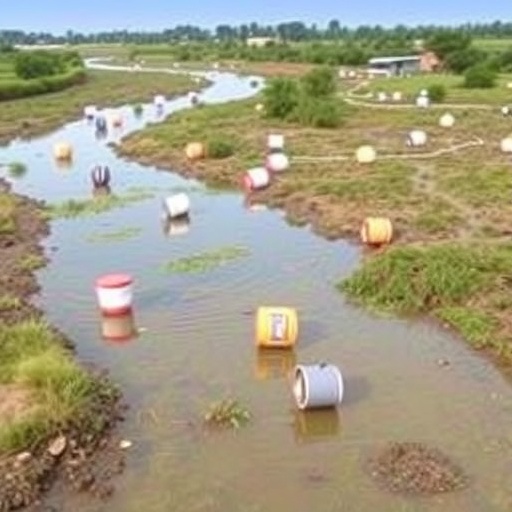
In a groundbreaking study published in Environmental Earth Sciences, researchers have unveiled alarming evidence regarding the contamination of floodplain soils along the Niger River with organochlorine pesticides (OCPs). This investigation, led by Iwegbue et al., delves deep into the environmental and potential health ramifications posed by persistent pesticide residues in these agriculturally and ecologically critical regions of West Africa. As organochlorines are notorious for their long-lasting and bioaccumulative nature, the findings bring to light the urgent need for comprehensive soil management and pollution mitigation strategies to safeguard both biodiversity and human populations.
The Niger River floodplains represent a vital resource not just for Nigeria but for several countries in the West African subregion, supporting diverse ecosystems and millions of people who rely on agriculture, fishing, and other floodplain-dependent livelihoods. The introduction of synthetic pesticides during the mid-20th century revolutionized agricultural productivity but also precipitated unintended consequences. Organochlorines, initially heralded for their efficacy against a range of pests and vectors such as mosquitoes, have since been linked to persistent environmental pollution due to their high chemical stability and lipophilicity.
The research expands upon the spatial distribution and concentration levels of various OCP compounds, including well-known names such as DDT, aldrin, dieldrin, and endosulfan, in soil samples systematically collected along different sites within the Niger floodplain. Advanced chromatographic and mass spectrometric techniques deployed by the investigators allowed precise quantification of these pesticides at nanogram to microgram per kilogram levels. A pattern emerged indicating hotspots of contamination especially near agricultural and urban runoff zones, with concentrations in some cases exceeding established safety thresholds.
This contamination is not merely a local concern. The prolonged persistence of OCPs in soils can lead to their uptake by crops and entry into terrestrial and aquatic food webs, potentially endangering wildlife and human communities alike. The bioaccumulation phenomenon, wherein concentration of OCPs increases with each trophic level, could result in severe ecological disruptions and chronic health issues such as endocrine disruption, carcinogenicity, and neurological impairments. These risks are compounded by the floodplain’s natural hydrological cycles that facilitate pesticide mobility and spreading to adjacent environments.
The study emphasizes the complexity of organochlorine behavior in floodplain soils, influenced by factors such as soil type, organic matter content, moisture, and microbial activity. Soils rich in organic carbon tend to adsorb more pesticides, reducing immediate bioavailability but potentially acting as long-term reservoirs. Conversely, periodic flooding events may redistribute these contaminants, enhancing their spatial dispersion but also exposing new biotic communities to pesticide residues. The researchers underscore the necessity of incorporating hydrological and soil chemistry models to better predict fate, transport, and risk assessments.
Moreover, the investigation highlights the historical legacy of banned pesticides. Despite global regulations and bans under the Stockholm Convention, residues of banned OCPs like DDT and lindane were still detected in the Niger floodplain soils decades after their official discontinuation. This persistence raises questions about illegal usage, improper disposal, or legacy stocks yet undisclosed. It also reflects on the challenges faced by developing nations in monitoring and enforcing chemical safety standards amidst agricultural demands and limited infrastructure.
Addressing such pollution requires multi-pronged strategies. The researchers advocate for enhanced environmental surveillance programs coupled with farmer education to prevent misuse and promote integrated pest management (IPM) approaches that reduce reliance on chemical pesticides. Additionally, bioremediation techniques employing indigenous microbial consortia capable of degrading organochlorines are proposed as promising avenues for detoxifying contaminated soils. However, these approaches demand careful ecological assessments to avoid unintended consequences.
The findings also bear implications for public health policies. Considering the heavy dependence of local communities on the floodplain resources for food and water, there is an immediate need to evaluate dietary exposure pathways and establish regulatory limits that are both scientifically sound and culturally appropriate. Collaborative efforts between governmental agencies, local stakeholders, and international bodies will be pivotal in designing frameworks for environmental health protection and sustainable agricultural practices.
One remarkable aspect of this research is its contribution to filling data gaps in environmental contaminant monitoring within sub-Saharan Africa. Often underrepresented in global studies, regions like the Niger floodplain provide crucial insights into pesticide dynamics under tropical climatic conditions, which differ markedly from temperate zones where most legacy studies have been conducted. This geographic specificity is essential for tailoring intervention measures that correspond to actual ecological and socio-economic contexts.
The methodological rigor demonstrated in this study sets a new benchmark for environmental geochemistry research in analogous floodplain ecosystems worldwide. By integrating both chemical analyses and spatial distribution mapping, the research team presented a comprehensive overview that facilitates targeted remediation and policy prioritization. This multidisciplinary approach exemplifies how environmental science can directly interface with public policy and community initiatives to foster resilience against pollution pressures.
Importantly, this research also raises awareness about the interconnectedness of environmental compartments—soil, water, and biota—and the cascading impacts of anthropogenic chemicals. It reminds us that interventions must transcend isolated actions and instead adopt systems thinking. Considering climate change projections that predict altered rainfall patterns and flood regimes in the Niger Basin, the behavior of pollutants like organochlorines could further complicate ecosystem management and risk paradigms.
In conclusion, the study by Iwegbue et al. provides an authoritative account of organochlorine pesticide pollution in one of Africa’s most pivotal ecological zones. It calls for urgent attention from environmental scientists, policy makers, and civil society to safeguard the Niger River floodplains. Understanding and mitigating such pollution is not only essential for preserving biodiversity and agricultural sustainability but also for protecting human health against the insidious threats posed by persistent organic pollutants.
The Niger River floodplain’s contamination with old yet enduring organochlorine pesticides exemplifies the paradox of technological progress where solutions to one problem spawn new, complex challenges. As this research illuminates the shadows of chemical legacy pollution, it also charts a route forward, emphasizing the indispensable value of science-driven stewardship to secure the health of generations to come.
Subject of Research: Impact of organochlorine pesticide pollution in floodplain soils of the Niger River
Article Title: Impact of organochlorine pesticide pollution in floodplain soils of the river Niger
Article References:
Iwegbue, C.M., Aziza, A.E., Oghoje, S.U. et al. Impact of organochlorine pesticide pollution in floodplain soils of the river Niger. Environ Earth Sci 85, 57 (2026). https://doi.org/10.1007/s12665-025-12610-9
Image Credits: AI Generated


