

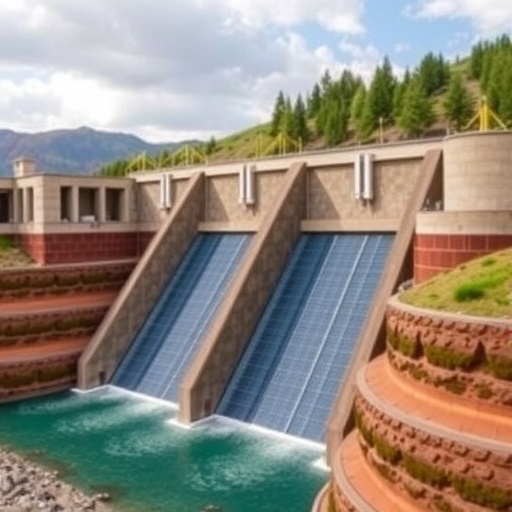
In the evolving landscape of civil engineering and environmental safety, the structural integrity of earth dams remains a pivotal concern. Recent advancements by researchers Shrivastava, Khatri, Banerjee, and colleagues mark a significant step forward in enhancing the seepage control and stability of these crucial infrastructures. Their pioneering work, published in Environmental Earth Sciences, explores the optimization of triangular toe filters—a critical aspect that addresses longstanding challenges in earth dam design and maintenance.
Earth dams, fundamental in water resources management, irrigation, and hydroelectric power generation, face persistent threats from seepage-induced failures. Seepage, the slow movement of water through soil or porous materials, can undermine the structural base of these dams, leading to potential breaches. The team’s research meticulously dissects this problem through a dual methodology combining both experimental setups and advanced numerical simulations, offering a comprehensive insight into seepage dynamics and the stabilizing influence of specially designed toe filters.
The study pivots around the innovative concept of the triangular toe filter—an engineered filter placed at the base of the dam’s downstream slope. This filter not only facilitates proper drainage but also impedes the progression of soil particles that could be carried away by seepage water, thereby preserving the dam’s foundational stability. By carefully tailoring the geometry and composition of this filter, the researchers demonstrate how its effectiveness can be maximized, setting new benchmarks in dam safety protocols.
Experimentally, the team constructed scaled physical models of earth dams embedded with varying designs of triangular toe filters. These laboratory models underwent rigorous testing under controlled seepage conditions to observe the influence of different filter configurations on water flow paths and internal erosion phenomena. The empirical data underscored the critical role that filter geometry plays in mitigating seepage velocity and reducing pore pressure buildup within the dam body.
Complementing these physical trials, the researchers deployed sophisticated numerical models calibrated with the experimental results to simulate a broad spectrum of real-world scenarios. This integration of experimental and computational approaches allowed for adjustments in filter designs to optimize performance parameters such as hydraulic conductivity and particle retention. Notably, these simulations highlighted how subtle variations in the filter’s dimensions could significantly alter seepage patterns, offering a predictive tool for engineers.
A cornerstone of this investigation is the detailed analysis of the stability mechanisms imparted by the triangular toe filters. The researchers elucidate how the filters function as both a mechanical barrier and a hydraulic conduit, ensuring the controlled release of seepage water while preserving the cohesion of the dam’s downstream materials. This dual functionality is critical in preventing internal erosion and subsequent structural failures, which are often catastrophic.
The implications of this research extend beyond mere structural reinforcement. By enhancing the safety and longevity of earth dams, these findings contribute to sustainable water resource management and disaster risk reduction. The optimized toe filters not only mitigate the immediate threats posed by seepage but also reduce maintenance costs and the environmental footprint associated with dam repairs and failures.
Moreover, the methodological rigor of combining physical experimentation with advanced computational modeling represents a significant methodological advancement in geotechnical engineering research. This approach allows for nuanced exploration of soil-water interactions at scales and complexities unattainable with traditional methods alone. It sets a precedent for future investigations into earth dam safety and other geotechnical structures facing similar challenges.
One of the standout aspects of this study is how it navigates the balance between practical engineering application and theoretical insight. The researchers succeeded in articulating complex seepage mechanics through accessible models without compromising on the scientific depth. This makes the research highly applicable for field engineers tasked with the design and maintenance of earth dams in diverse geographies and climatic conditions.
Environmental considerations also feature prominently in the study. The optimized filter design not only enhances dam stability but also supports ecological integrity by minimizing soil erosion and sedimentation downstream. This aligns with broader goals of environmental earth sciences, which emphasize harmony between human infrastructure and natural systems, highlighting the interdisciplinary nature of the research.
Furthermore, the results garnered through this study offer valuable guidance for revising existing engineering standards and codes related to earthen dam construction. By quantifying the benefits of triangular toe filters in concrete terms, the research facilitates evidence-based policymaking and standardization, paving the way for safer dam construction practices worldwide.
The collaborative nature of this research, bridging experts in hydraulic engineering, soil mechanics, and computational modeling, underscores the multifaceted challenges in dam safety. This interdisciplinary teamwork enhances the robustness of the findings and underscores the necessity of integrating diverse expertise to tackle complex engineering problems.
Looking ahead, the authors envision extending this line of research to explore the filter optimization in larger-scale dams and under varying environmental stressors such as seismic activity and extreme weather events. Such future work will be vital in adapting dam safety measures to the uncertainties imposed by climate change and increasing human reliance on engineered water systems.
In sum, the study spearheaded by Shrivastava et al. delivers a transformative insight into one of the most pressing issues in earth dam engineering. Their methodical examination and optimization of triangular toe filters forge a path toward safer, more resilient, and environmentally conscientious earth dam infrastructures. This contribution not only elevates the field of geotechnical engineering but also has the potential to profoundly influence global water resource management practices.
As the world grapples with growing demands on water infrastructure and the escalating risks posed by climate variability, innovations like the optimized triangular toe filter could serve as crucial safeguards. The blending of empirical experimentation and numerical modeling delineated in this research offers a powerful template for developing future engineering solutions that are both scientifically robust and pragmatically viable.
Subject of Research: Seepage control and stability in earth dams through optimized triangular toe filters.
Article Title: Seepage control and stability in earth dams: an experimental and numerical study of optimising triangular toe filters.
Article References:
Shrivastava, S., Khatri, V.N., Banerjee, A. et al. Seepage control and stability in earth dams: an experimental and numerical study of optimising triangular toe filters. Environ Earth Sci 85, 40 (2026). https://doi.org/10.1007/s12665-025-12758-4
Image Credits: AI Generated


