

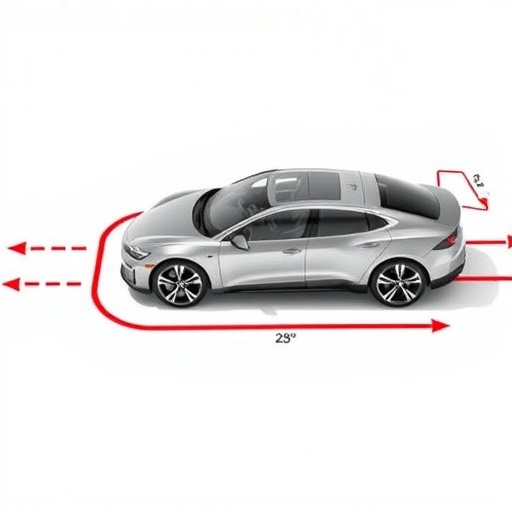
In the evolving landscape of electric vehicles (EVs), the quest for efficiency never pauses. Researchers from leading automotive engineering programs have recently published transformative findings that could significantly enhance the operational efficiency of overactuated electric vehicles. Their study delves into power-optimal torque distribution strategies, which are instrumental in leveraging the capabilities of EVs to achieve not only maximum performance but also unparalleled energy efficiency.
The impetus behind the study rests upon the inherent characteristics of overactuated systems. These vehicles employ multiple actuators to manage power distribution across the drive wheels, and each actuator’s torque can be finely tuned to achieve optimal performance. This level of control is critical for enhancing traction, stability, and overall drivability, especially under varying load and environmental conditions. By harnessing the potential of overactuation, engineers can avoid the energy losses typical of less advanced systems.
A significant aspect of the research focuses on developing a mathematical framework that accurately models torque allocation in overactuated vehicles. Through comprehensive simulations and experimental validation, the authors demonstrate that their proposed model yields substantial improvements in both efficiency and performance metrics. This framework enables a new paradigm in torque management that shifts the traditional paradigms of vehicle dynamics.
Central to their findings is the realization that torque distribution must be dynamically adjusted based on real-time data, including vehicle speed, road gradient, and even driver behavior. This adaptability enables the vehicle to respond optimally to different driving conditions, ultimately leading to a smoother and more controlled driving experience. The implications of such advancements not only improve energy efficiency but also elevate user satisfaction, a critical factor in the competitive EV market.
The researchers conducted a series of extensive experiments to validate their theoretical models. Their approach involved both laboratory tests and real-world driving scenarios. This comprehensive validation provides a solid foundation for industry adoption, demonstrating how the model can be realistically applied to existing technologies. The results revealed that vehicles utilizing the new torque distribution strategies exhibited significant reductions in energy consumption, thus making a strong case for the model as a reliable solution.
Furthermore, the team investigated the implications of their findings for future electric vehicle design. Conventional designs often impose limitations on power distribution capabilities, leading to inefficiencies and potential performance bottlenecks. By implementing overactuated concepts, manufacturers could broaden the scope of design possibilities, allowing for more innovative vehicle architectures that promote greener and more efficient transportation solutions.
The incorporation of advanced sensors and real-time data analytics systems enhances the viability of the proposed torque distribution model. Such integrations could facilitate smarter vehicles capable of making informed decisions on-the-fly, adapting to the ever-changing road and traffic conditions. This evolution toward fully autonomous driving systems dovetails with contemporary trends in the automotive industry, responding to both regulatory demands for increased safety and consumer desires for a seamless driving experience.
Addressing the potential challenges of implementing such a system, the researchers acknowledge that while the mathematical model shows promising results, practical applications must be approached cautiously. The complexity of real-world driving conditions means that additional layers of testing will be necessary before widespread adoption is feasible. Moreover, considerations such as the cost of integrating sophisticated actuators and sensors into existing vehicle platforms could present hurdles that need to be overcome.
Nevertheless, the study’s findings spark optimism for the future of electric mobility. As the global automotive industry accelerates its transition towards electrification, the insights gained from this research could spearhead breakthroughs in efficiency and performance that were previously deemed unattainable. This could ultimately enable manufacturers to produce electric vehicles that are not only more environmentally friendly but also deliver superior driving experiences.
Additionally, the potential to pair power-optimal torque distribution with other advanced technologies, such as regenerative braking and energy recovery systems, opens up further avenues for exploration. The synergies created by these technologies could drive the development of next-generation electric vehicles that push the boundaries of what is currently possible, both in terms of performance and sustainability.
In conclusion, the implications of this research extend beyond mere mechanics; they touch upon the broader narrative of sustainable transportation. By pushing the boundaries of what electric vehicles can achieve through power-optimal torque distribution, the study captures the spirit of innovation that fuels the future of the automotive industry. With ongoing research and development efforts, the realization of highly efficient, overactuated electric vehicles may soon transition from theoretical frameworks into commonplace reality, ensuring that the move towards greener transportation continues unabated.
As the automotive industry stands on the cusp of a revolution, understanding and implementing innovative solutions for torque distribution will be pivotal. The meticulous work of this research team not only enriches our understanding of electric vehicle dynamics but fosters a collective ambition across the industry to embrace efficiency, innovation, and sustainability in the electric era ahead. As we look to the future, these advancements herald a new age of vehicular design, powered by cutting-edge research and a commitment to excellence.
Subject of Research: Power optimal torque distribution for overactuated electric vehicles
Article Title: Power optimal torque distribution for overactuated electric vehicles: analysis and experimental validation.
Article References:
Klein, D., Mandl, P., Plöchl, M. et al. Power optimal torque distribution for overactuated electric vehicles: analysis and experimental validation. Automot. Engine Technol. 11, 2 (2026). https://doi.org/10.1007/s41104-025-00164-8
Image Credits: AI Generated
DOI: https://doi.org/10.1007/s41104-025-00164-8
Keywords: electric vehicles, power distribution, torque optimization, overactuation, performance metrics, energy efficiency


