

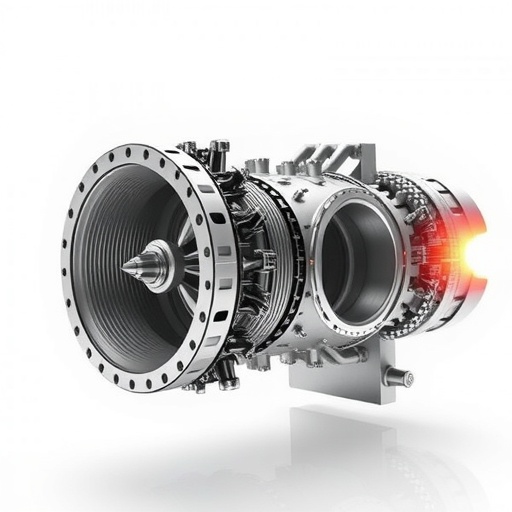
The world of space propulsion is undergoing a remarkable transformation thanks to the advent of hybrid rocket engines. These engines, which combine solid and liquid propellants, have garnered immense interest due to their potential for improved efficiency, safety, and performance. Recent research led by Chavhan, Pawar, and Thakur introduces groundbreaking insights into the optimization of these hybrid engines through the use of nano-additives. This innovative approach promises to address some of the key challenges in rocketry and propulsion were beginning to make waves in aerospace engineering.
One of the primary advantages of hybrid rocket engines is their ability to offer controllable thrust. Unlike traditional solid rockets, hybrid designs allow for modulation of the fuel flow, granting engineers a level of precision previously unattainable with conventional systems. This inherent flexibility enables engineers to tailor engine performance to specific mission requirements, ultimately enhancing the capability and reliability of space missions. By employing regression analysis to explore these dynamics, the authors pave the way for a more nuanced understanding of how to maximize engine performance.
The introduction of nano-additives into the hybrid rocket fuel propellant system reveals a fascinating interplay between materials science and propulsion technology. These additives, often on the scale of billionths of a meter, have been noted for their unique properties that can significantly alter flow dynamics, combustion rates, and even thermal stability of the propellant. The researchers’ regression analysis focuses on identifying optimal blends of these nano-additives, underscoring the essential role of chemistry in rocket design. Their findings provide a scientific basis for adjusting propellant characteristics to achieve desired thrust profiles and burn rates.
The integration of nano-additives poses several challenges, particularly in the realm of dispersion and homogeneity within the fuel matrix. Without meticulous attention to how these additives are mixed and stabilized within the propellant, one could inadvertently create more problems than solutions. Chavhan, Pawar, and Thakur delve into these complexities, offering insights into best practices for ensuring uniform distribution of nano-additives. Their work exemplifies a marriage between dynamics and chemical engineering principles, reinforcing how these disciplines converge in advanced propulsion systems.
Further exploration of the environmental impact of hybrid rocket engines is a vital aspect of their research. As space agencies worldwide focus on sustainable practices, the adoption of greener propellant alternatives becomes imperative. By examining the emissions output from hybrid engines enhanced with nano-additives, the authors contribute to a growing body of literature advocating for environmentally responsible rocket technology. This holistic view further establishes the relevance of their research, as it endeavors not only for performance gains but also for compliance with international environmental standards.
Moreover, the regression analysis framework presented in their study offers a toolbox for engineers looking to push the boundaries of hybrid rocket performance. Traditional approaches to propulsion design often rely on empirical testing and prototype iteration, leading to lengthy development cycles. In contrast, the computational techniques highlighted by the authors allow for iterative design adjustments based on rigorous statistical data. This could significantly reduce time-to-market for new rocket designs, thereby accelerating advancements in space exploration.
A significant achievement of this research is the development of predictive models that can simulate engine behavior under varying conditions. The ability to forecast performance will enhance mission planning and execution, providing engineers with comprehensive data to optimize thrust-to-weight ratios and fuel efficiency well before any physical tests take place. This predictive capability could streamline not only the design of hybrid rockets but also potentially reconfigure how entire missions are conceptualized and executed.
The potential applications for nano-enhanced hybrid rocket engines extend far beyond mere propulsion. These technologies could provide critical support for future deep-space missions, where efficiency and payload capacity play crucial roles. Furthermore, the ability to produce thrust on-demand and with high reliability opens new possibilities for satellite deployment, interplanetary travel, and even habitation in extraterrestrial environments. By enhancing the safety and performance of rocket engines, this research lays the groundwork for humanity to reach new frontiers in space.
The holistic approach taken by Chavhan and his colleagues exemplifies the modern trends in aerospace research where interdisciplinary collaboration meets technological innovation. Their work resonates with the growing recognition that the challenges of space exploration require novel solutions that cross traditional academic boundaries. By melding aerospace engineering with materials science, their study sets a precedent for future researchers embarking on similar paths.
In the context of an increasingly competitive race to explore the universe, the research by Chavhan, Pawar, and Thakur is essential. The quest for efficient, powerful, and environmentally friendly propulsion systems is a pivotal aspect of modern space exploration. With their regression analysis framework and findings on the integration of nano-additives, this study is bound to have a lasting impact on both academic research and practical engineering solutions.
As the world anticipates advancements in hybrid rocket technology, stakeholders across the aerospace industry, including governmental space agencies, private aerospace firms, and academic institutions, have much to gain from the findings presented in this research. It provides a solid foundation for future innovations, fostering a culture of efficiency and sustainability as humanity continues its journey beyond Earth.
In conclusion, hybrid rocket engines represent the future of propulsion technology, and research into optimizing their performance through innovative means is critical. The work by Chavhan, Pawar, and Thakur exemplifies this drive toward excellence in aerospace engineering. The insights gained from their regression analysis are not just academic; they hold the key to unlocking new possibilities for human advancement in the cosmos.
With each passing year, the landscape of space exploration transforms, driven by the relentless pursuit of knowledge and innovation—one that Chavhan, Pawar, and Thakur contribute significantly toward through their pioneering research on hybrid rocket engines.
Subject of Research: Optimization of hybrid rocket engine performance through nano-additives.
Article Title: Regression analysis on the selection of hybrid rocket engine with suitable nano–additives.
Article References:
Chavhan, H., Pawar, A. & Thakur, A.K. Regression analysis on the selection of hybrid rocket engine with suitable nano–additives.
AS (2026). https://doi.org/10.1007/s42401-026-00453-6
Image Credits: AI Generated
DOI: 10.1007/s42401-026-00453-6
Keywords: Hybrid rocket engines, nano-additives, propulsion technology, regression analysis, aerospace engineering, materials science, sustainable practices, space exploration, predictive models.


