

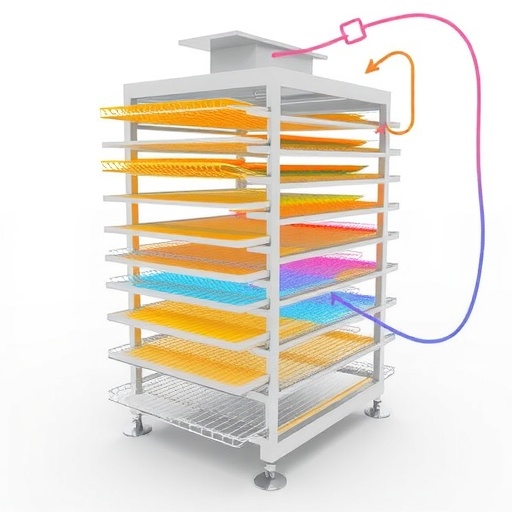
In a groundbreaking study published in Scientific Reports, researchers Asrate, Tadle, and Mihretie delve into an essential yet often overlooked aspect of food processing technology: the enhancement of airflow uniformity in multi-tray dryers. This study, titled “Enhancement of airflow uniformity in multi-tray dryers through a CFD-integrated sequential linear programming framework,” explores how the application of computational fluid dynamics (CFD) can optimize the drying process, thus ensuring food products maintain their quality while achieving maximum efficiency.
The significance of airflow uniformity in drying processes cannot be understated. Inefficient airflow can lead to uneven drying, which affects the moisture content inconsistently across the trays. As a result, certain areas may under-dry, leading to microbial growth, while other sections may over-dry, compromising the nutritional and sensory qualities of the food. The researchers recognized this critical issue and aimed to develop a sophisticated model that integrates CFD with sequential linear programming to predict and enhance airflow patterns.
The researchers began their investigations by establishing a baseline of the airflow dynamics in typical multi-tray dryers. Traditional methods of optimizing airflow often rely on empirical adjustments, which can result in suboptimal outcomes. Through CFD simulations, the team was able to visualize airflow patterns in real-time, highlighting areas where turbulence and stagnation occurred. This visualization was critical in understanding the nuances that typical mechanical and empirical approaches ignore.
A pivotal point in the study was the integration of sequential linear programming—the mathematical optimization technique that enables decision-makers to determine the best course of action from a set of constraints and desired outcomes. By applying this approach to the results generated from the CFD models, the researchers were able to establish a refined framework capable of suggesting modifications to the dryer’s design and operational parameters. This dual-faceted approach of combining CFD with programming optimization marks a significant advancement in drying technology.
As detailed in the research, one of the primary objectives was to adjust the fan speeds, tray configurations, and the placement of air distribution ducts. Using the information gained from the CFD analysis, the researchers were able to simulate various scenarios, leading to an optimized design that could potentially standardize airflow across all trays, thus creating a more uniformly dried product. This simulation aspect of the study demonstrates the power of modern computational techniques in agricultural and food science applications.
The implications of improving airflow uniformity extend beyond merely enhancing product quality. By ensuring that moisture is evenly removed during the drying process, manufacturers can significantly reduce energy consumption. This aspect is particularly relevant given the increasing global emphasis on sustainability and the reduction of carbon footprints in food processing. The reduced operational costs tied to energy savings, in addition to potential increases in product quality, create a compelling case for adopting these innovative practices in the industry.
To validate the effectiveness of their proposed system, the researchers conducted a series of drying experiments in a controlled environment. By comparing the results of the traditional drying methods with those using the newly implemented CFD-optimized framework, they observed a marked improvement in moisture distribution across the trays. This quantitative assessment confirmed that airflow optimization not only improved uniformity but also shortened drying times significantly, thus further enhancing productivity.
Real-world application of these findings can have a profound impact on various sectors of the food industry, from fruits and vegetables to meats and grains. Since drying processes are integral to preservation, flavor retention, and shelf stability, the advancements highlighted in the study are poised to contribute to better preservation methods, ultimately benefiting consumers and producers alike.
Moreover, the researchers hypothesize that the principles established in their study could be applied to a wide range of drying technologies beyond multi-tray dryers. Whether in industrial-scale operations or smaller artisanal setups, the potential for broad applicability indicates a significant shift in the way drying processes can be approached. Such advancements can foster innovation across various sectors, enhancing the overall quality of food products available in the market.
In conclusion, the research conducted by Asrate, Tadle, and Mihretie serves as a pioneering step toward revolutionizing drying technology in the food processing industry. By leveraging cutting-edge computational techniques to optimize airflow and promote uniformity, they have underscored the importance of innovative solutions in the quest for efficiency and quality in food production. As the industry evolves to meet rising consumer demands and sustainability goals, research like this lays the groundwork for future advancements and the continuous improvement of food processing technologies.
This significant study not only provides actionable insights for manufacturers but also opens avenues for further research in the intersection of computational modeling and food science. As technology progresses, remaining at the forefront of such innovation not only benefits industries but ultimately plays a crucial role in addresses global food challenges, making the case for continued investment in research and development in this vital area of study.
Given the critical implications of this work, further exploration into more complex materials and drying processes is encouraged. There remains much to learn about how CFD and optimization techniques can intersect with other food preservation methodologies, potentially leading to even stronger advancements. Embracing this holistic and systemic view will likely yield the most significant benefits for the future of food processing and safety.
Subject of Research: Optimization of airflow uniformity in multi-tray dryers.
Article Title: Enhancement of airflow uniformity in multi-tray dryers through a CFD-integrated sequential linear programming framework.
Article References:
Asrate, D.A., Tadle, F.B. & Mihretie, Y.D. Enhancement of airflow uniformity in multi-tray dryers through a CFD-integrated sequential linear programming framework.
Sci Rep (2025). https://doi.org/10.1038/s41598-025-34360-1
Image Credits: AI Generated
DOI: 10.1038/s41598-025-34360-1
Keywords: airflow optimization, multi-tray dryers, computational fluid dynamics, drying technology, food preservation, sustainability, energy efficiency, sequential linear programming.


