

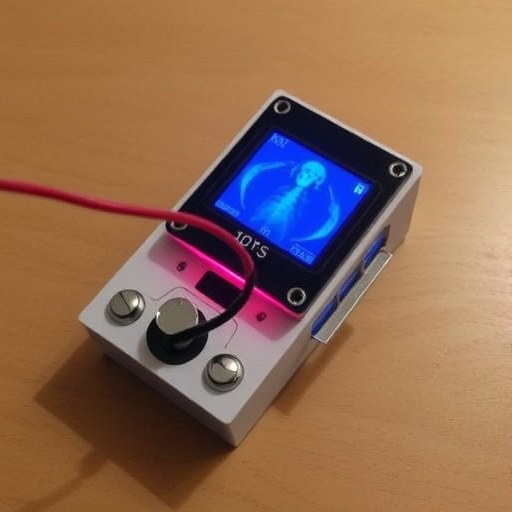
In an era where personalized health monitoring and workplace safety are more critical than ever, the development of accessible, precise, and reliable dosimetry technology marks a significant leap forward. A recent breakthrough presented in the open-access article “OpenDosimeter: Open hardware personal X-ray dosimeter” by Ger, Ku, Lopez, and colleagues in Communications Engineering introduces an innovative open hardware device designed for personal X-ray dose monitoring. This new instrument, aptly named the OpenDosimeter, promises to revolutionize the way radiation exposure is tracked, particularly for healthcare professionals and workers routinely exposed to ionizing radiation.
The motivation behind OpenDosimeter lies in a pressing global need: the continuous, individual-level monitoring of cumulative X-ray exposure in environments such as hospitals and industrial settings. Traditional dosimeters, though effective, are often costly, proprietary, and lack the transparency and flexibility that open hardware designs provide. By leveraging an open-source platform, the researchers aim to democratize access to high-precision personal dosimetry, enabling broader adoption and customization without the barriers imposed by commercial limitations.
Technically, the OpenDosimeter combines state-of-the-art semiconductor sensor technology with an efficient signal processing system integrated into an elegantly compact device. Its architecture harnesses off-the-shelf components coupled with custom-designed printed circuit boards that facilitate real-time detection and logging of X-ray doses in millisievert units. This ensures not only high accuracy but also the convenience of on-the-go monitoring, a capability previously limited to large, cumbersome devices or institutional setups.
The core sensor utilizes a silicon photodiode array capable of detecting ionizing radiation by measuring charge output generated from incoming X-ray photons. This photodiode is sensitively calibrated against a series of controlled radiation sources to maintain accurate quantification across a broad spectrum of doses. The device incorporates a microcontroller unit that digitizes the signals, applies correction algorithms accounting for energy dependence and environmental factors, and stores the cumulative data in accessible memory modules.
One of the most remarkable achievements of the OpenDosimeter is its open hardware philosophy. The entire hardware design—including schematics, firmware code, and calibration protocols—is openly available, fostering a community-driven ecosystem of developers, researchers, and end-users. This transparency not only ensures reproducibility and trust but also invites improvements and adaptations tailored to specific applications ranging from clinical radiology to industrial radiography.
Furthermore, the device supports wireless data transmission via Bluetooth Low Energy (BLE), allowing seamless synchronization with smartphones or dedicated monitoring consoles. This feature transforms raw dose data into user-friendly insights through companion mobile applications. Real-time alerts, dose accumulation reports, and personalized exposure histories empower wearers to actively manage their radiation safety and comply with regulatory limits enforced by occupational health authorities.
The OpenDosimeter also stands out with its robust energy discrimination capability. Unlike conventional single-threshold dosimeters, it can differentiate exposure across multiple X-ray energy bands, providing nuanced information about the radiation field’s composition. This innovation is crucial for accurately assessing biological risk since the biological impact varies significantly with photon energy levels.
Manufacturing the OpenDosimeter in cost-effective quantities is another feather in the cap. Estimates from the research team suggest that mass production could drive prices well below current market dosimeters, making it feasible for widespread individual deployment—even in resource-limited settings. The low-cost nature, combined with scientific rigor, could be a game-changer in low and middle-income countries where access to advanced radiation protection technology remains a challenge.
Crucially, the researchers conducted hands-on trials in hospital environments to evaluate the dosimeter’s performance in real-world conditions. Radiologic technologists equipped with OpenDosimeters reported enhanced confidence in their personal safety, as the devices reliably tracked exposure during routine fluoroscopy and CT scan procedures. The feedback gathered through these pilot studies informed iterative device improvements, enhancing usability and ergonomics without compromising technical performance.
The open hardware model also facilitates regulatory compliance and certification pathways. By publishing their design and validation data transparently, Ger and colleagues hope to accelerate the process for formal approval by bodies like the US FDA or the European Medicines Agency. Such authorization would position OpenDosimeter as a credible alternative to entrenched proprietary devices, potentially reshaping market dynamics towards more open innovation.
OpenDosimeter’s influence could extend beyond the medical field. Industrial workers handling X-ray nondestructive testing or security personnel exposed to radiological scanning devices could benefit from personal, real-time radiation monitoring. The adaptability of the open platform means additional sensors or modules could be integrated to measure other forms of ionizing radiation, such as gamma rays or beta particles, broadening the device’s utility.
In addition, this advancement sets the stage for comprehensive exposure registries, aggregating anonymized data across hospitals or companies while respecting privacy. Such databases could fuel epidemiological research, track dose trends, and inform safety protocols more effectively. By bridging the gap between individual monitoring and systemic radiation management, OpenDosimeter could contribute substantially to occupational health sciences.
The research team’s commitment to open science and environmental sustainability is reflected in the device’s design for modularity and repairability. Rather than disposable units, OpenDosimeter components can be upgraded or replaced to extend lifespan and reduce electronic waste. This consideration echoes the growing recognition of sustainability in medical and industrial technology development.
Beyond the hardware, the accompanying software ecosystem includes open source tools for data visualization, trend analysis, and alarm customization. The developers are actively cultivating an online community forum and documentation hub to support users from novice technicians to advanced researchers. This community-centric approach accelerates knowledge exchange and collective innovation, enhancing device functionality through user feedback and code contributions.
Looking forward, the OpenDosimeter team foresees potential integrations with AI-driven dose optimization systems in medical imaging, enabling dynamic adjustment of X-ray parameters based on real-time exposure data. By closing the loop between measurement and machine control, radiation risks could be minimized while preserving diagnostic image quality, a long-sought goal in radiology.
In summary, the OpenDosimeter represents a pivotal moment in radiation safety technology. Offering precise, low-cost, and adaptable personal X-ray dosimetry through an open hardware platform addresses critical unmet needs in healthcare and industry. As adoption spreads and community engagement flourishes, this innovation could usher in a new era of transparent, personalized radiation monitoring, enhancing protection for millions worldwide.
Subject of Research: Personal X-ray Dosimetry, Open Hardware Radiation Monitoring Devices
Article Title: OpenDosimeter: Open hardware personal X-ray dosimeter
Article References:
Ger, N., Ku, A., Lopez, J. et al. OpenDosimeter: Open hardware personal X-ray dosimeter. Commun Eng 4, 207 (2025). https://doi.org/10.1038/s44172-025-00540-0
Image Credits: AI Generated
DOI: https://doi.org/10.1038/s44172-025-00540-0
Keywords: X-ray dosimeter, open hardware, radiation monitoring, personal dosimetry, semiconductor sensors, occupational safety, radiation protection, real-time dose measurement


