

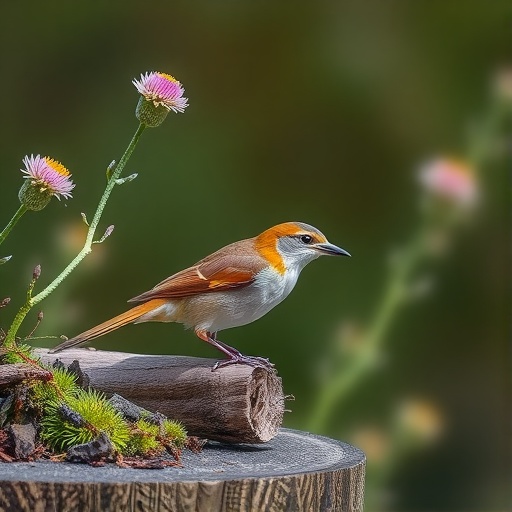
A Critical Two-Decade Window to Safeguard British Biodiversity Amid Climate and Land Use Change
In an unprecedented examination of Britain’s ecological future, a recent study by the UK Centre for Ecology & Hydrology (UKCEH) has illuminated a narrow twenty-year window during which key decisions on climate policy and land management will decisively shape the survival or extinction trajectories of native species. Britain, already recognized as one of the most nature-depleted countries worldwide, faces a potential crisis that could irreversibly transform its ecological landscapes and jeopardize the intricate ecological functions that underpin human and environmental health.
This landmark research diverges from traditional species-by-species projections, instead employing innovative community-level ecological modeling. By evaluating interlinked groups of plants, birds, and butterflies within 1km square grids across the country, researchers have constructed holistic environmental scenarios that produce more nuanced insights into biodiversity dynamics under varying environmental stressors. This systemic approach allowed the detection of broad biodiversity shifts, capturing emergent patterns of species loss and habitat alteration that isolated analyses might overlook.
Central to their findings is the sobering prediction that by 2050, the UK could face a “point of no return” in biodiversity management. This juncture marks a decisive threshold where all conservation and land-use policies implemented beforehand inexorably dictate whether species decline accelerates or if nature recovery can be promoted on a meaningful scale. The study stresses that this temporal demarcation is critical because ecological processes and species trajectories have delayed responses to environmental pressures, meaning policies enacted now will echo across decades.
The modeling examined six plausible futures, differentiated by greenhouse gas emission trajectories and intensity of land exploitation. Under the grim worst-case prospect, characterized by an approximate 4°C rise due to unchecked fossil fuel consumption coupled with intensified agriculture and urban sprawl, more than 200 species in three key groups would inexorably vanish from Britain. This includes approximately 196 plant species accounting for 20% of native flora, 31 bird species representing 14% of existing populations, and seven butterfly species equating to 12% of their local diversity. These extinction rates would surpass historical baselines by more than triple, signaling a biodiversity crisis unprecedented in both magnitude and speed.
Regionally, the impacts would be marked by drastic species declines as localized ecosystems lose up to one-fifth of their constituent species. Furthermore, the composition of nearly 90% of British habitats would be significantly altered, with possible dominance by thermophilic (warm-adapted) species flourishing at the expense of ecologically sensitive taxa. This ecological restructuring risks cascading effects on ecosystem services such as pollination, nutrient cycling, and soil stabilization, which are foundational to both wild biodiversity and human agricultural productivity.
Conversely, the study teased out more optimistic outcomes from scenarios involving strong mitigation and sustainable land stewardship. This pathway would incorporate robust carbon emission reductions, substantial reductions in meat and dairy consumption aligned with environmental goals, and a cultural shift where the intrinsic value of biodiversity is widely acknowledged and integrated into policy. Under such conditions, the extinction of native species could be curtailed by up to 69 species, preserving vital ecological functions and fostering more resilient ecological communities.
Notably, the research spotlights species already under substantial threat, such as the Merlin falcon—Britain’s smallest bird of prey—as well as butterfly species including the Mountain Ringlet and Large Heath, alongside rare plants like the Burnt Orchid and Grass-of-Parnassus. The loss of these emblematic species would not only diminish biodiversity but impair the integrity of habitats with which they are intimately connected.
Underlying these ecological decay scenarios is a complex synthesis of direct climate stressors—such as temperature rise, altered precipitation patterns, and extreme weather events—with anthropogenic pressures involving unsustainable land use, habitat fragmentation, and pollutant loads. The synergy of these factors accelerates biodiversity loss beyond the rates predicted within individual threat models.
The study’s authors underscore the importance of integrating climate and land-use policies to avoid piecemeal efforts that fail to address compounded ecological challenges. Landscape-scale conservation planning, habitat restoration, and policies incentivizing sustainable agriculture are central pillars in promoting future biodiversity resilience. The modeling results provide a compelling evidence base for policymakers, emphasizing time-sensitivity and the cascading long-term gain or loss resulting from present decisions.
Despite highlighting the fragility of British ecosystems, the report importantly conveys an element of hope. Current environmental trajectories can still be redirected, provided concerted societal change occurs rapidly. By prioritizing eco-centric values, reducing greenhouse gas emissions, and adopting land management practices that honor ecological integrity, Britain has the opportunity to reverse some adverse trends and foster a future where biodiversity and human societies coexist healthily.
Moreover, the study’s inclusion of multiple ecological groups—plants, birds, butterflies—reflects the interconnectedness of ecosystem components and emphasizes that losses in one taxonomic group ripple across trophic levels and habitats. For instance, the disappearance of pollinating butterflies or nectar-providing plants could reduce pollination services, thereby affecting crop yield and wild plant regeneration. Similarly, bird population declines may disrupt seed dispersal and pest control functions vital to ecosystem balance.
The implications of this study resonate beyond Britain, serving as a paradigmatic example of how integrated ecological forecasting can inform biodiversity conservation globally. The clear link between emissions trajectories, land management intensity, and species outcomes underscores the universality of combining climate mitigation with sustainable development for ecological stewardship.
Authored by a consortium including UKCEH, the Natural History Museum, British Trust for Ornithology, and Butterfly Conservation among others, and published in the prestigious journal Nature Communications, this research embodies a collaborative, multidisciplinary approach vital for addressing pressing environmental crises. Funded by the Natural Environment Research Council, it provides openly accessible data and models facilitating further research and policy development.
In conclusion, this study issues a call to action with a fixed deadline: to secure Britain’s ecological future, transformative shifts in climate and land-use policies must be embraced within the next twenty years. Failure to do so risks accelerating biodiversity loss to unprecedented levels, imperiling ecological resilience, ecosystem functions, and the very natural heritage that defines Britain’s landscapes. The window is closing, but with informed, decisive action, a path exists towards safeguarding the rich biodiversity that sustains both nature and humanity.
Subject of Research: Future scenarios for British biodiversity under climate and land-use change
Article Title: 2026. Future scenarios for British biodiversity under climate and land-use change
News Publication Date: 1-Apr-2026
Web References:
https://www.nature.com/articles/s41467-026-70064-4
References:
Cooke et al. 2026. Future scenarios for British biodiversity under climate and land-use change. Nature Communications. DOI: 10.1038/s41467-026-70064-4
Image Credits: Rob Cooke
Keywords: biodiversity loss, climate change, land use, UK ecology, species extinction, ecological modeling, conservation policy, sustainable land management, pollination, habitat transformation


