

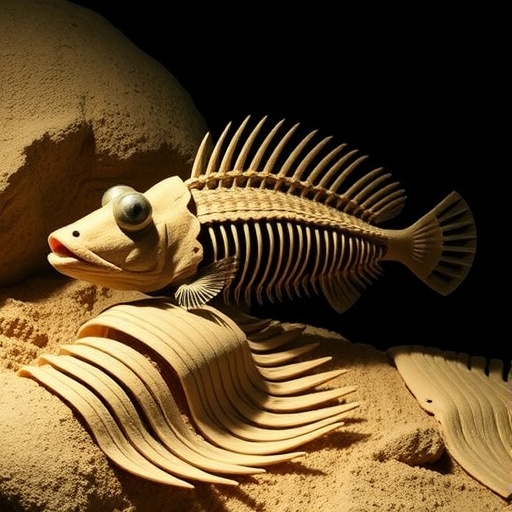
In an extraordinary breakthrough that reshapes our understanding of vertebrate evolution, paleontologists have unveiled the oldest articulated bony fish fossil, dating back to the early Silurian period approximately 436 million years ago. This unprecedented find from the Chongqing Lagerstätte in China marks the earliest near-complete osteichthyan specimen ever discovered, pushing back the timeline for bony fish emergence and filling a crucial gap in the fossil record. Until now, findings of articulated osteichthyans had largely been restricted to the late Silurian or later periods, making this discovery a monumental leap in unraveling the deep evolutionary history of jawed vertebrates.
Osteichthyans, the diverse clade comprising both sarcopterygians (lobe-finned fishes and tetrapods) and actinopterygians (ray-finned fishes), dominate extant vertebrate biodiversity, yet their early fossil record remains fragmentary and poorly understood. The newly described specimen displays a remarkable fusiform body plan that speaks to a generalized early osteichthyan morphology. Strikingly, it bears an array of anatomical features hitherto rare or unseen in definitive bony fishes of this antiquity, such as the absence of lepidotrichia—the bony fin rays characteristic of most post-Devonian osteichthyans—offering fresh insights into the primitive fin structure of early bony fish.
Among its defining features, the fossil exhibits a series of median dorsal plates arrayed serially along its back, alongside robust fin spines on the pectoral, dorsal, and anal fins. These traits are particularly provocative, having been reported almost exclusively in stem chondrichthyans (early cartilaginous fishes) and in one placoderm—a group of armored jawed fishes long extinct. This mosaic of plesiomorphic (ancestral) features in combination with derived traits, such as a single dorsal fin and caudal fulcra commonly associated with actinopterygians, suggests a far more complex evolutionary mosaic in early bony fishes than previously appreciated.
Phylogenetic analyses employing both Bayesian inference and maximum parsimony methods position this new fish firmly on the osteichthyan stem lineage, highlighting its transitional status in vertebrate evolution. However, the strict consensus analysis reflects some unresolved relationships within osteichthyans, underscoring the intricacies of early vertebrate phylogeny and the need for further fossil discoveries to clarify these evolutionary pathways. This ambiguity spotlights the transitional nature of early osteichthyans, displaying traits bridging the morphological divides between major lineages.
This discovery significantly elevates the known diversity of Silurian osteichthyans and enriches the fossil record of early stem-group bony fishes, presenting compelling evidence that these organisms had already undergone substantial morphological diversification by the early Silurian. The remarkable anatomical disparity observed among early osteichthyans implies that the radiation of bony fishes during the Silurian to Early Devonian interval was more extensive than traditionally understood based on previous fossil and microfossil data.
The fossil’s implications extend beyond anatomical novelty; it challenges and refines existing paradigms regarding the tempo and mode of early vertebrate evolution. Prior fossil evidence documented only fragmentary remains or isolated elements from the Silurian, limiting reconstructions of early bony fish biology and ecology. By revealing a complete, articulated specimen, researchers can now infer a more nuanced picture of ecological interactions, functional morphology, and developmental constraints that shaped the earliest osteichthyan radiation.
Moreover, the new find has profound ramifications for interpreting the sequence of character acquisition among jawed vertebrates. The juxtaposition of chondrichthyan-like spines and placoderm-related dorsal plates in this early osteichthyan suggests that the ancestral jawed vertebrate may have possessed a composite suite of features that later diverged among descendant lineages. This mosaicism calls into question simplistic models that neatly separate osteichthyan and chondrichthyan traits, advocating instead for a reticulate and overlapping evolutionary process during the vertebrate radiation.
The preservation quality of the Chongqing Lagerstätte proves crucial for this scientific milestone. Its exceptional fossilization conditions have allowed researchers to visualize delicate morphological details, such as fin spine articulation and plate patterns, previously inaccessible in similarly aged deposits. This window into early vertebrate anatomy provides not only structural data but also paleoecological context for interpreting evolutionary drivers during a pivotal geological interval marked by dynamic environmental changes.
Furthermore, this early Silurian osteichthyan fills a critical temporal and phylogenetic gap. Previously documented articulated sarcopterygians and stem osteichthyans appeared only in the late Silurian with actinopterygians showing up unambiguously in the Middle Devonian. This new discovery shifts that timeline backward, indicating a more ancient origin for bony fishes and suggesting their evolutionary diversification was well underway considerably earlier than formerly acknowledged.
In sum, the reporting of the oldest articulated bony fish heralds a transformative advance in vertebrate paleontology, bridging significant knowledge gaps about the origin and early diversification of osteichthyans. By integrating morphological, phylogenetic, and stratigraphic evidence, this research illuminates the intricate evolutionary experimentation that underpinned the emergence of the dominant lineage of modern vertebrate fauna. It opens new avenues for future investigations into the evolutionary dynamics that produced the extraordinary variety of jawed vertebrates populating Earth’s aquatic ecosystems today.
Subject of Research:
Fossil discovery and phylogenetic analysis of the oldest articulated osteichthyan (bony fish) from the early Silurian period.
Article Title:
The oldest articulated bony fish from the early Silurian period.
Article References:
Zhu, YA., Chen, Y., Li, Q. et al. The oldest articulated bony fish from the early Silurian period. Nature 651, 128–134 (2026). https://doi.org/10.1038/s41586-026-10125-2
Image Credits: AI Generated
DOI: 05 March 2026


