

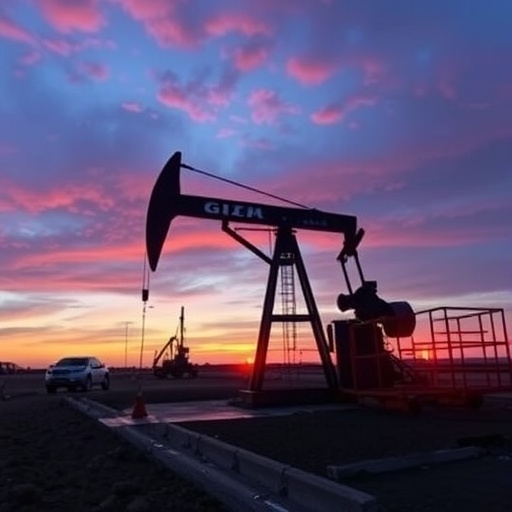
Unveiling Invisible Threats: How U.S. Public Schoolchildren Are Exposed to Oil and Gas Development
In a groundbreaking investigation, Clark et al. (2026) have illuminated a pressing and underexplored public health concern: the exposure of U.S. public schoolchildren to environmental hazards caused by nearby oil and gas development. This study represents one of the most comprehensive assessments to date, underlining the hidden and potentially harmful contaminant pathways infiltrating the school environments of millions of children across America. The implications reverberate beyond environmental science, posing urgent questions about regulatory frameworks, community health, and educational equity.
At the heart of this research lies a meticulous geospatial analysis linking oil and gas activity locations with the spatial distribution of schools across the continental United States. The authors leveraged vast datasets from federal and state agencies, integrating them with demographic variables to paint a detailed portrait of risk exposure on a scale unprecedented in prior scholarship. Their findings reveal that a significant fraction of public schoolchildren attend schools located in proximity to active oil and gas operations, potentially subjected to an array of airborne and soil-borne contaminants.
Understanding the mechanics of oil and gas development is crucial to grasping how exposure occurs within school environments. Activities like hydraulic fracturing, well drilling, and production involve the release of volatile organic compounds (VOCs), particulate matter, and hazardous air pollutants. These emissions can emanate from well pads, processing plants, and transport corridors, dispersing into surrounding air and soil. Given that children are physiologically more vulnerable to environmental toxins due to their developing organs and increased respiration rates, proximity to such emission sources raises significant health concerns.
The investigative team employed sophisticated exposure modeling techniques, including buffer analyses around schools and atmospheric dispersion models accounting for local meteorological conditions. This dual-layered approach allowed the researchers to identify not only schools within a predefined radius of oil and gas sites but also those where emissions were likely to be transported by prevailing winds. The geographic exposure risk map generated paints a stark picture: tens of thousands of schoolchildren face daily exposure during crucial developmental hours.
One of the study’s most sobering findings relates to the socio-economic disparities embedded within these exposure patterns. Schools serving predominantly low-income and minority students disproportionately appear near oil and gas development sites. This environmental justice dimension raises alarming concerns about the compounding vulnerabilities these communities face, linking industrial environmental processes with systemic inequalities in health and education access.
Beyond mere proximity, the authors delve into the complex cocktail of pollutants released, focusing on known or suspected carcinogens and neurotoxins such as benzene, toluene, ethylbenzene, and xylene (collectively referred to as BTEX compounds). Long-term exposure to these chemicals, especially during childhood, has been associated with developmental deficits, respiratory ailments, and increased cancer risks. The study calls attention to the lack of regulatory oversight or environmental monitoring tailored to protect school environments specifically, spotlighting a critical policy gap.
The research team also discusses the limitations inherent to their work, including potential inaccuracies in oil and gas site data due to underreporting or temporal lags. They underline the need for enhanced environmental surveillance systems equipped to capture real-time pollutant concentrations around schools. Such data could empower public health officials and educators to implement targeted interventions mitigating exposure risks.
Importantly, this study transcends descriptive epidemiology by proposing actionable recommendations. The authors advocate for buffer zones around schools where oil and gas development activities are restricted or subject to stringent emission control protocols. They argue that existing setback regulations, often insufficiently protective, must be reevaluated in light of emerging evidence to prioritize child health.
The public response to this research could be profound, catalyzing community advocacy and pushing policymakers toward more robust environmental safeguards. Given the escalating energy demands and ongoing oil and gas expansion in many regions, balancing economic interests with children’s health represents a vital contemporary challenge. Clark et al. emphasize the ethical imperative of shielding vulnerable populations from preventable harm.
From a scientific perspective, the integration of environmental exposure science with epidemiology and geospatial analytics showcased in this paper exemplifies the interdisciplinary rigor required to tackle complex public health issues. The authors’ systematic approach, combining big data analytics with ecological context, charts a promising path forward in exposure science.
Notably, this research arrives at a critical juncture as global discussions intensify around climate change, sustainable energy, and environmental justice. While the focus on oil and gas emissions often centers on greenhouse gases, this work underscores the equally urgent need to consider localized pollutant impacts on communities, especially children, who bear disproportionate health burdens.
Future research directions outlined by the authors include longitudinal cohort studies tracking health outcomes of children exposed to oil and gas emissions from early life onwards. Such work could elucidate dose-response relationships and inform risk assessment models used by regulatory agencies. Additionally, exploring mitigation technologies and pollution control strategies tailored to school settings may offer pathways for immediate improvements.
The research community and broader society now stand at a critical crossroads. The evidence presented by Clark et al. demands a reevaluation of how industrial activities intersect with public health safeguards. Schools, traditionally viewed as safe havens, must be reimagined as environments diligently protected from industrial pollutants. Only then can the promise of education unfold unimpeded by invisible toxic threats.
In conclusion, this landmark study shines a spotlight on a hitherto invisible public health threat tied to one of the United States’ largest and most contentious industries. By revealing the extent of oil and gas exposure risks within the core spaces of child development—public schools—Clark and colleagues have set the stage for urgent policy reform, community action, and renewed scientific inquiry. Their work challenges us to ask fundamental questions about the environments we deem safe for our children and compels us to build a healthier and more equitable future.
Subject of Research:
Environmental exposures of public school children to oil and gas development emissions in the United States.
Article Title:
School-based exposures to oil and gas development for public school children in the United States.
Article References:
Clark, C.J., Campbell, E., Grady, S.T. et al. J Expo Sci Environ Epidemiol (2026). https://doi.org/10.1038/s41370-026-00864-9
Image Credits:
AI Generated
DOI:
10.1038/s41370-026-00864-9
Keywords:
Oil and gas development, schoolchildren exposure, environmental health, volatile organic compounds, BTEX, environmental justice, geospatial analysis, public health risk, air pollution, environmental epidemiology


