

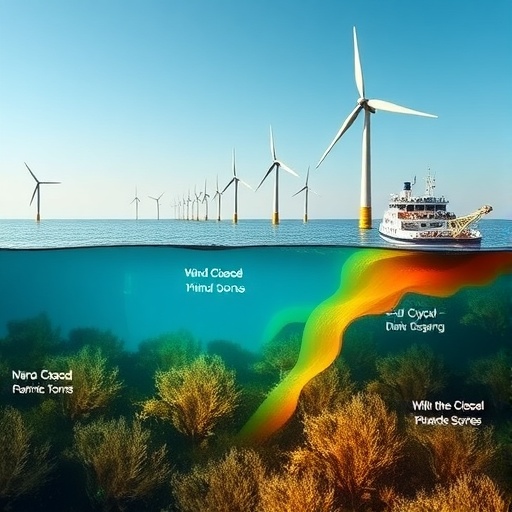
As the global push toward renewable energy intensifies, offshore wind farms have emerged as a promising solution to address climate change and reduce greenhouse gas emissions. However, while their contribution to clean energy generation is undeniable, the environmental footprint of these large-scale installations beneath the ocean surface is only beginning to be fully understood. In groundbreaking new research published in Communications Earth & Environment, Chen et al. (2026) provide a detailed examination of how offshore wind farms influence sediment transport pathways and the burial of organic carbon in shelf seas—a critical aspect of marine ecological balance and carbon sequestration.
The study explores a facet that has often been overlooked in environmental impact assessments: the physical and biogeochemical alterations driven by the presence of towering offshore turbines and their associated infrastructure. Sediment transport within marine shelf environments plays a pivotal role in shaping underwater landscapes, supporting benthic habitats, and facilitating carbon burial, a natural process trapping carbon in seafloor sediments, effectively removing it from the atmosphere for millennia. Alterations to these pathways can therefore cascade through marine ecosystems and influence global carbon cycles.
Through an intricate combination of numerical modeling, field data, and sediment core analysis, the research team uncovers how offshore wind farms modify hydrodynamic conditions. The turbines interrupt natural water currents and wave patterns, leading to changed sediment resuspension and deposition regimes. These physical disturbances influence the spatial distribution of sediments and organic material, with some areas experiencing enhanced deposition, while others face erosion intensification. This heterogeneity in sediment behavior has profound implications for carbon burial efficiency.
Particularly notable is how the foundations of turbines—the monopiles or jackets anchored to the seabed—act as physical barriers, redirecting sediment flow and altering local sediment dynamics. The scouring effect caused by increased flow velocities around these structures can prevent organic carbon-rich sediments from settling, diminishing the capacity of the seabed to trap carbon in those zones. Conversely, in downstream areas where flow velocities decrease, increased sediment accumulation may occur, potentially enhancing organic carbon burial under certain conditions.
Chen and colleagues further emphasize the temporal dimension of these impacts. The sediment and organic carbon redistribution patterns evolve as the wind farm matures and as the marine environment adjusts to the installations. This dynamic aspect challenges static environmental assessment paradigms, calling for long-term monitoring and adaptive management strategies to understand cumulative and lasting impacts on marine sedimentary processes.
One of the critical findings from the paper is that offshore wind farms can alter sediment transport not just locally but across broader shelf sea regions through modifications in large-scale current patterns. Modeling results suggest that changes in existing sediment pathways may influence sediment delivery to ecologically sensitive habitats such as seagrass meadows and coral reefs, which are foundational to marine biodiversity and act as important carbon sinks themselves.
The research highlights the dual-edged nature of offshore wind farms’ environmental footprint. While contributing significantly to the decarbonization agenda and reducing reliance on fossil fuels, these installations inadvertently disrupt natural processes vital to the ocean’s ability to act as a carbon reservoir. Such insights underscore the urgency of integrating marine sediment and carbon cycle dynamics into the spatial planning and design of offshore wind projects to mitigate ecological trade-offs.
Moreover, the study discusses the potential feedback mechanisms between altered sedimentation and benthic microbial activity. Since microbes play a crucial role in organic carbon degradation and burial, changes in sediment composition and oxygen penetration depth caused by modified sediment deposition could shift microbial community structures and biogeochemical rates, further influencing carbon cycling processes.
Chen et al. call for interdisciplinary collaborations to extend these findings, combining oceanography, ecology, and engineering disciplines to devise offshore wind designs and operational strategies that minimize sediment disruption. Innovations could include choosing turbine placements that avoid sediment transport corridors or employing foundation designs that reduce scouring effects while providing new habitats for marine life.
This research also has implications for carbon accounting frameworks and climate policy. The current carbon impact assessments primarily focus on the emissions saved by renewable energy but seldom account for the indirect effects on natural carbon sinks. Incorporating sediment transport and carbon burial alterations into lifecycle analyses of offshore wind farms could lead to more nuanced understandings of their net climate benefits.
Furthermore, the paper invites policymakers to consider marine spatial planning more holistically, balancing renewable energy development with the conservation of sedimentary habitats and their carbon storage functions. As offshore wind energy scales up globally, such considerations are vital to ensuring that climate solutions do not inadvertently compromise ocean health.
The methodological approach of combining high-resolution sediment transport models with empirical data sets a new standard for environmental impact studies in marine contexts. This integrative framework provides a template for future research to evaluate how anthropogenic marine infrastructure interacts with natural geophysical and ecological processes.
Finally, this study propels the scientific community to rethink how we evaluate the sustainability of offshore renewable energy projects. It serves as a cautionary tale that while advancing renewable energy is imperative, it must be pursued with a deep understanding of the complex and sometimes unintended consequences on marine ecosystems and their vital functions in the Earth system.
In summary, Chen et al. (2026) illuminate a previously underappreciated dimension of offshore wind energy impacts—alterations to sediment transport pathways and organic carbon burial in shelf seas. Their findings enrich our understanding of how renewable energy infrastructure interacts with ocean dynamics, highlighting the necessity of multi-faceted environmental assessments. As the world races toward a greener energy future, such insights will be critical for deploying offshore wind responsibly, maximizing climate benefits while safeguarding oceanic carbon sinks and marine biodiversity.
Subject of Research: Changes in sediment transport dynamics and organic carbon burial caused by offshore wind farms in shelf sea environments.
Article Title: Sediment transport pathways and organic carbon burial impacted by offshore wind farms in shelf seas.
Article References:
Chen, J., Christiansen, N., Porz, L. et al. Sediment transport pathways and organic carbon burial impacted by offshore wind farms in shelf seas. Commun Earth Environ (2026). https://doi.org/10.1038/s43247-026-03390-6
Image Credits: AI Generated
DOI: 10.1038/s43247-026-03390-6
Keywords: Offshore wind farms, sediment transport, organic carbon burial, shelf seas, marine sediment dynamics, carbon sequestration, renewable energy environmental impact


