

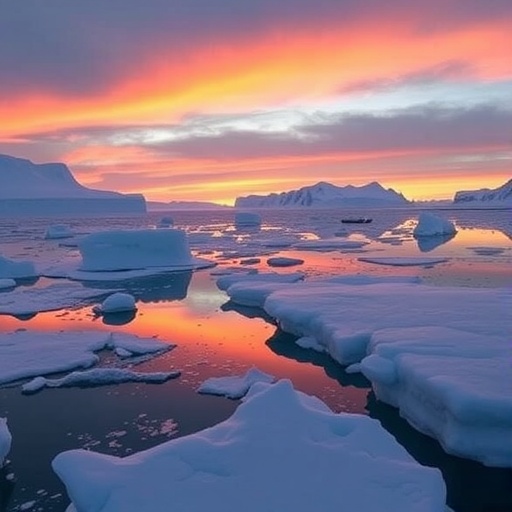
The West Antarctic Ice Sheet (WAIS) represents one of Earth’s most critical indicators of climate change, acting as a vast reservoir of frozen water locked beneath the flowing ice. Recent research has shed unprecedented light on the complex mechanisms driving its historical retreat following the Last Glacial Maximum (LGM), roughly 20,000 years ago. This retreat, it turns out, was not merely a consequence of atmospheric warming but was significantly influenced by the influx of oceanic heat penetrating continental margins deep beneath the ice shelves. The study conducted by Mawbey, Smith, Hillenbrand, and colleagues, published in Nature Communications in 2026, offers a transformative view of how marine thermal forcing orchestrated the behavior of the WAIS, with implications reaching far beyond paleoclimate reconstruction to predictions about future sea-level rise.
The LGM represents the peak of the last Ice Age, when global temperatures were markedly lower and ice sheets extended over much of the Northern and Southern hemispheres. In particular, Antarctica’s ice coverage was at its greatest extent, buttressing global sea levels at significantly lower positions than today. As the planet emerged from this intense cold period, the WAIS began its retreat, a process that had profound impacts on global ocean circulation, marine ecosystems, and ultimately the habitability of coastal regions worldwide. Previous hypotheses often attributed this retreat primarily to atmospheric warming and subsequent reductions in snowfall and surface ice mass. However, the new research leverages state-of-the-art sedimentological analysis, geophysical surveying, and coupled climate-ice modeling to reinterpret the relative roles of oceanic versus atmospheric drivers.
Central to the findings is a detailed reconstruction of ocean temperature anomalies along the continental shelf edge of West Antarctica. Sediment cores extracted from the seafloor reveal a distinct signal of warm, circumpolar deep water intruding beneath ice shelves during the post-LGM period. These findings verify that submarine melting, driven by ocean heat transported onto the continental shelf by changing ocean currents and circulation patterns, was a primary agent of ice shelf thinning and grounding line retreat. This challenges previously held assumptions that primarily attributed ice sheet mass loss to surface melt and runoff, highlighting the vital heat exchange processes occurring at the ice-ocean interface.
The study critiques the oversimplification of ice sheet retreat narratives that focus solely on surface climatic conditions. Instead, it emphasizes that the complex thermodynamics beneath the ice shelves—often hidden from standard observational techniques—play a pivotal role in the stability of marine-based ice sheets like the WAIS. By linking basal melt rates to intruding warm water masses, the research underscores a feedback mechanism where ocean heat stresses lead to ice shelf thinning, which in turn accelerates grounding line retreat and ultimately contributes to irreversible ice loss. This mechanism serves as a crucial analog for understanding potential future contributions of the WAIS to global sea-level rise under ongoing anthropogenic warming.
The methodological approach taken by the researchers is as innovative as their conclusions. They combined high-resolution seismic reflection imaging with isotopic and geochemical analysis from collected cores to pinpoint timing and pathways of ocean heat transfer. Coupled with sophisticated ice sheet models that incorporate these thermal inputs, the results demonstrate that variations in ocean circulation patterns controlled the episodic nature of ice retreat phases. These patterns were further influenced by global climate drivers, such as shifts in Southern Ocean winds and the strength of the Antarctic Circumpolar Current, which amplify deep water warming intrusions into continental shelf cavities.
From a geological perspective, the retreat of the WAIS during this period left a distinctive geomorphological fingerprint on the seafloor. Features such as iceberg scours, sediment deposition patterns, and grounding zone wedges collectively map the trajectory and timing of ice margin retreat. The researchers used these sedimentary proxies to synchronize marine records with terrestrial ice core data, providing a finely resolved timeline that links oceanographic changes directly with glaciological responses. This high-resolution temporal framework enables a better appreciation of the complex interplay between ocean heat forcing and ice sheet dynamics in a warming world.
The study further contextualizes the post-LGM retreat of the WAIS within broader glacio-eustatic processes. As ice sheets shrank, vast amounts of meltwater were released into the oceans, impacting sea level and global thermohaline circulation. By clarifying the mechanisms behind the WAIS ice margin changes, scientists can improve projections of meltwater fluxes and their feedbacks on ocean circulation systems like the Atlantic Meridional Overturning Circulation (AMOC), which play critical roles in modulating global climate. The findings suggest that ocean-driven ice loss from Antarctica has the potential to alter weather patterns and climate regimes across hemispheres.
One of the more striking implications of this research relates to the vulnerability of marine-based ice sheets to ongoing and future ocean warming. Unlike ice sheets grounded on bedrock above sea level, regions of the WAIS rest on retrograde bed slopes below sea level, making them susceptible to marine ice sheet instability. The warm water incursions documented in this study provide a direct analog for contemporary processes, where warming ocean currents and increased heat uptake beneath floating ice shelves may trigger accelerated ice retreat. Understanding these past episodes deepens insight into potential tipping points and irreversible transitions in ice sheet behavior under continued warming.
Beyond the physical sciences, the research holds significance for policymakers and coastal communities. Rising seas pose existential risks to low-lying areas worldwide, threatening ecosystems, infrastructure, and livelihoods. This enhanced understanding of ocean heat forcing’s role in ice sheet collapse offers a more nuanced perspective on the timescales and magnitudes of future sea-level rise. It stresses the urgency of integrated climate action, targeting both atmospheric greenhouse gas reductions and improved ocean monitoring, to anticipate and potentially mitigate the impacts of Antarctic ice loss.
Moreover, the interdisciplinary nature of the study exemplifies the power of combining geological records, oceanographic data, and cutting-edge computational modeling. It pushes the boundaries of paleoclimate research from descriptive accounts of reconstructed ice margins to mechanistic explanations rooted in physical principles and modern analogs. This scientific rigor not only advances our knowledge of Earth’s past but equips the predictive frameworks scientists rely on to inform climate resilience strategies.
The geographic scope of the analysis primarily covers the Amundsen Sea Embayment sector of West Antarctica, one of the most dynamically responsive regions to ocean-induced melting today. By focusing on this critical sector, the researchers provide a targeted case study that resonates with recent satellite observations documenting rapid ice mass loss and grounding line migration. Integrating findings across temporal scales—from millennia past to present day—establishes continuity and coherence in understanding ice sheet-ocean interactions.
Technological advancements played a pivotal role in enabling these discoveries. The high spatial and temporal resolution of marine sediment records, combined with sophisticated ocean circulation models capable of resolving sub-ice-shelf dynamics, mark a significant leap forward. These tools have uncovered the subtle but significant interaction between remote oceanic processes and grounded ice stability, a relationship that traditional paleoclimate proxies alone could not resolve as clearly.
The study also carries implications for the calibration of climate models projecting Antarctic ice sheet behavior and global sea levels under various emissions scenarios. By providing empirical constraints on the rates and drivers of ice retreat, the research helps refine model parameterizations related to basal melt, ocean heat transport, and feedbacks within the cryosphere-ocean system. This contributes to reducing uncertainty in long-term sea-level projections critical for global adaptation planning.
Finally, the work echoes a broader scientific imperative: to deepen understanding of the interconnected Earth system, where ocean, atmosphere, ice, and biosphere form a dynamically coupled whole. As anthropogenic activities continue to reshape the planet’s climate, insights into how ancient environmental changes unfolded and the factors guiding ice sheet stability become ever more relevant. The legacy of the past glacial retreat offers cautionary signals and hopeful guidance for navigating Earth’s climatic future.
Subject of Research: The impact of oceanic heat forcing on the post-Last Glacial Maximum retreat of the West Antarctic Ice Sheet, specifically exploring the role of warm circumpolar deep water intrusions in driving ice shelf thinning and grounding line retreat.
Article Title: Ocean heat forced West Antarctic Ice Sheet retreat after the Last Glacial Maximum
Article References:
Mawbey, E.M., Smith, J.A., Hillenbrand, C.D., et al. Ocean heat forced West Antarctic Ice Sheet retreat after the Last Glacial Maximum. Nat Commun (2026). https://doi.org/10.1038/s41467-026-68949-5
Image Credits: AI Generated


