

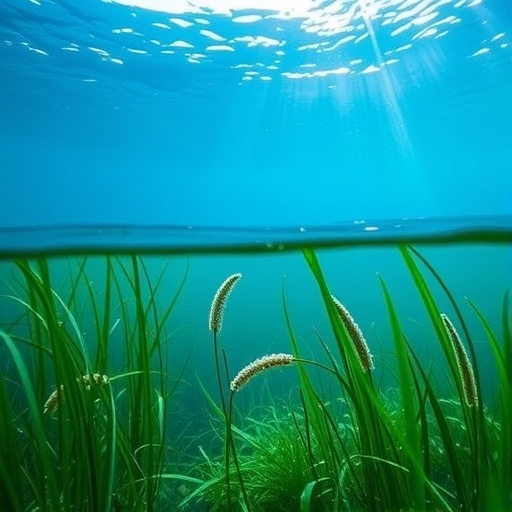
In an era marked by escalating concerns surrounding climate change and the accumulation of atmospheric carbon dioxide, nature’s own carbon sinks are emerging as crucial allies. Seagrass meadows, often overshadowed by terrestrial forests and oceanic phytoplankton, are now the subject of groundbreaking research revealing their enhanced capacity for carbon burial under conditions of ocean acidification. This intriguing development, uncovered by the team led by Kindeberg, Teixidó, and Comeau, sheds light on the complex interactions between marine ecosystems and the changing chemistry of our oceans, offering a glimmer of hope in the relentless fight against global warming.
Ocean acidification, a direct consequence of increased atmospheric CO2 dissolving into seawater, alters the marine carbonate system by lowering pH levels and modifying carbonate ion availability. This shift has typically raised alarms due to its deleterious effects on calcifying organisms like corals and shellfish. However, the study explored the paradoxical influence of these acidic conditions on seagrass ecosystems, revealing an unexpected positive impact on carbon burial processes. By investigating natural carbon dioxide vents that simulate future acidification scenarios, the researchers have unveiled how seagrass meadows respond to changing seawater chemistry with enhanced efficiency in capturing and storing organic carbon in sediments.
Seagrass meadows, composed of flowering plants rooted in marine sediments, perform several critical ecological functions – from stabilizing shorelines and providing habitat to supporting fisheries. Crucially, they act as biological carbon sinks, sequestering atmospheric CO2 through photosynthesis and depositing it into the sediment in forms resistant to decomposition. The research employed an integrative approach, combining field observations around CO2 vents in volcanic regions with sediment chemistry analyses and carbon flux measurements, to ascertain how seagrass systems adapt to acidified conditions that mimic projected future oceans.
The findings reveal a notable increase in carbon burial efficiency within seagrass sediments exposed to elevated CO2 levels. Acidified water enhances photosynthetic rates in seagrass by increasing the availability of dissolved inorganic carbon, which the plants utilize during photosynthesis. This biochemical advantage translates into increased biomass production and greater organic carbon deposition in sediments, where it becomes locked away for long periods. The research further suggests that microbial processes responsible for organic matter breakdown slow down in acidic conditions, reinforcing carbon preservation and burial beneath these meadows.
Importantly, this phenomenon contradicts earlier models which anticipated a reduction in blue carbon storage capacity under acidification stress. The study posits that seagrass meadows may serve as resilient and even amplified carbon sinks in the future, partially mitigating anthropogenic carbon emissions. However, the researchers caution that such benefits are context-dependent and hinge on factors like sediment type, water flow, nutrient availability, and the existence of co-occurring stressors such as pollution or warming, which could impair seagrass health and offset gains.
This advanced bio-geochemical insight integrates ecological and geochemical methodologies to refine our understanding of blue carbon dynamics in marine ecosystems. By leveraging natural CO2 vents as analogues for future oceans, the study overcomes limitations of laboratory experiments by capturing the complex interactions in situ. The approach provides robust empirical data supporting the role of seagrasses as climate buffers, encouraging their inclusion in global carbon budget assessments and coastal management strategies aimed at climate mitigation.
The implications extend to policy, conservation, and restoration practices. Enhancing protection of seagrass meadows, reducing coastal pollution, and promoting restoration projects gain renewed importance in light of their elevated carbon storage potential. Furthermore, ocean acidification monitoring programs must include seagrass habitats to track ecosystem responses and carbon sequestration trends under shifting seawater chemistry. The study advocates a multi-disciplinary research agenda to further dissect mechanistic underpinnings and assess long-term viability across various marine biomes.
Moreover, this discovery reshapes the narrative about ocean acidification’s impacts by illustrating that not all marine ecosystems respond negatively. It provides a nuanced perspective that supports ecosystem-based adaptation within climate change frameworks. Through understanding the dual roles of marine systems as vulnerable habitats and vital carbon sinks, better adaptive management plans can be formulated, balancing conservation with ecosystem services preservation.
The complexity of marine carbon cycles emerges vividly from the study, highlighting how feedback loops between biological productivity and geochemical processes influence carbon sequestration longevity. The slower microbial degradation under acidified conditions enhances sedimentary carbon retention, implying that feedback mechanisms amplified by acidification might yield unforeseen benefits for carbon storage. However, uncertainties persist regarding thresholds beyond which acidification or additional stressors may cause detrimental effects, underscoring the need for ongoing, dedicated monitoring.
This research bridges gaps between oceanography, ecology, and climate science, offering a model of how empirical studies rooted in natural environmental gradients elevate understanding beyond laboratory confines. The nuanced findings underscore the heterogeneous nature of climate change effects and emphasize that ecosystem responses can be contextually positive or negative. The enhanced carbon burial pathway identified may become a key factor in coastal blue carbon accounting frameworks, strengthening natural climate solutions.
Yet, with all its promise, the study reminds us that seagrass meadows are fragile environments threatened worldwide by habitat loss, eutrophication, and physical disturbances. The protective and restorative efforts needed to harness their carbon storage potential alongside their biodiversity and fisheries support are crucial. Advocates call for inclusion of these findings in climate policy negotiations and carbon accounting methodologies to incentivize conservation investments.
In conclusion, the investigation spearheaded by Kindeberg, Teixidó, and colleagues not only enriches our scientific grasp of marine carbon dynamics but also delivers a hopeful message amid the gloom of ocean acidification narratives. By unveiling how seagrass meadows may amplify carbon burial under future acidic seas, the study highlights nature’s capacity to adapt and participate actively in climate mitigation. For policy-makers, scientists, and conservationists, this research invites a recalibration of perspectives about ocean acidification, championing the inclusion of seagrass ecosystems in the arsenal against climate change.
As humanity stands at the crossroads of ecological stewardship and climate action, these findings underscore the importance of protecting and restoring coastal vegetative habitats. They emphasize that solutions may be found within natural systems, which, under thoughtful management, can offer resilience and essential services far into the future. Investigating the mechanisms behind enhanced carbon burial in seagrass under acidification is therefore not just a scientific pursuit but a beacon of hope for sustainable climate futures.
Subject of Research: Carbon burial dynamics in seagrass meadows under ocean acidification using natural CO2 vents as experimental analogues.
Article Title: Enhanced carbon burial in seagrass meadows under ocean acidification revealed by carbon dioxide vents.
Article References:
Kindeberg, T., Teixidó, N., Comeau, S. et al. Enhanced carbon burial in seagrass meadows under ocean acidification revealed by carbon dioxide vents. Commun Earth Environ (2026). https://doi.org/10.1038/s43247-026-03349-7
Image Credits: AI Generated


