

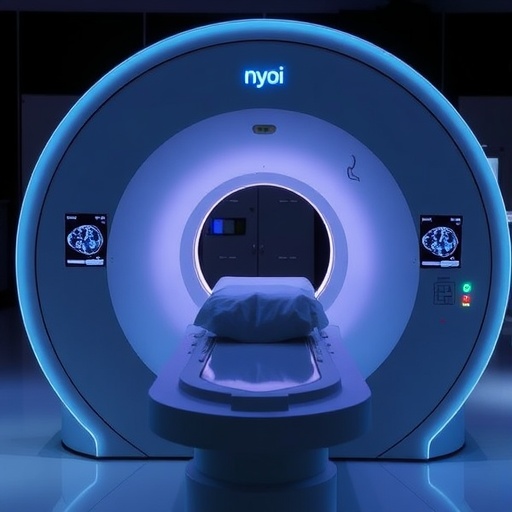
In a landmark advancement at the intersection of diagnostic imaging and cancer therapy, researchers from New York University Abu Dhabi have engineered a new class of multifunctional molecules designed to revolutionize how aggressive tumors are detected and treated. These smart molecules serve a dual purpose, acting not only as contrast agents to enhance magnetic resonance imaging (MRI) but also launching precise therapeutic attacks on malignant cells. This breakthrough represents a pivotal shift, promising to converge the traditionally separate domains of cancer diagnosis and treatment into one seamless platform.
MRI has long been the gold standard in non-invasive tumor detection, offering exceptional tissue contrast without the ionizing radiation associated with other imaging techniques. However, conventional MRI contrast agents function solely to enhance visual differentiation between healthy and pathological tissues, leaving the therapeutic dimension unaddressed. Recognizing this limitation, the NYU Abu Dhabi team harnessed sophisticated molecular engineering to design interlocked molecular architectures, often described metaphorically as knots and rings, that drastically amplify both imaging clarity and therapeutic efficacy within a single chemical system.
The employment of manganese as a central metal ion in these new compounds is particularly noteworthy. Unlike gadolinium, a contrast metal widely used in clinical MRIs but notorious for its potential accumulation and adverse side effects in patients, manganese is biologically essential and exhibits a more favorable safety profile. These novel molecules exploit the unique chemistry of manganese ions, engineered to remain inert in normal physiological environments and selectively activate within the slightly acidic microenvironment characteristic of cancerous tumors. When activated, the molecules release manganese ions that simultaneously sharpen MRI contrast and induce cytotoxic effects against tumor cells.
What sets this innovation apart from conventional small-molecule drugs is the molecules’ nontrivial topology—complex, interlocked structures conferring enhanced stability and functional versatility. These elaborate architectures facilitate controlled activation exclusively within tumorous tissues, minimizing collateral damage and systemic toxicity. Furthermore, the lengthy lifespans and specialized chemical environments within tumors promote the molecules’ accumulation and effectiveness, mitigating the need for repeated dosing.
A striking demonstration of the technology’s potential was its successful application to glioblastoma, a notoriously aggressive and difficult-to-treat brain cancer. Glioblastomas pose significant challenges in oncology due to their invasive nature and the protective blood-brain barrier that obstructs most therapeutic agents. Remarkably, the manganese-based molecules developed by the NYU Abu Dhabi team can traverse this blood-brain barrier, preferentially homing in on glioblastoma cells. This capability enables clinicians to achieve high-resolution imaging of brain tumors, overcoming one of the most persistent hurdles in neuro-oncology diagnostics.
Beyond imaging, these molecules deploy a therapeutic payload once inside the tumor microenvironment. The acidic conditions trigger the release of manganese ions, which not only facilitate image contrast by altering local magnetic properties but also engage in mechanisms that damage the DNA or disrupt metabolic pathways within cancer cells. This dual action optimizes treatment by precisely targeting malignancies while sparing healthy tissues, thereby reducing adverse effects often seen with systemic chemotherapy or radiation.
Lead researcher Farah Benyettou highlights the significance of this dual-function platform: “Our ambition was to create a singular molecular entity capable of enhancing tumor visibility on MRI scans while simultaneously delivering therapeutic benefits. The implications for brain tumors, where precision is paramount, are especially profound.” Her insights underscore how integrative approaches can reshape cancer care paradigms by shortening diagnosis-to-treatment timelines and tailoring interventions with unprecedented accuracy.
Furthermore, Professor Ali Trabolsi emphasizes the transformative potential of the molecules’ distinctive topology: “The complex interlocked structures these molecules adopt endow them with properties that conventional drugs simply cannot match.” This molecular complexity underpins not just controlled activation but also long-term biocompatibility and functional resilience under biological conditions, ensuring robustness from imaging through therapy.
Crucially, the shift away from gadolinium to manganese-based agents addresses mounting concerns regarding gadolinium deposits found in patients’ organs after repeated MRI scans. With manganese’s essential metabolic roles and easier body clearance, these new molecules herald safer contrast agents suitable for repeated diagnostic use, expanding their applicability across diverse patient populations.
The experimental study underpinning these findings was meticulously conducted with synthesized molecules crafted by research scientist Thirumurugan Prakasam, underlining the precision chemistry involved in creating these nontrivial molecular structures. Through rigorous in vitro and in vivo testing, particularly in glioblastoma models, the team validated not only enhanced imaging capabilities but also the molecules’ tumor-selective cytotoxic effects. This dual validation paves the path for eventual clinical translation.
This pioneering research has potential ramifications beyond glioblastoma. The fundamental principles of pH-sensitive activation, interlocked molecular topology, and manganese-based imaging and therapy could be adapted for other malignancies that present acidic microenvironments and require non-invasive diagnostic and therapeutic strategies. Such adaptability instills hope for a new era of personalized oncology where real-time tumor visualization and simultaneous targeted therapy become routine.
In summary, the development of manganese-templated, nontrivial molecular structures marks a substantial leap forward in creating intelligent molecular platforms that unify MRI diagnostics and cancer treatment. By marrying advanced chemical engineering with clinical oncology needs, these smart MRI molecules stand poised to enhance both the safety and precision of cancer care, particularly for intractable tumors such as glioblastoma. As this technology progresses toward clinical application, it promises to transform how clinicians detect and combat cancer, ultimately improving patient outcomes and quality of life.
Subject of Research: Cells
Article Title: Manganese-Templated Nontrivial Structures for MRI and Therapy
News Publication Date: 1-Apr-2026
Web References: http://dx.doi.org/10.1021/jacs.5c19016
Image Credits: Courtesy NYU Abu Dhabi
Keywords: Biomedical engineering, MRI contrast agents, manganese-based therapy, glioblastoma imaging, cancer diagnostics, molecular topology, dual-function molecules


