

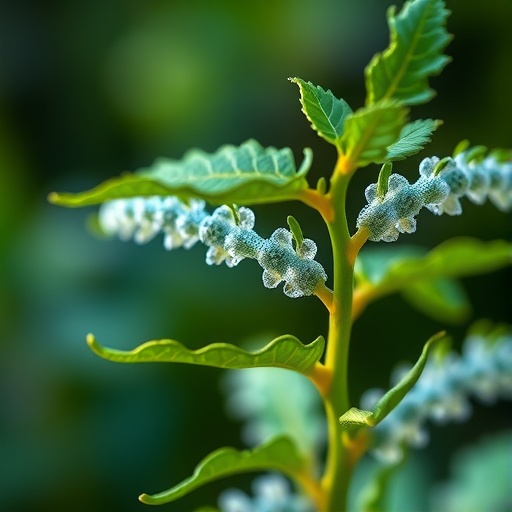
In a groundbreaking advance that challenges long-held assumptions in plant biology, researchers have identified a genetic mechanism enabling plant cells to actively internalize bacterial cells, a discovery with profound implications for agriculture, microbiology, and biotechnology. This landmark study, recently published in Nature Plants, reveals that a specific cis-regulatory element within the plant genome acts as a molecular gateway facilitating the engulfment of bacteria, a process previously believed to be largely absent in plant cells outside specialized symbiotic relationships. This revelation offers an unprecedented glimpse into the dynamic interactions between plants and their microbial environment, opening exciting new avenues for crop enhancement and disease resistance.
For decades, our understanding of plant-microbe interactions has been framed by the concept that plants primarily engage with bacteria through extracellular signaling and compartmentalized symbiosis, such as nitrogen-fixing nodules. Endocytic processes bringing bacteria directly into plant cells have been considered exceptional or limited to certain symbiotic associations. The discovery of a cis-element capable of enabling general bacterial uptake overturns this paradigm by demonstrating an intrinsic molecular feature in plants that can commandeer and direct the internalization machinery toward bacterial engulfment. This fundamentally revises our comprehension of plant cellular capabilities and their potential for intimate interactions with microbiota.
The cis-element identified by the multidisciplinary team led by Cathebras et al. is a short, non-coding DNA sequence residing within promoter regions of key plant genes. Functionally, this cis-element appears to modulate the expression of proteins critical to membrane remodeling and vesicle trafficking, orchestrating a cellular response that physically encases and engulfs bacterial invaders. The authors employed a suite of molecular tools including chromatin immunoprecipitation, reporter assays, and advanced live-cell imaging to map the precise activity and downstream effects of this regulatory motif. Strikingly, the element operates as a switch that can be toggled to promote bacterial uptake under defined conditions, a feature that could be exploited to enhance beneficial plant-microbe partnerships or to restrict pathogenic invasion.
What elevates this discovery beyond a mere molecular oddity is the breadth of bacterial taxa that can be internalized through this cis-element-dependent process. The research demonstrated that both Gram-negative and Gram-positive bacteria, encompassing a diverse range of species with varying cell wall architectures and surface chemistries, are susceptible to this form of entry. This broad spectrum bacterial uptake defies previous assumptions that plant cells selectively internalize only symbiotic or non-pathogenic microbes. Instead, it suggests a generalized endocytosis pathway capable of engaging with the microbial world in a manner reminiscent of phagocytosis in animal immune cells, albeit mediated by plant-specific biochemical routes.
The implications for plant immunity and pathology are vast. By internalizing bacteria, plant cells might have the capacity to directly neutralize or sequester pathogens before they can perpetrate damage on the extracellular matrix or access sensitive intracellular compartments. Conversely, pathogenic bacteria might subvert this mechanism to gain entry and colonize the host cell interior, deepening infection. Understanding the regulatory crosstalk governing this uptake process could yield novel strategies for crop protection, enabling biotechnologists to engineer plants with enhanced abilities to capture and eliminate harmful microbes or to foster beneficial microbiomes that boost growth and stress tolerance.
On the evolutionary front, the emergence of this cis-element paints a compelling picture of plant adaptation and the co-evolutionary arms race with microbes. The ability to internalize bacteria independently of specialized nodulation structures or fungal symbioses expands the conceptual framework for how plants might have evolved complex microbial engagement strategies. This mechanism could represent a primitive yet versatile form of endocytosis that plants refined multiple times to diversify their interactions with surrounding microbiota, contributing to their success across varied ecological niches and environmental challenges.
Technically, the elucidation of this cis-element’s function leveraged next-generation sequencing to identify conserved DNA motifs among plant species exhibiting variable bacterial uptake capabilities. Subsequent gene editing via CRISPR-Cas9 to delete or mutate this element abolished the uptake phenomenon, confirming its indispensable role. Complementary proteomic studies revealed an upregulation of membrane-associated proteins akin to dynamins and clathrins, indicating that canonical vesicular trafficking pathways are co-opted during bacterial internalization. The research thus highlights a sophisticated coordination between genetic regulation and cellular machinery traditionally associated with nutrient uptake or receptor recycling, repurposed here for microbial ingestion.
The study also delved into the signaling pathways downstream of the cis-element’s activation, unearthing a cascade involving calcium influx, reactive oxygen species (ROS) bursts, and cytoskeletal reorganization. These signaling events bear resemblance to defense responses yet are distinct in their orchestration, revealing a nuanced balance between protective immunity and cellular accommodation of bacterial entry. This duality underscores the fine-tuned trade-off plants must maintain, allowing some microbial entry for mutualistic purposes while defending against pathogenic intrusion.
Potential agricultural applications of these insights are particularly tantalizing. Engineering crops with optimized versions of this cis-element could promote the uptake and establishment of growth-promoting bacteria, boosting nutrient acquisition and stress resilience without the need for chemical fertilizers or pesticides. Such innovations align with the burgeoning field of synthetic microbiome engineering, where tailored plant-microbe interactions are designed to maximize crop yield and sustainability. Moreover, this mechanism could be harnessed to deliver genetic material or agrochemicals intracellularly using bacterial vectors, revolutionizing plant biotechnology.
Despite the excitement, the authors acknowledge that much remains to be learned about the specificity and regulation of this bacterial uptake mechanism. Crucial questions include how plants distinguish between beneficial and harmful bacteria once internalized, what limits or terminates the uptake process, and how widespread this cis-element is across different plant families. Future research deploying high-resolution imaging, single-cell transcriptomics, and functional assays across diverse plant and bacterial species will be essential to map the ecological and physiological roles of this newfound capability.
The discovery also invites a reevaluation of plant cellular biology textbooks, as endocytosis of whole microorganisms was previously relegated to special cases such as arbuscular mycorrhizal fungi or rhizobia. This generic bacterial uptake mechanism represents a novel cell biological phenomenon signaling a more active and dynamic interplay between plant cells and their microbial neighbors than ever appreciated. It challenges the simplistic notion of plant cells as passive recipients and instead positions them as selective and capable actors in the microbial world.
Ethically and environmentally, manipulating this cis-element in crops raises critical considerations about the unintended consequences of enhanced bacterial uptake, including the potential for new pathogen entry routes or disruptions of native microbial communities. The authors advocate for cautious, stepwise translational studies coupled with in-depth ecological assessments before widespread agricultural deployment. Responsible application of this knowledge will necessitate a systems-level understanding integrating plant genetics, microbiome dynamics, and ecosystem health.
In sum, the identification and mechanistic elucidation of a novel cis-element enabling bacterial uptake by plant cells mark a paradigm shift in plant science. This breakthrough accomplishes more than expanding fundamental understanding; it sets the stage for transformative technological innovations in sustainable agriculture and plant microbiology. As researchers continue to disentangle this complex genetic and cellular landscape, the prospect of harnessing plants’ newfound cellular prowess to address global food security and environmental challenges shines brighter than ever.
This pioneering work, spearheaded by Cathebras, Gong, Andrade, and colleagues and published in Nature Plants, exemplifies the power of integrative multidisciplinary research to unlock nature’s secrets and translate them into solutions with real-world impact. By revealing a hidden dimension of plant biology, it beckons a future where agriculture is smarter, more sustainable, and intimately connected to the invisible microbial forces shaping life on Earth.
Subject of Research: Novel cis-element-mediated bacterial uptake by plant cells
Article Title: A novel cis-element enabled bacterial uptake by plant cells
Article References:
Cathebras, C., Gong, X., Andrade, R.E. et al. A novel cis-element enabled bacterial uptake by plant cells. Nat. Plants (2026). https://doi.org/10.1038/s41477-025-02161-z
Image Credits: AI Generated
DOI: https://doi.org/10.1038/s41477-025-02161-z


