

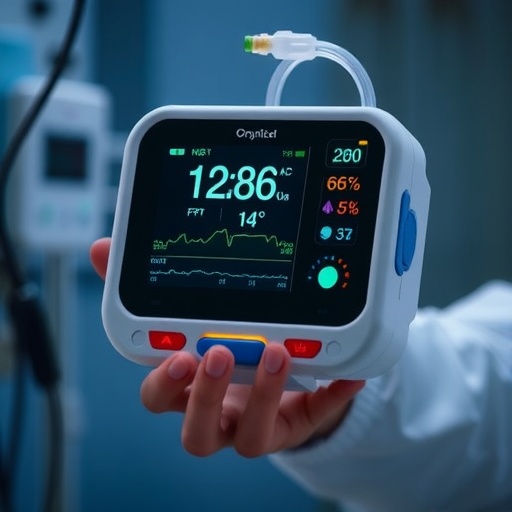
In a groundbreaking advancement for neonatal care, scientists have unveiled novel insights into noninvasive oxygenation monitoring in newborns suffering from persistent pulmonary hypertension (PPHN), a critical condition that challenges the fragile respiratory systems of neonates. The study rigorously evaluates the accuracy and clinical utility of the Oxygen Saturation Index (OSI) and the SpO₂/FiO₂ ratio (S/F) as reliable surrogates for the traditionally invasive Oxygenation Index (OI) and PaO₂/FiO₂ ratio (P/F), respectively. This research marks a significant step toward minimizing invasive procedures while ensuring precise assessment of a neonate’s oxygenation status—vital for tailoring effective therapeutic strategies.
Persistent pulmonary hypertension of the newborn is marked by elevated pulmonary vascular resistance, leading to hypoxemia and respiratory failure, and requires swift, careful monitoring. Clinicians traditionally rely on arterial blood gases to measure the PaO₂/FiO₂ ratio and invasively calculate the Oxygenation Index, both of which involve painful blood draws and potential complications. The need for a noninvasive yet scientifically robust alternative has spurred the investigation into indices based on pulse oximetry, a less intrusive modality that continuously monitors oxygen saturation (SpO₂).
Central to this study was the examination of the Oxygen Saturation Index, a metric derived from easily accessible SpO₂ levels and inspired oxygen fractions, hypothesized to reflect the lung’s oxygenation capacity accurately. Similarly, the SpO₂/FiO₂ ratio offers a noninvasive counterpart to the established arterial blood gas ratios. By measuring the correlation and agreement between these novel indices and their invasive counterparts, the researchers aimed to validate noninvasive monitoring tools that could revolutionize bedside assessment in neonatal intensive care units.
The research design meticulously accounted for a cohort of neonates diagnosed with PPHN, with simultaneous collection of arterial blood gases and pulse oximetry data. This robust dataset enabled a comprehensive statistical analysis evaluating the strength of the relationship between OSI and OI, and between S/F and P/F ratios, through correlation coefficients and Bland-Altman agreement plots. Such analyses are crucial for discerning not only how closely these indices track one another but also their interchangeability in clinical scenarios.
Remarkably, the findings demonstrated excellent correlation between the Oxygen Saturation Index and the Oxygenation Index across the spectrum of disease severity. The OSI consistently mirrored the trends observed in the invasive OI measurements, suggesting that OSI could serve as a reliable proxy for assessing oxygenation inefficiency and respiratory compromise in neonates with PPHN. This revelation underscores the potential to reduce arterial line usage and associated risks, while maintaining high-fidelity monitoring.
Similarly, the SpO₂/FiO₂ ratio proved to be a pragmatic alternative to the traditional PaO₂/FiO₂ ratio. Given the ease of measuring SpO₂ continuously via pulse oximetry, clinicians could benefit from real-time data that correlates strongly with invasive oxygenation indices. This capability not only refines evaluation but could expedite clinical decision-making, especially when rapid changes occur in the neonate’s respiratory status.
One of the most clinically impactful components of the study was the identification of specific noninvasive OSI and S/F thresholds that correspond to critical values of OI and P/F, which are often used to stratify the severity of respiratory failure and guide interventions such as inhaled nitric oxide, mechanical ventilation settings, or extracorporeal membrane oxygenation (ECMO). Establishing these thresholds redefines the noninvasive approach, offering neonatologists actionable data from pulse oximetry alone.
This research carries profound implications for neonatal intensive care, particularly in settings where arterial catheterization is risky or not feasible. The ability to noninvasively monitor oxygenation indices with validated accuracy promises to enhance patient comfort, reduce infection risks, and streamline workflow without compromising clinical vigilance. Furthermore, the continuous nature of SpO₂ monitoring surpasses intermittent arterial blood gas analyses, offering a more dynamic understanding of a neonate’s pulmonary status.
Beyond the immediate utility in PPHN, these validated indices may catalyze broader adoption of noninvasive monitoring across a spectrum of neonatal respiratory disorders. As oxygenation abnormalities are central to many neonatal pathologies, the OSI and S/F ratio provide adaptable tools that could standardize respiratory monitoring protocols and outcomes reporting. These advancements might well set a new clinical standard, emphasizing less invasive yet precise care paradigms.
Technological integration of these indices into existing pulse oximetry devices or neonatal monitors is eminently feasible, enabling seamless real-time computation and display at the bedside. This user-friendly, technology-embedded approach has the potential to democratize oxygenation monitoring globally, even in resource-limited settings where invasive monitoring options are constrained.
Future directions emerging from this work involve larger-scale validation across diverse neonatal populations and clinical environments, as well as investigating the responsiveness of OSI and S/F to therapeutic interventions in real-time. The incorporation of machine learning algorithms to predict respiratory deterioration or response based on these indices is another promising avenue, poised to transform neonatal care through artificial intelligence-enhanced decision support.
Ultimately, the validation of noninvasive oxygenation indices in PPHN neonates represents a pivotal stride toward precision medicine in neonatology. It enhances our understanding of oxygenation dynamics and equips clinicians with robust, minimally invasive tools, expanding the possibilities for optimal respiratory management while minimizing the risk and discomfort inherent in conventional invasive methods.
As neonatal newborn care continues to evolve, the impact of such research resonates beyond the immediate clinical sphere, inspiring innovation in biomedical device development, clinical guidelines formulation, and health policy considerations. Emphasizing less invasive, more continuous monitoring aligns with the broader goals of improving neonatal outcomes, reducing hospital stays, and enhancing family-centered care.
In the context of neonatal research, this study exemplifies the critical interplay between clinical necessity and technological innovation. It addresses a persistent clinical challenge with elegant scientific inquiry, paving the way for future studies and ultimately transforming the standard of care for vulnerable newborns worldwide.
In conclusion, the validation of OSI and S/F as accurate, reliable, and noninvasive surrogate markers of oxygenation in neonates with persistent pulmonary hypertension heralds a new era in neonatal respiratory care. Clinicians and researchers alike stand on the cusp of integrating these findings into everyday practice, marking a profound leap forward in the quest to combine precision, safety, and comfort in newborn care.
Subject of Research: Noninvasive oxygenation monitoring in neonates with persistent pulmonary hypertension (PPHN).
Article Title: Noninvasive oxygenation monitoring in PPHN: validation of the oxygen saturation index and the oxygen saturation to fraction of inspired oxygen ratio against conventional invasive indices.
Article References:
Li, D., Yao, M., Shi, H. et al. Noninvasive oxygenation monitoring in PPHN: validation of the oxygen saturation index and the oxygen saturation to fraction of inspired oxygen ratio against conventional invasive indices. J Perinatol (2026). https://doi.org/10.1038/s41372-026-02663-4
Image Credits: AI Generated
DOI: 10 April 2026


