

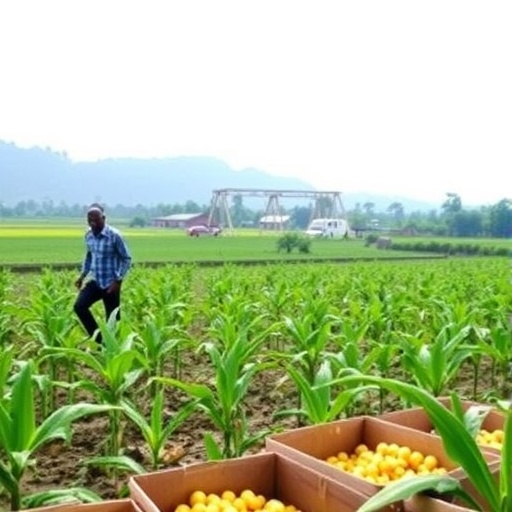
In a groundbreaking study published in the journal Discover Agriculture, researchers Agbolosoo, Akey, and Asiedu present a comprehensive analysis of the economic impact of non-traditional export crops in Ghana from 1970 to 2022. The evidence gathered through time series analysis highlights the pivotal role these crops have played in transforming Ghana’s agricultural landscape and contributing to its overall economic growth. With the increasing relevance of non-traditional crops in the export market, this research not only unveils critical insights but also opens new avenues for policy formulation that could further enhance agricultural productivity in Ghana.
The agricultural sector has always been a cornerstone of Ghana’s economy, historically dominated by traditional crops like cocoa and palm oil. However, the emergence of non-traditional export crops such as cashew, shea, and various horticultural products has begun to reshape the economic profile of the country. This shift underscores an essential question: how do these crops drive economic growth, and what mechanisms are at play in this dynamic relationship? The researchers embarked on an exploration to answer this question through a meticulous time series analysis that spanned over five decades.
Their findings indicate that non-traditional export crops have not only diversified Ghana’s agricultural output but also increased the country’s resilience against global market shocks. As global demand shifts, particularly for health-conscious and organic products, Ghana’s ability to respond through its non-traditional crop exports proves essential. By tapping into lucrative foreign markets, Ghana has enhanced its export revenues, thereby fueling economic growth. This trend reflects a broader global movement where countries leverage their unique agricultural strengths to meet changing consumer preferences.
One of the most compelling aspects of this study is the incorporation of data analytics and econometric techniques. Utilizing advanced modeling methods, the researchers were able to disentangle the complex interactions between non-traditional crop production and economic indicators. By analyzing historical data, they were able to draw correlations between non-traditional exports and GDP growth, employment rates, and foreign exchange earnings. Such rigorous methodology not only bolsters the credibility of their findings but also serves as a model for similar studies in other developing nations.
The researchers also highlight the importance of policy support in sustaining the growth of non-traditional export crops. Despite their potential, many smallholder farmers lack access to resources, markets, and information that would enable them to fully capitalize on the opportunities presented by these crops. The study argues for the need for targeted interventions—such as financial assistance, training programs, and infrastructure development—to empower farmers and elevate their market competitiveness. As the global agriculture sector continues to evolve, the need for supportive policies becomes increasingly critical.
Equally noteworthy is the environmental dimension of non-traditional crop production. As agricultural practices evolve, researchers are increasingly considering sustainability as a key factor in economic analyses. The study acknowledges the potential environmental risks associated with the expansion of non-traditional agriculture, such as deforestation or soil degradation. Therefore, it calls for integrated approaches that prioritize sustainable practices alongside economic gains, ensuring that the future of Ghana’s agriculture is both economically beneficial and environmentally sound.
Moreover, the research outlines the role of global trade dynamics in shaping the landscape of crop exports. As economies become more interconnected, Ghana must navigate the complexities of global supply chains and trade agreements. Understanding these dynamics is essential for maximizing the benefits derived from non-traditional crops. The researchers emphasize the need for Ghana to actively engage in international negotiations to secure favorable trade terms that enhance its export capacity.
The insights derived from this study also resonate with the broader narrative of economic transformation in Ghana. As the nation steadily moves away from over-reliance on traditional commodities, the diversification of agricultural products through non-traditional crops is emblematic of a more resilient economy. This transformation signifies a commitment to innovation and adaptability in a changing global market, which is crucial for the country’s future economic trajectory.
In examining the societal implications of non-traditional crop production, the study brings attention to the potential for job creation and rural development. By expanding the agricultural sector to include a wider array of crops, there is greater potential for economic opportunity, especially in rural areas where employment options can be limited. The ripple effects of this growth can also foster community development, as increased income from crop sales can lead to better education, healthcare, and quality of life for farmers and their families.
In conclusion, the research by Agbolosoo, Akey, and Asiedu presents a compelling case for the transformative power of non-traditional export crops in Ghana. By employing a rigorous analytical framework, the study sheds light on their substantial contributions to economic growth, and the findings underscore the urgent need for supportive policies and sustainable practices. As Ghana continues to navigate the complexities of global agriculture, the emphasis on diversification through non-traditional exports could serve as a blueprint for other developing nations aiming for economic resilience and sustainability.
The time series analysis presented in this study not only offers valuable insights into the past but also carries implications for the future. As the world faces shifting agricultural demands and environmental challenges, the case of non-traditional export crops in Ghana serves as a reminder of the critical intersection between agriculture and economic growth. This research stands as a testament to the potential of leveraging local agricultural resources to drive economic transformation, offering a path forward that balances economic aspirations with environmental stewardship.
Subject of Research: Economic growth in Ghana through non-traditional export crops
Article Title: Contribution of non-traditional export crops to economic growth in Ghana: evidence from time series analysis (1970–2022)
Article References:
Agbolosoo, J.A., Akey, E.A., Asiedu, C.Y. et al. Contribution of non-traditional export crops to economic growth in Ghana: evidence from time series analysis (1970–2022).
Discov Agric 4, 27 (2026). https://doi.org/10.1007/s44279-026-00495-6
Image Credits: AI Generated
DOI: https://doi.org/10.1007/s44279-026-00495-6
Keywords: Non-traditional export crops, economic growth, Ghana, time series analysis, agricultural diversification, policy support, environmental sustainability, global trade dynamics, rural development.


