

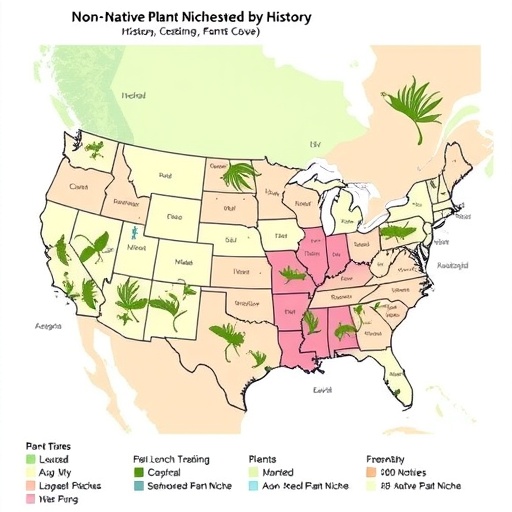
In an era where biological invasions rank among the most pressing ecological challenges, understanding how non-native plants establish and expand in new territories is crucial for managing biodiversity and ecosystem health. Recent research spearheaded by Rönnfeldt, Holle, Schifferle, and colleagues, soon to be published in Nature Communications, delves deeply into the enigmatic concept of climatic niche conservatism among introduced plant species. Their findings illuminate how the interplay of introduction history and biogeographic context can radically shape the climatic preferences and adaptability of non-native flora, offering a nuanced lens through which to predict and mitigate invasion risks.
Climatic niche conservatism refers to the tendency of species to retain their ancestral climatic preferences even after relocating to novel environments. This phenomenon holds substantial implications for invasion biology, as it influences the potential range expansions and establishment success of non-indigenous species. Historically, debates have raged about whether exotic species maintain these conservative climatic profiles or rapidly adapt to new conditions, thereby complicating management strategies. The current study situates itself at this scientific crossroads by integrating extensive species occurrence records with sophisticated ecological niche modeling, thereby dissecting the ecological and evolutionary dynamics that govern climatic niche shifts or stability in non-native plants.
The authors embarked on a comprehensive meta-analysis by compiling occurrence data across multiple continents for a diverse assemblage of non-native plant species. This large-scale dataset was pivotal in assessing whether these species exhibited climatic niche conservatism in the invaded ranges and how the introduction history—comprising the timing, number of events, and source regions—interacted with the original biogeographic context to influence this pattern. Employing state-of-the-art statistical modeling and niche overlap metrics, the researchers were able to quantify the degree of niche conservatism with unprecedented precision.
One of the seminal discoveries of this study is the nuanced role of introduction history. Species introduced multiple times or from varied source regions displayed a marked tendency to broaden or shift their climatic niches. This suggests that repeated introductions, potentially accompanied by admixture and hybrid vigor, could facilitate exploration of novel climatic conditions, thereby challenging the traditional view of strict climatic niche conservatism. Conversely, single introduction events from homogenous source populations tended to preserve the ancestral climatic niche, which may limit their invasive capacity or restrict them to environments similar to their native ranges.
But introduction history is only part of the story. The biogeographic context, encompassing the climatic diversity and ecological conditions of both the source and recipient regions, emerged as a critical modulator of niche dynamics. Plants originating from climatically diverse native ranges tended to exhibit greater plasticity or shifts in their invaded ranges, likely owing to pre-existing adaptation to variable conditions. Similarly, recipient regions with climates that overlap broadly with the species’ native niches showed a stronger signal of niche conservatism, highlighting how environmental congruence can dictate invasion trajectories.
The study also scrutinized the temporal dimension of introductions, highlighting that older introductions were more likely to present niche shifts or expansions. This temporal effect likely reflects evolutionary processes such as local adaptation or genetic assimilation occurring over multiple generations, enabling non-native plants to exploit climates that differ from their original ranges. Such insights contribute to a growing recognition that invasions are dynamic processes where both ecological stasis and evolutionary change are at play.
A critical methodological advancement underpinning this work was the application of finely resolved climatic datasets coupled with extensive herbarium and citizen science records, enabling robust niche characterization at global scales. This approach allowed the authors to circumvent previous limitations associated with coarse data resolution or geographically biased sampling, thereby increasing the generalizability and reliability of their conclusions. Moreover, integrating phylogenetic information provided an evolutionary context that enriched interpretations about the conservatism of climatic niches.
These findings carry profound implications for biodiversity conservation and invasive species management. By revealing the contingencies under which non-native plants maintain or shift their climatic niches, resource managers can better anticipate which species pose significant invasion risks under current and future climate scenarios. Specifically, species with introduction histories that favor niche shifts and those originating from climatically variable native ranges may require heightened surveillance and proactive containment strategies due to their capacity to colonize a broader spectrum of environments.
Importantly, this research underscores the necessity of considering historical and biogeographic contingencies when developing predictive models for biological invasions. Traditional models often assume static niches, but this work reveals that nuances in introduction pathways and ecological context can lead to either remarkable niche fidelity or unexpected expansions. Such revelations advocate for more refined, data-rich models that can integrate these complexities, ultimately enhancing the accuracy of invasion forecasts.
The concept of climatic niche conservatism also intersects with the broader discourse on species’ responses to climate change. The capacity for niche shifts in non-native plants may mirror potential plasticity or evolutionary adaptability in native species confronting rapid climatic shifts. Hence, insights gleaned from this study not only inform invasion biology but also contribute to understanding ecological resilience and adaptation in a changing world.
In the context of global environmental policy, this study provides actionable intelligence by identifying key predictors of niche conservatism and shift in non-native plants. Policymakers and stakeholders can leverage this knowledge to prioritize surveillance of introductions that are likely to result in niche shifts, and to allocate resources for interventions in high-risk biogeographic zones. Such targeted approaches promise to curtail the ecological and economic damage wrought by invasive species while fostering more sustainable management practices.
The authors further anticipate that future research will expand upon these findings by incorporating genomic data to unravel the genetic underpinnings of climatic niche dynamics. Investigating how gene flow, hybridization, and genetic adaptation contribute mechanistically to niche conservatism or shifts will deepen our comprehension of invasion biology and may reveal novel targets for biological control or restoration efforts.
Beyond practical applications, this study exemplifies the power of interdisciplinary collaboration, synthesizing ecological theory, biogeography, evolutionary biology, and advanced computational methods. Such integrative science is vital for tackling complex environmental challenges and represents a model for future endeavors in biodiversity research.
As climate change continues to alter habitats and disturb ecological equilibriums, the patterns elucidated in this study will become increasingly relevant. Understanding how non-native plants may either cling to their ancestral climatic envelopes or dynamically readjust to new climates will inform projections of ecosystem transformations and guide adaptive management under uncertainty.
In summation, Rönnfeldt and colleagues have delivered a landmark contribution to invasion ecology by demystifying the factors that govern climatic niche conservatism in non-native plants. Their meticulous analysis reveals that introduction history and biogeographic context collaboratively dictate whether these species remain niche-conservative or embark on climatic niche expansions—a revelation poised to reshape how scientists and managers approach plant invasions in an era marked by global change.
Subject of Research: Climatic niche conservatism and niche dynamics in non-native plant species influenced by introduction history and biogeographic context.
Article Title: Climatic niche conservatism in non-native plants depends on introduction history and biogeographic context.
Article References:
Rönnfeldt, A., Holle, V., Schifferle, K. et al. Climatic niche conservatism in non-native plants depends on introduction history and biogeographic context. Nat Commun (2026). https://doi.org/10.1038/s41467-025-68023-6
Image Credits: AI Generated


