

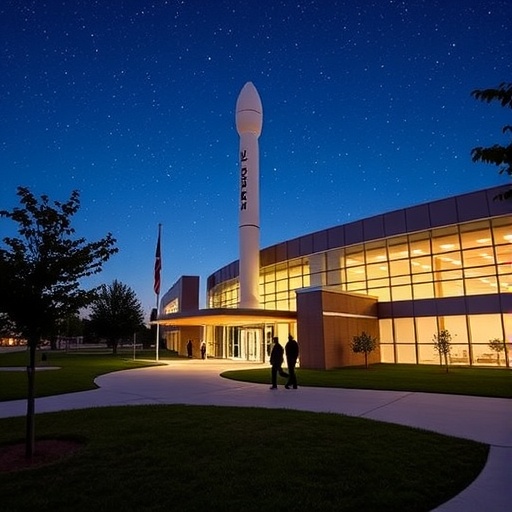
The University of Texas at Arlington (UTA) has long held a prestigious position in the domain of space physics education and research, establishing a foundation that merges rigorous scientific inquiry with advanced technological applications. In 2024, this commitment has been significantly bolstered through the creation of the Center for Space Physics and Data Science, a multidisciplinary initiative aimed at propelling UTA into the forefront of space science research and workforce development. This newly launched center is supported by a $1.5 million grant from the National Science Foundation (NSF), specifically awarded under the Faculty Development in GeoSpace Science program, emphasizing the university’s strategic focus on integrating space physics with cutting-edge data science methodologies.
The Center for Space Physics and Data Science exemplifies a visionary approach to academic and scientific advancement by not only consolidating current research strengths but also expanding educational offerings that align with the evolving demands of the aerospace sector. Its mission goes beyond traditional space physics to cultivate interdisciplinary expertise among students and faculty, leveraging collaborations with high-profile funding sources such as NASA, the NSF, and the United States Air Force. The center aims to nurture a new generation of experts proficient in space environment simulation, spacecraft instrumentation, astrophysics, and computational data analysis, thereby equipping them to handle complex challenges presented by the rapidly growing space industry.
Helming this ambitious endeavor are distinguished faculty members whose research portfolios intersect the domains of physics, aerospace engineering, and data science. Led by Professor Yue Deng, an established authority in space physics and the principal investigator on the NSF grant, the center benefits from the expertise of Ramon Lopez, associate director for education, and Anton Artemyev, associate director for research. Together, they oversee a consortium of core and affiliate faculty members who contribute a diverse range of scientific specializations, from space plasma physics to mechanical and aerospace engineering, enriching the center’s breadth and depth.
One of the key strengths of the center lies in its integrated curriculum, which is designed to produce graduates adept at navigating the intricate landscape of space physics and its technological counterparts. UTA now offers a dedicated bachelor’s degree in space physics and data science, complemented by a fast-track master’s degree option for students seeking advanced training. These programs are meticulously structured to encompass coursework on spacecraft and launch systems engineering, space environment dynamics, and interdisciplinary training in computational science, policy implications, and data analytics. Such comprehensive education ensures adaptability and technical proficiency, making graduates highly competitive in the space technology and research sectors.
The center’s multifaceted academic agenda is reflective of the complex nature of space exploration and the associated technical challenges. For instance, students engage with sophisticated space simulation models that replicate magnetospheric physics and heliospheric interactions using high-performance computing frameworks. This exposure provides critical insights into the behavior of charged particles, solar wind interactions, and geomagnetic phenomena, all central to mission planning and satellite operation. Moreover, the focus on space instrumentation introduces learners to the design and deployment of cutting-edge sensors and telemetry systems that collect vital data from orbital and deep-space platforms.
Another integral aspect of this initiative is its emphasis on data science as a transformative tool within space physics research. By fusing traditional physical science with advanced information science techniques such as machine learning and big data analytics, the center is pioneering novel methodologies to process and interpret vast datasets obtained from space missions. This methodological synergy not only enhances the accuracy of space weather forecasting but also optimizes the performance of spacecraft systems subject to turbulent space environments, delivering practical benefits to both scientific understanding and operational safety.
The strategic location of UTA in Texas—a state increasingly recognized as a hub for the aerospace industry—further amplifies the center’s potential impact. Texas hosts numerous space enterprises and government facilities, fostering a conducive environment for internships, research partnerships, and technology transfers. The center’s graduates are thus well positioned to enter a robust labor market characterized by imminent growth in commercial space endeavors, satellite technology development, and national security applications. The center’s initiatives align seamlessly with regional economic priorities, contributing both to workforce readiness and technological innovation.
UTA’s faculty affiliations reflect a multidisciplinary collaboration that extends beyond the confines of traditional physics departments. In addition to core faculty from the Department of Physics, experts from the Department of Mechanical and Aerospace Engineering are integral to the center’s research agenda, facilitating advancements in spacecraft design and propulsion systems. The partnership with seasoned professionals such as Levent Gurdemir, director of the UTA Planetarium, enriches public engagement and educational outreach efforts, fostering a culture of scientific curiosity and literacy that complements rigorous academic training.
Furthermore, the center has cultivated strategic affiliations with other academic and research entities, including the University of Texas at Dallas and the Southwest Research Institute in San Antonio. These collaborations enhance the center’s research capabilities and broaden the scope of scientific inquiry, allowing access to sophisticated laboratory facilities, joint grant applications, and interdisciplinary project development. Such alliances signify a collective effort to consolidate Texas’ position as a national leader in space science research, leveraging regional expertise to achieve national and global impact.
Research funding sustains the center’s activity at a robust level, with affiliated faculty currently managing nearly $3 million annually sourced from NASA, NSF, and additional federal agencies. The center’s integration within NASA’s Heliophysics Science Center program further underlines its relevance in addressing the physical processes governing the space environment, particularly phenomena such as space weather—solar flares, geomagnetic storms, and their effects on Earth’s magnetosphere—that pose operational risks to satellites and ground infrastructure alike. This research serves as a cornerstone for understanding and mitigating space environment hazards.
In sum, the establishment of the University of Texas at Arlington’s Center for Space Physics and Data Science marks a pivotal moment in advancing space science education and applied research. It embodies a forward-thinking nexus where physics, aerospace engineering, and data science converge, addressing the intricate challenges of space exploration and technology development. The center offers a transformative academic environment, producing capable professionals who will contribute significantly to the scientific, technological, and economic dimensions of the burgeoning space industry in Texas and beyond.
Subject of Research: Space physics, astrophysics, space instrumentation, space weather, data science in space research
Article Title: Launch of the University of Texas at Arlington’s Center for Space Physics and Data Science Accelerates Leadership in Space Science
News Publication Date: 2024
Web References: University of Texas at Arlington News
Keywords: Space physics, space research, space technology, space weather, astronomy, astrophysics, aerospace engineering, data science, information processing, information science, data analysis


