

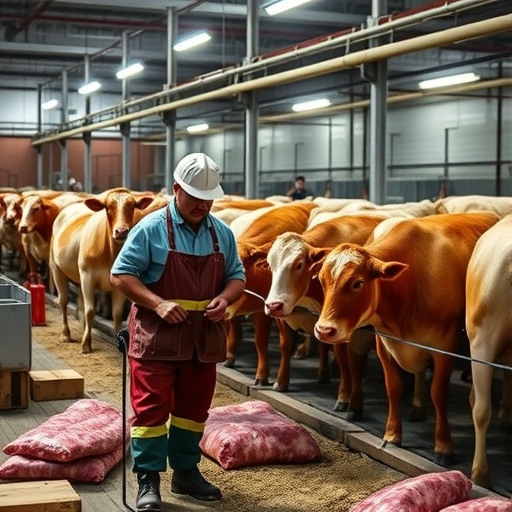
In the wake of the ongoing workers’ strike at one of the largest slaughterhouses in the United States, a recent survey conducted jointly by Morning Consult and the Physicians Committee, a nonprofit health advocacy organization, has revealed striking insights into public sentiment regarding labor rights, immigration enforcement, and the future of meat production. The strike, centered at a JBS facility located in Greeley, Colorado, highlights significant concerns among meatpacking workers related to pay and workplace safety, igniting a national conversation about labor rights in one of the most perilous industries.
The survey results underscore a robust public consensus on workers’ rights, with an overwhelming 71% of Americans affirming that meatpacking workers possess the fundamental right to strike in pursuit of improved pay and safer working conditions, as opposed to being compelled to continue production without interruption. This statistic reflects a vital acknowledgment of labor rights amid the challenges faced by those on the front lines of food production, particularly in industries notorious for hazardous working environments.
Another critical dimension explored in the survey pertains to the demographic breakdown of attitudes toward the potential transformation of traditional meat processing facilities. While Americans are largely divided—with 36% in support and 38% in opposition—there is a pronounced inclination among younger respondents, specifically Generation Z and Millennials, to endorse the conversion of slaughterhouses into facilities dedicated to the production of plant-based or cell-cultivated meat products. This generational divergence points to a broader cultural shift favoring sustainable and ethical alternatives within the food industry.
The economic rationale for this potential shift is compelling. According to financial analyses reported by the Wall Street Journal, major meatpacking corporations, including JBS—the world’s largest meatpacker—have experienced considerable financial losses in their conventional beef operations. Notably, JBS reported an adjusted operating loss of $617 million in its beef sector over the past year, a stark increase from the $37 million loss recorded the previous year. This financial pressure may incentivize an accelerated pivot toward more profitable and environmentally sound alternatives such as plant-based proteins.
A crucial social aspect illuminated by the survey involves the status of migrant workers within the meatpacking industry. Many of the striking workers are migrants, with a notable portion being undocumented. The visibility of these workers on the picket lines has raised concerns about the possibility of immigration enforcement agencies conducting targeted raids. However, the survey reveals that a substantial majority—61% of Americans—believe it would be unjust to subject striking workers to immigration enforcement actions as a consequence of their labor activism. This finding highlights a widespread public empathy towards vulnerable workers striving for improved conditions.
The survey also delves into public perceptions regarding legal ramifications associated with labor strikes. Only 19% of respondents favor the imposition of legal consequences, such as immigration enforcement, against workers participating in strikes. Meanwhile, 61% oppose such measures, and 20% remain uncertain. This prevailing sentiment affirms a recognition of labor strikes as a legitimate exercise of workers’ rights, rather than an activity warranting punitive actions.
Experts within the Physicians Committee for Responsible Medicine emphasize the intrinsic danger associated with meatpacking, describing it as one of the most hazardous occupations in the United States. Xavier Toledo, a registered dietitian affiliated with the organization, underscores the public’s empathy toward striking workers and connects the discourse to larger systemic issues within the food production sector. He articulates that a transition toward the manufacture of plant-based or cell-cultivated meat products could result in significantly safer and cleaner working environments.
The survey’s implications are multifaceted, touching on occupational health, ethical consumption, economic sustainability, and immigration policy. It challenges stakeholders—industrial leaders, policymakers, and consumers alike—to rethink the paradigms governing meat production. The intersection of worker safety and environmental considerations creates a compelling argument for a paradigm shift in how protein is generated and processed at scale.
Consumers’ growing support for sustainable alternatives, particularly among younger generations, signals a potentially transformative movement in food production practices. Coupled with the economic urgency prompted by increasing losses in conventional beef production, the momentum toward plant-based and cell-cultivated proteins appears to be gaining traction not merely as a niche market but as a viable industrial strategy.
The survey outcomes also serve as a clarion call for enhanced protections for vulnerable migrant workers who constitute a critical labor force within meatpacking plants. The widespread opposition to immigration enforcement actions against striking workers suggests a societal acknowledgment that labor rights should not be undermined by immigration status, thereby urging humane and equitable treatment.
From a public health perspective, the transition to plant-based protein production may yield benefits beyond worker safety, potentially reducing zoonotic disease risks and environmental degradation associated with traditional livestock farming. The Physicians Committee’s advocacy thus aligns labor rights with broader goals of preventive medicine and sustainable food systems.
In conclusion, the comprehensive survey by Morning Consult and the Physicians Committee reveals a significant shift in American public opinion favoring workers’ rights to strike and a cautious but growing endorsement for the transformation of meat production facilities toward plant-based outputs. These findings reflect evolving societal values that prioritize worker safety, economic pragmatism, and environmental stewardship, indicating a pivotal moment for the future of food production in the United States.
Subject of Research: People
Article Title: Public Opinion Supports Meatpacking Workers’ Strike Rights and Endorses Plant-Based Protein Transition Amid Industry Struggles
News Publication Date: Not specified
Web References: Not provided
References: Wall Street Journal report on JBS financial losses
Image Credits: None provided
Keywords: Meatpacking strike, labor rights, JBS slaughterhouse, plant-based protein, cell-cultivated meat, migrant workers, immigration enforcement, workplace safety, economic losses, sustainable food production, public opinion survey, Physicians Committee for Responsible Medicine


