

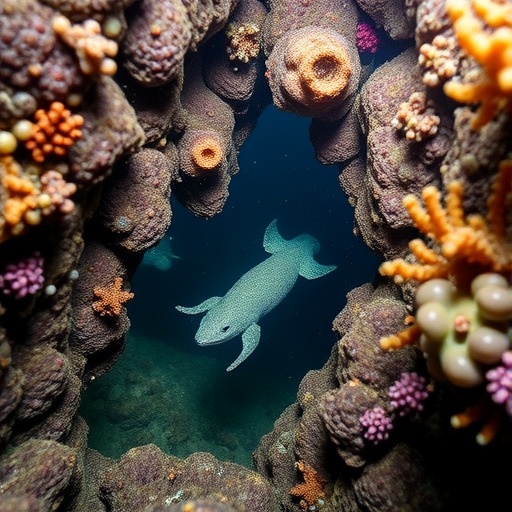
In a groundbreaking exploration that pushes the boundaries of human knowledge about the deepest parts of our oceans, a recent comprehensive study has unveiled remarkable insights into the life forms inhabiting the abyssal and hadal zones of the Japan, Ryukyu, and Izu-Ogasawara trenches in the Northwest Pacific. This unprecedented research, published in the Biodiversity Data Journal, has cataloged over one hundred distinct morphotaxa—significantly expanding our understanding of biodiversity nearly 10 kilometers beneath the ocean’s surface.
The expedition utilized the dual technological prowess of crewed submersible transects and free-fall baited landers during a two-month voyage aboard the DSSV Pressure Drop in 2022. This innovative approach enabled researchers to observe seafloor-associated animals in their natural benthic habitats visually, while simultaneously capturing elusive bait-attending species such as deep-sea fishes and decapods. This method circumvents the destructive nature of traditional trawling, allowing scientists to witness authentic behavioral patterns often lost in conventional sampling.
One of the crowning achievements of the study was the observation of a mysterious organism, temporarily classified as Animalia incerta sedis. This enigmatic creature, filmed twice at depths exceeding 9,000 meters, defies current taxonomic categorization despite extensive reviews by global experts. Its slow glide and morphological features bear faint resemblance to nudibranchs and sea cucumbers, yet it remains an extraordinary puzzle in marine biology, hinting at the limitations of our existing classification systems in the hadal realm.
Exploration via the submersible also uncovered vast “crinoid meadows” at the base of the Boso triple junction. Here, over 1,500 stalked crinoids carpeted rugged rock terraces, presenting a stunning vista of deep-sea biodiversity rarely documented at such depths. These biological aggregations illustrate complex benthic ecosystems reliant on interactions with their physical environment, including geological structures and nutrient fluxes, underscoring the ecological richness and intricacy of trench habitats.
At depths between 9,568 and 9,744 meters in the Izu-Ogasawara Trench, another record was set by the identification of carnivorous sponges from the Cladorhizidae family. These specialized predatory sponges, previously noted at shallower depths, were recorded here at unprecedented levels within the hadal zone. The presence of such organisms challenges previous assumptions about species distributions and adaptive strategies in extreme deep-sea environments highly characterized by pressure, low temperature, and limited food resources.
On the other hand, the free-fall baited landers documented an extraordinary biological feat: the deepest in-situ observation of a fish, identified as a species of Pseudoliparis snailfish, actively feeding at a staggering depth of 8,336 meters. This milestone not only revises the known vertical range of vertebrate life but also provides critical behavioral data on how vertebrates survive pressures and environmental conditions nearly a kilometer deeper than many earlier fish observations.
Additionally, these landers revealed the widespread presence of Alicella gigantea, the so-called “supergiant” scavenging amphipod, across all surveyed trenches. Organisms such as Alicella gigantea play vital roles in deep-sea nutrient recycling and ecosystem functioning, their discovery across a vast geographic range emphasizing the complex trophic dynamics operating within these deep-oceanic trenches.
The study revealed significant regional differences in species diversity and composition. The Japan Trench displayed the highest diversity of observed morphotaxa among the three, highlighting how local geological activity, depth variations, and surface water productivity collectively influence benthic community structure. These findings contribute to ongoing discussions about biogeographical partitioning and evolutionary adaptation in subduction zone ecosystems.
Crucially, the research also detected human impacts at unprecedented depths—various forms of anthropogenic debris were observed within the trenches, likely transported downhill by sedimentary and downslope processes. This sobering evidence challenges the conventional view of deep trenches as untouched sanctuaries and brings forward urgent questions about pollution and ecosystem vulnerability at the very bottom of the ocean.
The implications of this research extend beyond mere species cataloging. It underscores the necessity for non-destructive, imagery-based approaches in deep-sea biodiversity studies to preserve delicate ecosystems and capture behavioral complexities. Traditional trawl-based methods, while instrumental historically, often compromise fragile fauna and cannot replicate the in situ environmental context—a gap now addressed through advanced visual technologies.
By producing an extensive illustrated compendium of abyssal and hadal ecosystems in the Northwest Pacific, the research establishes a foundational framework for future exploration. Such datasets are invaluable for monitoring biodiversity changes, understanding ecological processes in subduction zones, and informing conservation efforts focused on these least-understood environments on Earth.
Ultimately, this body of work highlights the deep ocean’s role as one of Earth’s final frontiers—richly diverse, ecologically complex, and critically important for global biodiversity. As the team concludes, these explorations offer not only discovery but also a crucial foundation for confronting the challenges and mysteries that lie miles beneath the surface, propelling marine science into a bold new era of deep ocean research.
Subject of Research: Biodiversity and ecology of the abyssal and hadal zones in the Japan, Ryukyu, and Izu-Ogasawara trenches.
Article Title: Faunal biodiversity of the lower abyssal and hadal zones of the Japan, Ryukyu and Izu-Ogasawara trenches (NW Pacific Ocean; 4534-9775 m)
News Publication Date: March 3, 2026
Web References: Biodiversity Data Journal
References: Jamieson AJ, Swanborn DJB, Bond T, Cundy MC, Fujiwara Y, Lindsay D, Stott MS, Kitazato H (2026) Faunal biodiversity of the lower abyssal and hadal zones of the Japan, Ryukyu and Izu-Ogasawara trenches (NW Pacific Ocean; 4534-9775 m). Biodiversity Data Journal 14: e182172.
Image Credits: Minderoo-UWA Deep-Sea Research Centre, Inkfish and Caladan Oceanic
Keywords: Hadal Zone, Abyssal Depths, Deep-Sea Biodiversity, Japan Trench, Ryukyu Trench, Izu-Ogasawara Trench, Submarine Trenches, Deep-Sea Fauna, Snailfish, Carnivorous Sponges, Crinoid Meadows, Deep-Sea Exploration, Non-Destructive Sampling


