

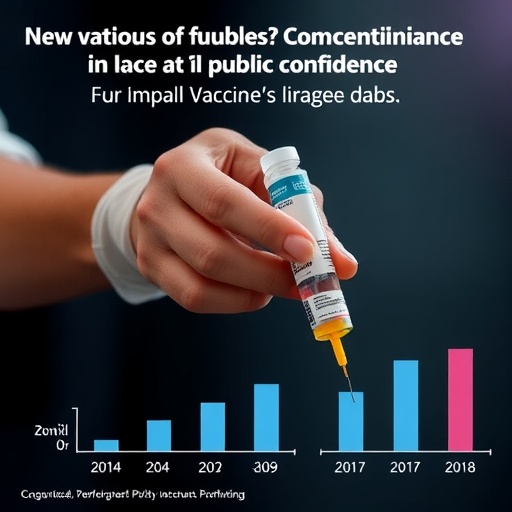
As the United States confronts a challenging winter season marked by a resurgence of influenza, ongoing Covid-19 infections, and an alarming spike in measles cases, a comprehensive survey conducted by the Annenberg Public Policy Center reveals nuanced public perceptions regarding vaccine safety. This study highlights that while a substantial majority of Americans continue to consider vaccines against these serious illnesses as safe, confidence in these immunizations has statistically declined over recent years, signaling a critical shift in public health sentiment.
Amid rising flu transmission rates, substantiated by the Centers for Disease Control and Prevention’s (CDC) surveillance data, emergency room visits by children over five years old have notably increased. This upsurge in healthcare utilization coincides with the highest measles case count seen in the United States since 1991, with over two thousand confirmed cases reported in 2025, primarily fueled by a persistent outbreak in South Carolina. Concurrently, Covid-19 incidence remains elevated in various regions, exacerbating the complexity of managing multiple infectious disease threats simultaneously.
The Annenberg Public Policy Center’s nationally representative panel survey, carried out from mid-November to early December 2025, gathered responses from 1,637 adults across the country. The survey’s results illuminate perceptions of safety surrounding three vaccines: the MMR (measles, mumps, and rubella), influenza, and Covid-19 vaccines. Analysis reveals that 83% regard the MMR vaccine as safe, 80% express safety confidence in the flu vaccine, and 65% perceive the Covid-19 vaccine as safe. These figures, albeit reflecting majority support, manifest a measurable erosion compared to past surveys.
A longitudinal comparison with data from November 2024 exposes a significant decline in perceived safety for both the MMR and influenza vaccines, dropping by three percentage points each. Interestingly, the perception of Covid-19 vaccine safety remained relatively stable in that interval. A broader temporal analysis stretching back to August 2022 uncovers a more pronounced depreciation across all three vaccines, with the MMR vaccine’s safety perception diminishing by five points, the flu vaccine by five points, and the Covid-19 vaccine by eight points. This trend signals an ongoing attenuation of public confidence over time.
These waning confidence levels emerge during a politically charged atmosphere, where contradictory federal health messages may undermine trust in vaccination programs. Notably, Dr. Mehmet Oz, current administrator of the Centers for Medicare and Medicaid Services, has vocalized support for measles vaccination amidst outbreaks, emphasizing the disease’s dangers and the vaccine’s critical role. Contrastingly, Robert F. Kennedy Jr., the Secretary of Health and Human Services since 2025 and a long-time vaccine skeptic, has propagated misleading narratives about vaccine safety, fueling public skepticism.
Kennedy’s tenure has been punctuated by contentious actions, including the controversial removal of all seventeen members of a vital CDC advisory committee responsible for vaccine recommendations. Such moves have drawn sharp criticism from medical experts, including former CDC director Tom Frieden, who warned that these changes risk eroding public trust under the pretense of reform. Kennedy has also made unfounded claims linking the measles vaccine to annual deaths and has publicly downplayed the risks of Covid-19 to children while overstating vaccine risks, according to thorough analyses by FactCheck.org.
Further complicating the vaccine landscape, the CDC shifted its childhood vaccination guidelines in early 2026, rescinding universal mandates for six vaccines—among them influenza and Covid-19 vaccines—thereby reducing the standard schedule from 17 to 11 vaccinations. These six are now recommended exclusively through “shared clinical decision-making,” a strategy that delegates the decision of vaccination to dialogues between healthcare providers and patients or guardians. This approach represents a significant departure from previous universal recommendations aimed at maximizing immunization coverage.
Medical professional organizations, including the American Medical Association (AMA), have expressed grave concerns regarding these modifications. The AMA cautions that altering vaccine schedules absent robust evidence-based processes jeopardizes public confidence in immunizations and potentially exposes children to avoidable infectious diseases. They reaffirm support for childhood immunizations endorsed by national specialty societies as critical for safeguarding public health.
The recurrent declines in vaccine safety perceptions raise questions about the broader influences shaping public opinion, including changing CDC directives and high-profile vaccine skepticism among federal health leaders. Continuous monitoring and research are imperative to understand these dynamics and address factors that might dampen vaccine acceptance amid ongoing disease threats.
The Annenberg survey underscores the persistent challenge of balancing scientific communication, public health policy, and societal trust. It serves as a timely reminder that even well-established vaccines like MMR, which underpin herd immunity thresholds crucial for disease control, face mounting public hesitancy that could jeopardize community protection.
The methodological rigor of the Annenberg Public Policy Center’s survey, undertaken by SSRS, an independent research organization, adds credibility to these findings. With a margin of error of ±3.5 percentage points and a representative sampling framework, the survey provides valuable insights that policymakers and health communicators must consider in strategizing vaccine advocacy and education.
In conclusion, while the majority of Americans maintain that vaccines for measles, influenza, and Covid-19 are safe, the documented declines in public confidence coincide with rising infectious disease cases and shifting federal health policies. These intertwined developments underscore the urgent need for clear, consistent messaging and evidence-based recommendations to uphold vaccine trust and protect public health in the United States.
Subject of Research: People
Article Title: Public Confidence in Vaccine Safety Faces Challenges Amid Rising Infectious Disease Cases and Shifting Policies
News Publication Date: February 2026
Web References:
- Annenberg Public Policy Center Vaccine Safety Survey: https://www.annenbergpublicpolicycenter.org/wp-content/uploads/aw26-do12b-topline-safe.pdf
- CDC FluView Surveillance: https://www.cdc.gov/fluview/surveillance/usmap.html
- FactCheck.org Analyses on Vaccine Claims: https://www.factcheck.org/
References: - Annenberg Public Policy Center reports and FactCheck.org evaluations of public vaccine perceptions and health policy impacts
Image Credits: Annenberg Public Policy Center
Keywords: Vaccination, COVID-19 vaccines, Flu vaccines, Attenuated vaccines, mRNA vaccines, Science communication, Infectious diseases, Public policy, Public health, Family medicine


