

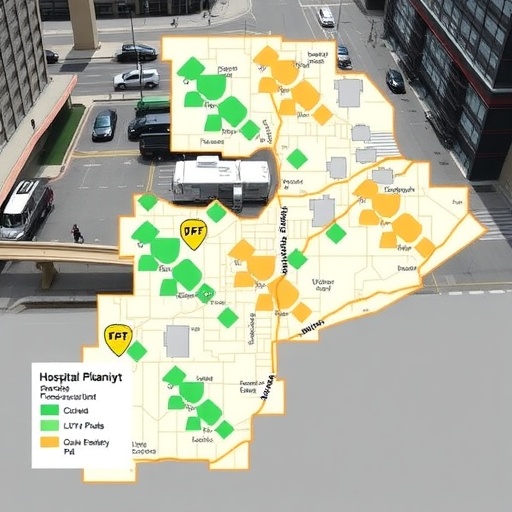
As climate change intensifies, the frequency and severity of extreme weather events like flooding are mounting pressures on critical infrastructure worldwide. Nowhere is this more pressing than in healthcare systems, where resilient access to hospitals and medical supplies during such disasters is paramount. A groundbreaking study led by Dr. Seth Bryant of the GFZ Helmholtz Centre for Geosciences in Germany has uncovered a largely overlooked threat: flood-induced disruptions to transportation networks that can severely diminish hospital accessibility, even for facilities not directly impacted by floodwaters themselves.
The research, recently published in Communications Earth & Environment, integrates cutting-edge flood modeling with sophisticated transportation simulations to reveal hidden vulnerabilities within Germany’s healthcare infrastructure. Traditionally, flood risk assessments have focused on direct inundation impacts, identifying where water rises and damages terrain or structures. However, the link between flooding and its cascading effects on road networks and emergency transport routes has received limited scrutiny. Dr. Bryant’s team has bridged this gap by coupling the GFZ Regional Flood Model with a gravity-based traffic framework capable of simulating nationwide detours, congestion, and rerouted patient flows more realistically than ever before.
Germany’s complex river basins were divided into seven principal catchment areas for detailed analysis. By downscaling flood data to street-level resolution—in some cases as precise as five meters—the team could assess how rising waters impede specific roads, triggering chain reactions in transportation accessibility. Overlaying this with population and hospital data, the model predicts how patient demand might surge at facilities that remain physically dry but become overwhelmed due to redirected patient inflows from inaccessible flood-affected zones. The results are alarming: 75 hospitals across Germany face potential patient overflow exceeding 30 percent under severe flood scenarios modeled.
Equally concerning is how one-third of these vulnerable hospitals lie more than ten kilometers from any predicted flood zone. This means many critical healthcare providers may be blindsided by indirect disruptions their emergency plans do not account for. The impact is not merely theoretical but poses tangible risks for increased morbidity and mortality during extreme weather events. For example, intensive care units may be inundated with overflow patients, while crucial supplies and ambulance services experience delays due to road closures and traffic congestion.
Among these hospitals, 29 stand out as particularly imperiled—they are projected to encounter patient demand surges of over 50 percent simply due to flood-induced transport network failure. There are nine hospitals under the most severe strain, with patient loads increasing by 85 to 400 percent in simulations. These extreme bottlenecks highlight systemic vulnerabilities not traditionally recognized in flood resilience or healthcare contingency planning.
The study’s innovative approach combines two powerful methodologies. The GFZ Regional Flood Model, a mature system refined over a decade, provides detailed hydrological forecasts of flood spread. This output is then processed through a novel computational algorithm that refines the data’s spatial resolution. In parallel, the traffic simulation employs open-source demographic and transportation datasets within a gravity-model framework—a technique based on the principle that traffic flows gravitate toward larger population centers. This dual-link modeling permits the simulation of realistic rerouting and congestion, enabling the visualization of how flood-affected infrastructure fractures induce downstream effects on hospital catchment areas.
Beyond Germany’s borders, the analysis further underscores risks to cross-border infrastructure with neighboring countries’ health services also subject to strain under flood-induced transport failures. This emphasizes the critical need for coordinated multinational disaster management strategies that leverage shared resources and communication channels to mitigate transboundary health crises effectively.
The broader implication is a paradigm shift in how disaster resilience must be conceptualized. Hospitals cannot be considered safe simply because they lie outside floodplains if the road networks feeding them are vulnerable. Dr. Bryant stresses that preparedness must embrace system-wide resilience thinking—planning not only for direct flood impacts but also for the hidden ripple effects that transportation failures spawn.
To facilitate practical adoption of their findings, the researchers have created interactive maps and decision-support tools, granting healthcare planners, emergency managers, and policymakers clear insights into vulnerable infrastructure nodes and priority mitigation actions. These tools can guide strategic strengthening of transport corridors, pre-planned detour routes, and emergency supply chains to safeguard uninterrupted access to lifesaving care during floods.
Looking ahead, the research group aims to advance their framework by extending it across the European Union, adapting models for broader geographies and scenarios. Planned enhancements include integrating machine learning techniques to refine their downscaling algorithms further, improving the precision and scalability of flood and traffic simulations. This evolution will empower more comprehensive risk assessments and resilience planning across diverse climatic and infrastructural landscapes.
This pioneering research arrives as a critical wake-up call for not only Germany but all nations confronting increasing climate volatility. Its revelations underscore the intricate interdependencies between climate hazards, infrastructure systems, and public health outcomes. By unveiling these hidden vulnerabilities, Dr. Bryant and colleagues offer a powerful toolset to move beyond reactive disaster response toward strategic, anticipatory resilience readiness that can save lives and protect communities.
In summary, the increasing threat of climate-driven flooding demands that health infrastructure resilience planning evolve to incorporate indirect disruptions affecting transportation access. Germany’s example demonstrates how integrating hydrological and traffic flow modeling at high spatial resolution can reveal hidden healthcare vulnerabilities and provide actionable intelligence for emergency preparedness. As climate impacts intensify globally, such innovative, system-level risk assessments will be essential in safeguarding critical services and ensuring robust healthcare delivery when disaster strikes.
Subject of Research: Not applicable
Article Title: Unveiling hidden risks in healthcare from flood-induced transportation disruption in Germany.
News Publication Date: 19-Aug-2025
References: Wassmer et al. (2025) Communications Earth & Environment 6, 676.
Image Credits: CCBY 4.0 Fig. 1 from Wassmer et al. (2025) Communications Earth & Environment.


