

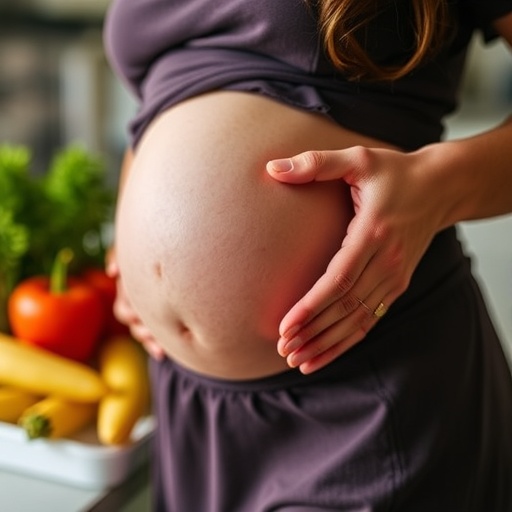
Listeria monocytogenes stands as a formidable public health challenge, especially among vulnerable populations such as pregnant individuals. As the third-leading cause of death linked to bacterial foodborne pathogens in the United States, Listeria claims a particularly severe toll during pregnancy. Despite this, prevailing food safety policies have generally relied on models that do not account for the unique physiological susceptibilities of pregnant people, leading to potential underestimations of risk for this group. A groundbreaking study, soon to be published in the journal Risk Analysis, seeks to remedy this gap by developing biologically informed, dose-response models tailored specifically to pregnant hosts.
Each year, approximately 1,250 listeriosis cases are documented across the U.S., with an alarming hospitalization rate of 86 percent and a fatality rate hovering around 14 percent. Pregnancy-associated listeriosis cases constitute about 14 percent of the total, yet these instances bear a disproportionate human cost. When L. monocytogenes crosses the placental barrier to infect the fetus, it precipitates stillbirth in roughly one-quarter of those infections. A significant clinical challenge with listeriosis during pregnancy is the often asymptomatic or mild presentation in expectant mothers, characterized by flu-like symptoms or no symptoms at all, allowing the pathogen to progress unnoticed. Recent outbreaks linked to contaminated ice cream, queso fresco, and enoki mushrooms have tragically resulted in multiple stillbirths within a narrow timeframe, underscoring the urgency of refined risk assessment.
Addressing the deficiency in population-specific risk modeling, researchers from Michigan State University—Tyler Stump, Carly Gomez, Ph.D., and Jade Mitchell, Ph.D.—have conducted a comprehensive analysis of animal model data. They focused on guinea pigs and gerbils, species that share critical biological and immunological traits with humans when it comes to Listeria pathogenesis. These data facilitated the construction of two novel dose-response models: one predicting maternal infection risk, and another estimating the likelihood of stillbirth following exposure. This approach marks a methodological advance by incorporating relevant host biology rather than extrapolating from generalized or immunocompromised populations.
A pivotal insight from this research is the identification of fetal brain infection as a highly precise and consistent sentinel indicator for stillbirth risk. Unlike direct measurement of stillbirth outcomes, which can be influenced by numerous confounding factors, the presence of Listeria in fetal brain tissue was found to perfectly correlate with stillbirth events in observed animal studies. In other words, every stillbirth was accompanied by fetal brain infection, and none of the non-stillbirth cases showed involvement of the fetal brain. This surrogate endpoint thus allowed the researchers to refine their statistical models significantly, enhancing predictive accuracy and biological plausibility.
By integrating fetal brain infection data with other stillbirth-related datasets, the team was able to generate a superior dose-response model compared to earlier versions. This enhanced model better fits empirical observations and offers a statistically robust framework for quantifying risks posed by varying levels of ingesting Listeria-contaminated foods. The implications are far-reaching, potentially informing not only regulatory standards but also clinical advisories tailored to the unique vulnerabilities of pregnant populations.
Dr. Jade Mitchell, a professor in Michigan State University’s Department of Biosystems and Agricultural Engineering, emphasized the importance of population-specific modeling in risk assessment. “Public health agencies should ground food safety guidance in models that reflect the biological and immunological nuances of pregnant individuals,” Mitchell argued. This stance challenges the conventional practice of applying generalized risk models across diverse populations, advocating instead for analytical frameworks that acknowledge differential susceptibility.
The study’s findings prompt a reevaluation of how food safety policies are devised to protect sensitive groups. The physiological and behavioral changes during pregnancy—ranging from immune system modulation to altered dietary patterns—are complex and multifaceted. These unique factors render generic immunocompromised population models inadequate for capturing the true risk landscape in pregnant individuals exposed to Listeria.
Complementing this scientific advancement, existing recommendations from the U.S. Food and Drug Administration (FDA) counsel pregnant people to avoid consumption of high-risk foods such as unpasteurized cheeses, raw sprouts, deli meats, hot dogs, and smoked seafood unless these products are thoroughly heated. This advice stems from Listeria’s unusual capability among foodborne pathogens: it can proliferate even under refrigeration, a trait that upends conventional assumptions about safe food storage. Moreover, symptoms of listeriosis—including fever, muscle aches, nausea, and diarrhea—may manifest anywhere from a day to several weeks post-exposure, complicating timely diagnosis and intervention.
The new dose-response models developed by the Michigan State team integrate detailed biological data and improve estimation of both maternal infection risk and fetal outcomes. They offer a refined quantitative toolset with the potential to be deployed by public health policymakers, regulatory agencies, and food safety professionals to formulate evidence-based measures. In the context of ongoing outbreaks and the persistent presence of Listeria in food supply chains, such advancements could substantially enhance preventive strategies, mitigating morbidity and mortality among pregnant people.
Furthermore, this research exemplifies the broader scientific imperative to tailor epidemiological modeling approaches to specific populations characterized by heightened susceptibility. Infections during pregnancy not only affect maternal health but have transgenerational consequences, underscoring the critical need for precision in understanding pathogen risks. By illuminating the mechanism and risk thresholds for placental and fetal infection, this study lays the groundwork for targeted interventions and improved surveillance protocols.
The collaborative effort of microbiology, toxicology, epidemiology, and risk analysis embodied in this study underscores the multidisciplinary nature required to confront complex public health threats. As Listeria continues to pose a hazard through a variety of contaminated foods, advanced modeling that integrates host-pathogen dynamics and population-specific variables paves a new path forward. Future research might expand on these models by incorporating human clinical data and exploring interventions to interrupt key pathways in Listeria’s vertical transmission during pregnancy.
In summary, the enhanced dose-response models for Listeria presented by the Michigan State University researchers mark a significant step towards precision public health. These models incorporate biologically plausible parameters derived from animal studies to better predict maternal infection and adverse fetal outcomes such as stillbirth. By centering pregnant individuals in risk assessment, the research challenges existing paradigms and advocates for more nuanced, scientifically grounded food safety policies that could ultimately prevent tragic pregnancy losses associated with listeriosis.
Subject of Research: Development of dose-response models for Listeria monocytogenes focusing on pregnancy-associated infection and stillbirth risk.
Article Title: Development of dose-response models for the ingestion exposure route and stillbirth outcome for Listeria monocytogenes
News Publication Date: March 17, 2026
Web References:
– https://www.cdc.gov/listeria/risk-factors/index.html#:~:text=Older%20adults,adults%20with%20this%20infection%20die.
– https://www.fda.gov/food/health-educators/listeria-food-safety-moms-be
Keywords: Listeria monocytogenes, listeriosis, pregnancy, dose-response models, stillbirth, maternal infection, food safety, fetal brain infection, risk assessment, public health, foodborne pathogens, FDA guidance


