
Saturday, February 28, 2026
Science
No Result
View All Result
  • Login
  • HOME
  • SCIENCE NEWS
  • CONTACT US
  • HOME
  • SCIENCE NEWS
  • CONTACT US
No Result
View All Result
Scienmag
No Result
View All Result
Home Science News Mathematics

New sensor technology enhances detection of tiny particles

August 27, 2024
in Mathematics
Reading Time: 3 mins read
0
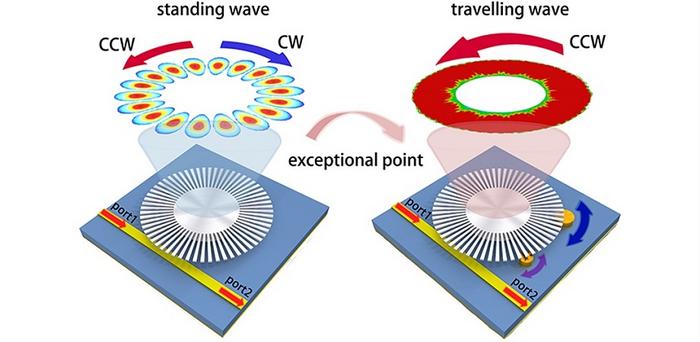
The tunable and reconfigurable EP sensing system operates on a single plasmonic resonator.
67
SHARES
609
VIEWS
Share on FacebookShare on Twitter
ADVERTISEMENT

In recent years, advances in photonics and materials science have led to remarkable developments in sensor technology, pushing the boundaries of what can be detected and measured. Among these innovations, non-Hermitian physics has emerged as a crucial area of research, offering new ways to manipulate light and enhance sensor sensitivity. A recent study published in Advanced Photonics Nexus reports a breakthrough in this field, presenting a new type of sensor that leverages exceptional points (EPs) to achieve unprecedented levels of sensitivity.

The tunable and reconfigurable EP sensing system operates on a single plasmonic resonator.

Credit: Y. Zhang, H. Hu, et al., doi 10.1117/1.APN.3.5.056004.

In recent years, advances in photonics and materials science have led to remarkable developments in sensor technology, pushing the boundaries of what can be detected and measured. Among these innovations, non-Hermitian physics has emerged as a crucial area of research, offering new ways to manipulate light and enhance sensor sensitivity. A recent study published in Advanced Photonics Nexus reports a breakthrough in this field, presenting a new type of sensor that leverages exceptional points (EPs) to achieve unprecedented levels of sensitivity.

This study introduces a highly sensitive and reconfigurable sensor based on a single spoof localized surface plasmon (LSP) resonator. Exceptional points are unique spectral singularities where eigenvalues and their corresponding eigenvectors converge, significantly boosting the sensitivity of optical sensors. Traditional EP-based sensors, such as whispering gallery mode (WGM) microtoroids, have demonstrated enhanced sensitivity compared to conventional sensors. However, these sensors face limitations: their EPs are fixed after fabrication, which makes precise adjustments challenging, and they often operate within a narrow frequency range, struggling to detect very small particles due to constraints in perturbation strength and excitation efficiency.

The novel sensor design addresses these issues by incorporating spoof LSP resonators, which simulate the behavior of localized surface plasmons and offer greater flexibility. Suspended above a microstrip line and paired with two movable Rayleigh scatterers, this setup allows for dynamic reconfiguration of EP states across a wide frequency range. This adaptability makes the sensor more robust to fabrication imperfections and enhances its capability to detect extremely small particles.

Key features of the new sensor include:

Reconfigurability: Adjustable Rayleigh scatterers enable dynamic formation and reconfiguration of EPs, improving the sensor’s precision and flexibility.

Enhanced perturbation strength: Confining electromagnetic fields to the resonator’s surface significantly increases sensitivity to perturbations from surrounding particles.

Multipolar mode excitation: The design supports various plasmonic resonance modes, expanding the sensor’s operational bandwidth and detection range.

This advancement represents a significant leap forward in sensor technology, offering exceptional sensitivity for detecting particles as small as 0.001 times the wavelength of light and opening new possibilities for applications in scientific research and industry.

Read the original Gold Open Access article by Y. Zhang, H. Hu, et al., “Reconfigurable exceptional point- based sensing with 0.001λ sensitivity using spoof localized surface plasmons,” Adv. Photon. Nexus 3(5) 056004 (2024), doi 10.1117/1.APN.3.5.056004.


Journal

Advanced Photonics Nexus

DOI

10.1117/1.APN.3.5.056004

Article Title

Reconfigurable exceptional point-based sensing with 0.001 λ sensitivity using spoof localized surface plasmons

Article Publication Date

20-Aug-2024

Share27Tweet17
Previous Post

Breakthrough in the process for mass fabricating an exotic quasi-one-dimensional material

Next Post

Dunick receives funding for Center For Economic Education

Related Posts

blank
Mathematics

Digital Clinical Decision Support Algorithm Significantly Cuts Antibiotic Prescriptions Without Affecting Recovery, Finds Non-Randomized Trial in 32 Rwandan Health Centers

February 26, 2026
blank
Mathematics

Review Indicates Music Might Not Enhance Focus or Mood During Exercise

February 26, 2026
blank
Mathematics

Aspirin Shows Limited Immediate Effect in Bowel Cancer Prevention

February 26, 2026
blank
Mathematics

SQU Research on Functionalized Gold Nanoparticles Featured on American Chemical Society Journal Cover

February 25, 2026
blank
Mathematics

Breakthrough Silicon Qubit Powers Next-Gen Telecom Technologies

February 25, 2026
blank
Mathematics

Breakthrough Achievement: Full Solution to the Polynomial Version of the Brocard–Ramanujan Problem Unveiled

February 25, 2026
Next Post
Dunick receives funding for Center For Economic Education

Dunick receives funding for Center For Economic Education

  • Mothers who receive childcare support from maternal grandparents show more parental warmth, finds NTU Singapore study

    Mothers who receive childcare support from maternal grandparents show more parental warmth, finds NTU Singapore study

    27618 shares
    Share 11044 Tweet 6902
  • University of Seville Breaks 120-Year-Old Mystery, Revises a Key Einstein Concept

    1022 shares
    Share 409 Tweet 256
  • Bee body mass, pathogens and local climate influence heat tolerance

    665 shares
    Share 266 Tweet 166
  • Researchers record first-ever images and data of a shark experiencing a boat strike

    532 shares
    Share 213 Tweet 133
  • Groundbreaking Clinical Trial Reveals Lubiprostone Enhances Kidney Function

    517 shares
    Share 207 Tweet 129
Science

Embark on a thrilling journey of discovery with Scienmag.com—your ultimate source for cutting-edge breakthroughs. Immerse yourself in a world where curiosity knows no limits and tomorrow’s possibilities become today’s reality!

RECENT NEWS

  • Host Factors Trump Kidney Function in Gut Microbiome
  • Early Heat Exposure Raises Preschoolers’ Neurodevelopmental Risks
  • Add-On Self-Care Boosts Recovery in Hip Surgery
  • Dual Receptor Knockout Boosts CAR T Solid Tumor Therapy

Categories

  • Agriculture
  • Anthropology
  • Archaeology
  • Athmospheric
  • Biology
  • Biotechnology
  • Blog
  • Bussines
  • Cancer
  • Chemistry
  • Climate
  • Earth Science
  • Editorial Policy
  • Marine
  • Mathematics
  • Medicine
  • Pediatry
  • Policy
  • Psychology & Psychiatry
  • Science Education
  • Social Science
  • Space
  • Technology and Engineering

Subscribe to Blog via Email

Success! An email was just sent to confirm your subscription. Please find the email now and click 'Confirm Follow' to start subscribing.

Join 5,190 other subscribers

© 2025 Scienmag - Science Magazine

Welcome Back!

Login to your account below

Forgotten Password?

Retrieve your password

Please enter your username or email address to reset your password.

Log In
No Result
View All Result
  • HOME
  • SCIENCE NEWS
  • CONTACT US

© 2025 Scienmag - Science Magazine