

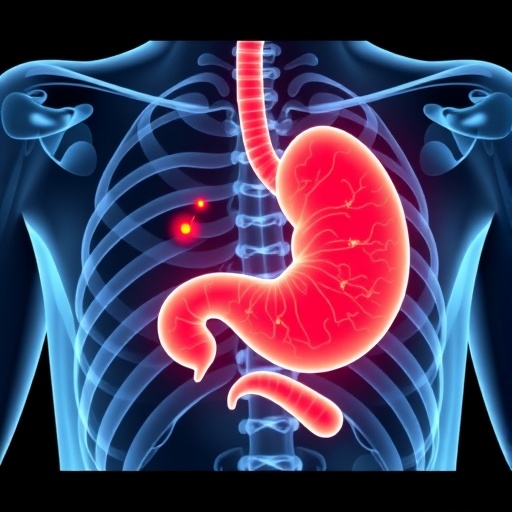
In a groundbreaking advancement poised to transform gastric cancer screening, researchers have developed and externally validated a straightforward yet highly effective prediction risk score (PRS) designed specifically for outpatient settings. Gastric cancer (GC) remains a formidable health challenge worldwide, where early detection significantly enhances outcomes but often eludes routine clinical practice due to resource limitations and invasive diagnostic procedures. This recent study, conducted across multiple centers in China, offers a beacon of hope by introducing a questionnaire-based tool that identifies individuals at elevated risk before subjecting them to gastroscopy.
The research team harnessed data from a large cohort of 4,800 participants in Guangzhou to construct the PRS. By leveraging regression coefficients from this robust sample, they derived a risk score encompassing five accessible and pertinent predictors: age, sex, body mass index (BMI), family history of gastric cancer in first-degree relatives, and the consumption of pickled foods—a known dietary risk factor associated with GC. The total risk score ranges from 0 to 11, enabling a quantitative stratification of patients into average- and high-risk groups.
Validation stands as a cornerstone of this study’s credibility. Following internal validation on an additional 2,058 individuals from the same Guangzhou cohort, the PRS underwent rigorous external evaluation in an independent group of 1,811 participants from Shenzhen. Further robustness was demonstrated with application to an extensive dataset from the China Kadoorie Biobank consisting of over 424,000 individuals. Across all these populations, the tool exhibited consistent discriminatory capability, reflected by area under the receiver operating characteristic curve (AUC) values spanning 0.723 to 0.789. Such performance metrics reflect excellent accuracy in distinguishing patients who harbor gastric malignancy from those who do not.
One of the most striking practical implications of this PRS lies in its potential to optimize gastroscopy deployment. In the Guangzhou training cohort, categorization of patients based on their risk scores revealed a substantial difference in GC prevalence: only 1.4% among those classified as average risk (scores 0–4), contrasted sharply with 8.3% in the high-risk group (scores 5–11). By selectively offering gastroscopy to the high-risk population, clinicians detected an impressive 85.2% of all GC cases, including around one-third of early-stage cancers. Crucially, this targeted approach allowed more than half of all gastroscopy procedures to be avoided in individuals unlikely to benefit, marking a significant stride toward cost-effective and resource-conscious cancer screening.
The practical advantages extend beyond economics. Gastroscopy, while definitive, is invasive, uncomfortable, and not without risk. Reducing unnecessary procedures decreases patient burden and enhances compliance. Meanwhile, early identification of high-risk individuals paves the way for timely intervention and improved survival rates, as early gastric cancer is more amenable to curative treatment. The PRS embodies a striking balance between simplicity and predictive power, capable of integration into routine clinical workflows without the need for costly or complex diagnostics.
From a methodological perspective, the study’s multicenter design and large sample sizes bolster the generalizability of findings. The statistical modeling underpinning the PRS incorporated standard regression techniques, ensuring interpretable and clinically actionable coefficients. Calibration analyses further confirmed the predictive accuracy, with no significant deviations between predicted and observed cancer risks, underscoring reliability across diverse populations.
The inclusion of diet, specifically pickled food consumption, reflects the nuanced understanding of GC etiology embraced by the investigators. Pickled foods, often high in nitrates, have been epidemiologically linked to gastric carcinogenesis. By integrating lifestyle factors alongside genetic predisposition and demographic variables, the PRS offers a holistic appraisal of risk, thereby enriching its applicability in public health interventions.
Importantly, the validation in the China Kadoorie Biobank—a population-based cohort not initially intended for gastric cancer risk prediction—attests to the scalability and adaptability of the score. Even amid varying baseline risks and demographic heterogeneity, the PRS maintained satisfactory discrimination and calibration, heralding its potential for deployment in varied outpatient scenarios across China and possibly beyond.
This breakthrough aligns well with global priorities seeking precision medicine approaches to cancer screening. By harnessing easily obtainable patient information, this PRS may empower clinicians to personalize recommendations, judiciously utilizing specialty services such as endoscopy where they’re most needed. Such risk stratification is particularly vital in resource-limited settings, where the burden of gastric cancer is often highest yet healthcare infrastructure is constrained.
Beyond clinical impact, the research emphasizes the importance of interdisciplinary collaboration—combining epidemiology, biostatistics, gastroenterology, and public health expertise—to address lingering challenges in cancer detection. The study’s transparent methodology and open dissemination of findings encourage adoption and further refinement by the medical community.
While promising, the PRS is not without limitations. Being questionnaire-based, it relies on accurate self-reporting by patients, which may be influenced by recall bias or misunderstanding of medical history. Additionally, the study cohorts, despite size and diversity, are primarily Chinese populations; thus, validation in other ethnic groups and international contexts is warranted to ensure universal applicability and cultural adaptability.
Looking ahead, integration of this PRS into electronic health records or mobile health platforms could streamline risk assessments during routine outpatient visits. Combining the score with emerging biomarkers or imaging technologies might further enhance predictive accuracy. Moreover, the tool could serve as a foundation for risk communication, facilitating shared decision-making between patients and providers regarding gastroscopy and surveillance strategies.
In conclusion, the development and multi-cohort validation of this simple gastric cancer prediction score mark a significant leap toward precision risk assessment in outpatient settings. By delineating high-risk individuals through a practical, non-invasive questionnaire, healthcare providers can prioritize gastroscopy judiciously, improving early detection rates while conserving valuable clinical resources. As the global community strives to confront cancer burden more effectively, innovations like this represent vital steps in tailoring screening paradigms to individual risk profiles, ultimately saving lives through earlier intervention and smarter resource allocation.
Subject of Research: Prediction risk score development for gastric cancer screening in outpatient settings
Article Title: Development and validation of a simple prediction risk score for predicting risk of gastric cancer in outpatient department
Article References:
Yi, S., Cai, Q., Dong, W. et al. Development and validation of a simple prediction risk score for predicting risk of gastric cancer in outpatient department. BMC Cancer (2025). https://doi.org/10.1186/s12885-025-15294-3
Image Credits: Scienmag.com
DOI: https://doi.org/10.1186/s12885-025-15294-3
Keywords: gastric cancer, prediction risk score, screening, gastroscopy, outpatient, early detection, epidemiology, China Kadoorie Biobank, validation, body mass index, family history, dietary risk factors


