

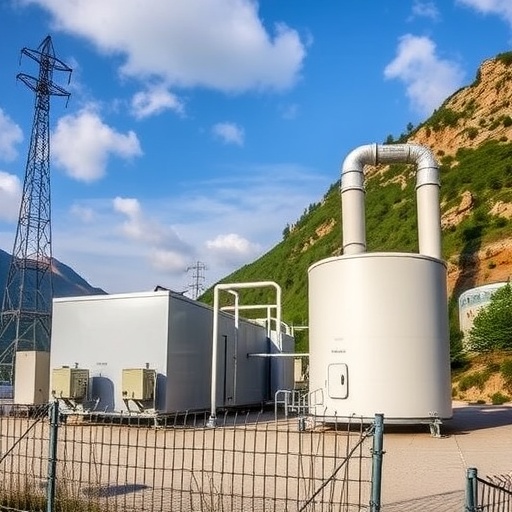
As the global push toward renewable energy accelerates, the critical challenge of intermittency in wind and solar power demands innovative energy storage solutions. One groundbreaking approach gaining traction is Compressed Carbon Dioxide Energy Storage (CCES), a technology that not only enables large-scale energy storage but also aligns synergistically with carbon capture, utilization, and storage (CCUS) systems. Offering a promising dual function in the pursuit of decarbonization, CCES is poised to revolutionize the energy landscape in ways previously unimaginable.
Unlike conventional compressed air energy storage (CAES), CCES leverages carbon dioxide as the working fluid, a choice that confers several remarkable advantages. Carbon dioxide’s thermodynamic properties, particularly its near-ambient critical temperature of about 31.4°C, enable more efficient phase transitions and energy density optimization. Its ability to liquefy at relatively mild conditions compared to air facilitates compact and high-capacity storage solutions, addressing a significant limitation associated with traditional CAES systems which often rely on large, geographically specific underground caverns.
Recent comprehensive reviews authored by researchers at Shanghai Jiao Tong University, North China Electric Power University, and China Petrochemical Corporation highlight the transformative prospects of CCES technology. Their work synthesizes diverse technological advancements, novel system configurations, and prominent demonstration projects, painting a vibrant landscape of innovation that positions CCES at the nexus of future low-carbon energy infrastructures. These integrated frameworks situate CCES not simply as a standalone storage system but as a core enabler of circular carbon economies.
A particularly compelling facet of CCES is its ability to integrate seamlessly within CCUS frameworks. This integration promotes a “closed-loop” carbon cycle where captured CO2 is not viewed as a waste product, but rather a vital working fluid that cycles through energy storage and release phases. This paradigm shift enables energy storage facilities to double as multifunctional carbon management hubs, enhancing both environmental impact and economic viability.
The symbiotic integration yields several critical benefits. By leveraging shared infrastructure, such as compressors, pipelines, and geological storage reservoirs, capital expenditure is significantly reduced, easing barriers to commercial deployment. Moreover, waste heat generated during industrial-scale carbon capture provides a valuable thermal resource to preheat CO2 during discharge cycles, thereby elevating round-trip efficiency beyond what typical compressed air systems can achieve. This resource-efficient loop optimizes thermodynamic performance while minimizing ancillary losses.
Furthermore, geological reservoirs serve dual functions in this integrated approach. Saline aquifers or salt caverns act as short-term buffers for energy release while simultaneously performing permanent carbon sequestration. This dual-use strategy not only improves spatial efficiency but also aligns with broader environmental targets by locking away substantial quantities of CO2 underground, contributing to net-negative emissions objectives.
Several landmark projects illustrate the rapid transition of CCES from conceptual research to practical deployment. In Italy, the Energy Dome pilot utilizes innovative flexible gas holders to experiment with liquid CO2 storage mechanisms. Meanwhile, China’s Wuhu Conch project showcases CCES’s capacity to harness cement kiln waste heat, coupling industrial processes with energy storage in a novel hybrid system. The impending 100 MW Huadian-Dongfang Electric Mulei facility in Xinjiang represents one of the largest CCES plants worldwide, designed to underpin vast renewable energy installations blending wind and solar resources.
Despite these advancements, significant technical challenges remain. Researchers emphasize the need to refine CO2-based gas mixtures to enhance thermodynamic properties and operational stability. Efficient low-pressure liquefaction remains a critical technology gap, as optimizing this process directly impacts energy density and capital costs. Moreover, ensuring the structural integrity and long-term safety of geological reservoirs subjected to cyclical pressure fluctuations necessitates rigorous monitoring and advanced modeling techniques.
Dynamic modeling and multi-objective optimization stand out as indispensable tools for future research. Balancing the triad of economic feasibility, energy efficiency, and environmental sustainability requires sophisticated simulation frameworks capable of capturing transient behaviors and operational intricacies. Precision in these computational models will drive the design of next-generation CCES systems capable of scaling effectively while adhering to stringent regulatory and safety standards.
In essence, CCES technologies integrated with CCUS represent a paradigm shift away from single-modality energy storage toward a synergistic approach that couples carbon management and energy resilience. This multi-functional integration amplifies the impact of renewable energy adoption, mitigates grid instability, and accelerates pathways toward a sustainable, carbon-neutral future. The evolving landscape underscores the imperative for continued interdisciplinary collaboration and investment to unlock the full potential of this promising technology.
In conclusion, the novel use of compressed CO2 as an energy storage medium, combined with strategic integration into carbon capture and storage infrastructures, holds profound implications for energy and environmental sciences. If successfully scaled and optimized, CCES could emerge as a cornerstone technology in the global effort to mitigate climate change, offering a scalable and efficient solution to one of renewable energy’s most persistent challenges: reliable, large-scale storage.
Subject of Research: Energy storage technology, carbon capture utilization and storage (CCUS), thermodynamic systems
Article Title: Compressed CO2 energy storage technology and its integration with CO2 capture, utilization and storage: A review and perspective.
News Publication Date: 1-Jan-2026
Web References: http://dx.doi.org/10.1007/s11708-026-1043-7
Image Credits: Qian Wu, Yang Li, Liang Yin & Qianguo Lin
Keywords: Energy, compressed CO2 energy storage, carbon capture, utilization and storage, CCUS, thermodynamics, renewable energy, energy storage, low-carbon systems


