

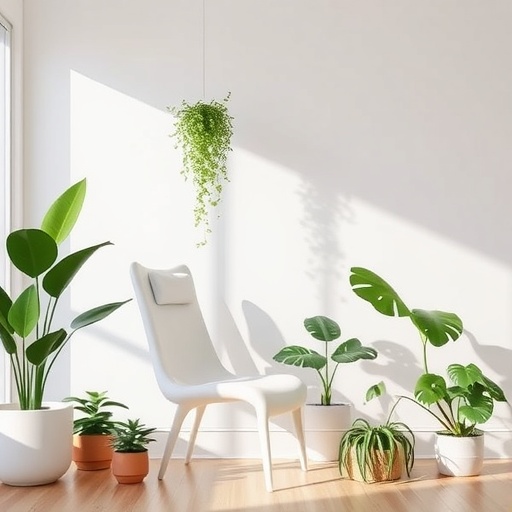
Emerging research from the University of Surrey’s Global Centre for Clean Air Research (GCARE) reveals groundbreaking insights into the powerful role of indoor plant systems in enhancing indoor environmental quality. This new study, published in the prestigious journal Building and Environment, offers an unprecedented comprehensive evaluation of how various forms of indoor greenery—from houseplants to sophisticated hydroponic towers and living walls—can influence indoor climates and human well-being. The findings accentuate the capacity of these green interventions not only to elevate humidity levels but also to improve thermal comfort and foster healthier, more climate-resilient buildings in a world increasingly impacted by global warming and deteriorating air quality.
Indoor greening has, until now, been an underexplored frontier in environmental science. While extensive work has documented the benefits of urban greening outdoors, the scientific community has lacked robust data regarding how indoor plants genuinely impact the air we breathe inside our homes, offices, and public spaces. The innovative framework developed by this international team addresses this critical gap by synthesizing evidence through ten key questions that examine the influence of indoor plant systems across multiple dimensions, including technical performance, microbial interactions, health benefits, socio-economic impacts, and spatial factors. This multidimensional approach sets a new standard for quantifying and understanding the effects of indoor greening technologies in real-world environments.
One of the study’s most compelling revelations is that larger indoor greening systems can perceptibly alter thermal perception without changing actual ambient temperatures. The presence of lush greenery indoors can make spaces feel up to two degrees Celsius cooler, a significant margin in terms of human thermal comfort. This phenomenon hinges on natural processes such as evapotranspiration, where plants release moisture into the air, thus increasing humidity and supporting cooler sensations at the skin level. Importantly, this subtle cooling effect is achieved without additional energy expenditure, offering a sustainable adjunct to traditional heating, ventilation, and air conditioning (HVAC) systems.
Beyond thermal regulation, the research highlights the air purification potential of certain engineered indoor plant configurations. By carefully calibrating plant density, lighting conditions, and system design, some installations demonstrate measurable reductions in fine particulate matter (PM2.5) and volatile organic compounds (VOCs)—two of the most ubiquitous indoor pollutants with well-documented negative impacts on respiratory and cardiovascular health. This finding challenges the once-cynical view that houseplants serve merely decorative purposes and positions them instead as active agents of indoor air pollution mitigation, especially relevant in densely populated urban areas where outdoor air quality is often compromised.
A fascinating and novel aspect of the study is its examination of the indoor microbiome, the complex community of microorganisms inhabiting built environments. Evidence suggests that indoor plants may enrich this invisible ecosystem by introducing beneficial microbes naturally derived from the environment. This microbial diversity has implications for human health, potentially contributing to immune system stimulation and reduced incidence of allergies or autoimmune conditions. Such microbiological impacts underscore the multidimensional benefits of plant-based indoor greening, expanding their value far beyond aesthetics or air quality alone.
The collaborative nature of this study, involving 35 researchers across continents—including the UK, Europe, the USA, Australia, India, and Brazil—reflects the global urgency and universal relevance of improving indoor environmental quality as climate change accelerates. Supported by the GREENIN Micro Network Plus project, the research benefits from the interdisciplinary expertise of universities and environmental organizations, integrating horticultural science, microbiology, engineering, and public health. This international alliance not only strengthens the study’s conclusions but charts a roadmap for future research efforts that can address remaining uncertainties and practical challenges.
Professor Prashant Kumar, the study’s lead author and founder of GCARE, emphasizes the critical distinction between using indoor plants as aesthetic decoration and considering them as essential environmental infrastructure. He notes that maximizing the benefits of indoor greening requires deliberate design choices and maintenance strategies, including adequate lighting, appropriate plant species selection, and ongoing care protocols. Only through such an informed approach can indoor greening systems deliver consistent improvements in air quality, thermal comfort, and occupant well-being.
Despite these promising results, the authors caution that much work remains to translate laboratory findings into practical, scalable solutions for everyday buildings. Many prior studies relied on artificial settings with unrealistic plant quantities or controlled chambers that do not replicate the complexity of real indoor environments, which include variations in ventilation, occupant behavior, lighting, and maintenance. The team advocates for long-term, in situ studies that can capture these dynamics, providing data that architects, designers, and building managers can rely on when integrating indoor greening into building systems.
The intervention’s socio-economic dimension also garners attention, as indoor greening has the potential to elevate quality of life in urban environments, particularly in dense housing or institutional settings such as schools and workplaces where access to nature is limited. Dr. Tijana Blanusa, a co-author and Principal Horticultural Scientist at the Royal Horticultural Society, underscores how indoor plants can reconnect people with nature, promoting psychological well-being and fostering environmental stewardship. This human-centered perspective reinforces that indoor greening investments are not merely about technical performance but also about nurturing healthier, happier communities.
This comprehensive study delivers a wealth of actionable insights for policy makers, urban planners, building designers, and environmental health professionals. The evidence-based ten-question framework offers a practical tool for evaluating and selecting indoor greening systems tailored to specific building contexts and occupant needs. Moreover, by highlighting existing knowledge gaps, the research delineates clear priorities for future scientific inquiry, including optimized plant species mixes, microbial interactions, maintenance protocols, and cost-benefit analyses in real-world settings.
In an era where climate change poses mounting threats to human health and building sustainability, this work illuminates the transformative potential of integrating living plants into indoor environments. Far from a niche aesthetic trend, indoor greening emerges as a multifaceted, scientifically supported strategy to advance air quality, thermal regulation, microbial health, and overall occupant comfort. As cities grow and the majority of life unfolds indoors, these green infrastructures could become essential components of resilient, climate-adaptive architecture.
The study also lays foundational groundwork for forthcoming design guidelines and regulatory frameworks by clarifying what indoor greening can realistically achieve. This clarity enables stakeholders to move beyond anecdotal claims and invest confidently in verified solutions that combine ecological benefits with human health imperatives. The research funded by the Engineering and Physical Sciences Research Council (EPSRC) under Grant No. APP55977 has set a new benchmark for the field, promising to inspire a wave of innovative indoor environmental interventions globally.
As the conversation around urban sustainability intensifies, this landmark research spotlights living interiors as a promising frontier, blending technological innovation with natural systems to create the buildings of the future—healthier, more comfortable, and deeply attuned to the rhythms of both people and planet.
Subject of Research: Indoor greening and its impact on environmental quality
Article Title: Ten questions on indoor greening and environmental quality
News Publication Date: 6 February 2026
Web References:
https://doi.org/10.1016/j.buildenv.2026.114336
References:
Kumar, P., et al. (2026). Ten Questions on Indoor Greening and Environmental Quality. Building and Environment 294, 114336.
Keywords:
Plants, Environmental health, Climate change mitigation, Human health


