

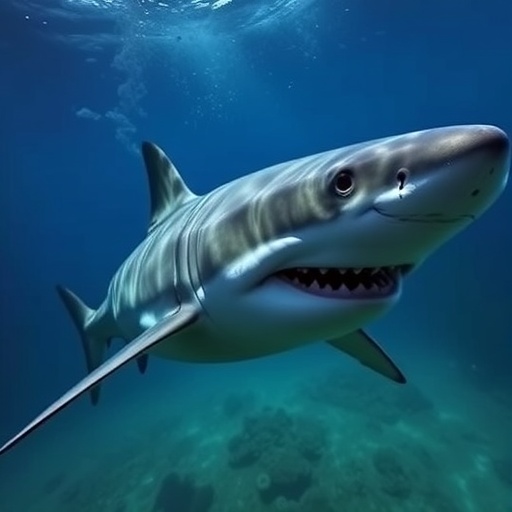
In a remarkable and rare encounter off the coast of the eastern Mediterranean peninsula, local fishermen inadvertently caught a juvenile great white shark (Carcharodon carcharias) measuring approximately 210 centimeters in length and weighing between 80 and 90 kilograms. This incidental capture, occurring on April 20, 2023, has provided a pivotal opportunity for marine biologists and researchers to revisit the historic and contemporary presence of this elusive apex predator in Mediterranean waters. The finding prompted a comprehensive review of records dating back as far as 1862, culminating in a detailed study now published in the open-access journal Acta Ichthyologica et Piscatoria.
The juvenile great white shark’s accidental capture serves as tangible evidence that this species, often described in the Mediterranean as a “ghost” population, persists despite its infrequent sightings. The review underscores the species’ sporadic yet continuous presence in the region, affirming that the great white shark has not been entirely extirpated from these waters. However, current data signal troubling signs: the Mediterranean population of Carcharodon carcharias remains vulnerable, with declining numbers prompting its classification as Vulnerable on the IUCN Red List. This revelation heightens the urgency for intensified research and conservation efforts focused on Mediterranean marine ecosystems.
One of the study’s lead researchers, Dr. José Carlos Báez, highlights the critical importance of the juvenile specimen’s presence. Juvenile individuals are key indicators suggesting that reproductive activity may be occurring locally, which, if confirmed, would redefine current understanding of the species’ breeding grounds and life cycle within Mediterranean waters. The confirmation of active reproduction would have profound implications for regional conservation strategies, potentially focusing efforts on protecting nursery habitats essential for early shark development.
The great white shark’s enduring reputation as a feared oceanic predator casts a shadow over public perception and scientific inquiry alike. Drawing on H.P. Lovecraft’s poignant reflection that “the oldest and strongest emotion of mankind is fear, and the oldest and strongest kind of fear is fear of the unknown,” the research team emphasizes the necessity of demystifying this species through rigorous scientific investigation. By illuminating the biology, ecology, and behavior of the Mediterranean white shark, the study endeavors to replace myths and misconceptions with evidence-based understanding.
Despite occasional sightings, the Mediterranean Sea remains a challenging environment in which to systematically study great white sharks. Their sporadic appearance combined with their vast, migratory range complicates efforts to gather comprehensive data. Researchers advocate for the implementation of long-term monitoring programs utilizing a combination of direct observation, tagging, and advanced satellite tracking technologies. These integrative approaches promise to capture crucial data on movement patterns, habitat use, and population dynamics, thereby informing more effective conservation frameworks.
The ecological role of the great white shark extends far beyond its formidable predatory capabilities. As highly migratory pelagic species, great whites contribute to the redistribution of energy and nutrients across extensive marine landscapes. Their scavenging behaviors help maintain ecosystem health by consuming carrion and thus limiting the spread of disease. The eventual sinking of deceased sharks provides a vital pulse of nourishment to deep-sea communities, linking surface and benthic environments through this natural subsidy.
Understanding the presence and population dynamics of great white sharks is not merely an academic pursuit but is vital for the sustainability of Mediterranean marine biodiversity. The decline of apex predators such as the great white disrupts trophic cascades, potentially leading to imbalances that affect fish stocks and overall ecosystem functionality. Maintaining these predators in the Mediterranean is essential for preserving the intricate ecological relationships that sustain healthy seas.
This newly documented juvenile specimen opens avenues for reevaluating the biogeographical distribution of great white sharks within the Mediterranean basin. Historically, Mediterranean sightings have been sporadic and poorly documented, often leading to underestimations of the species’ regional presence. The comprehensive review conducted by Dr. Báez and his team bridges historical records with contemporary data, painting a nuanced picture of this elusive predator’s persistence despite environmental pressures.
The researchers caution that the rarity of sightings does not equate to absence. Instead, it reflects the challenges inherent in marine research, including limited survey efforts, the vastness of habitat, and the inherently cryptic nature of the species. Enhanced scientific clarity facilitated by technological advancements, such as environmental DNA (eDNA) sampling and high-resolution acoustic monitoring, offer promising tools to detect and study these elusive individuals with minimal disturbance.
Conservation efforts targeting the Mediterranean great white shark must address multifaceted threats including habitat degradation, fishing bycatch, and pollution. The vulnerability of juvenile sharks, in particular, necessitates measures to protect potential nursery areas from human impacts, which could otherwise undermine reproductive success and juvenile survival rates. Collaboration between regional governments, fisheries, and conservation organizations is paramount to developing effective protective legislation and mitigating human-shark conflicts.
In conclusion, this accidental encounter with a juvenile great white shark serves as a compelling reminder of the interconnectedness of marine life and the hidden resilience of species face environmental adversities. It underscores the critical role of sustained, evidence-driven research to illuminate the mysteries of the deep and fosters a deeper appreciation for the great white shark’s pivotal role in Mediterranean ecosystems. As Dr. Báez eloquently asserts, understanding these majestic predators not only enriches scientific knowledge but also fosters respect and stewardship for the fragile marine environments they inhabit.
Subject of Research: Animals
Article Title: New record of white shark, Carcharodon carcharias (Elasmobranchii, Lamniformes, Lamnidae), from the Mediterranean Spanish coast
News Publication Date: January 27, 2026
Web References: http://dx.doi.org/10.3897/aiep.56.173786
References: Báez, J.C., Puerto, M.A., Torreblanca, D., Varela, J.L., Carmona, L. and Macías, D. (2026). New record of white shark, Carcharodon carcharias (Elasmobranchii, Lamniformes, Lamnidae), from the Mediterranean Spanish coast. Acta Ichthyologica et Piscatoria, 56, pp.27–31. doi:10.3897/aiep.56.173786
Image Credits: Báez et al., 2026
Keywords: Great white shark, Carcharodon carcharias, Mediterranean Sea, juvenile shark, species distribution, apex predator, conservation, marine ecology, population dynamics, vulnerable species


