

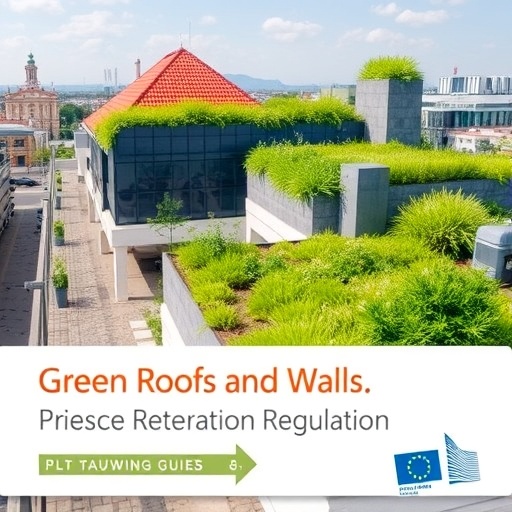
Green roofs and living walls have transcended their status as niche architectural curiosities to become integral, scalable elements within urban sustainability strategies across Europe. Emerging as potent nature-based solutions, these infrastructures contribute multifaceted benefits encompassing biodiversity enhancement, climate resilience, energy efficiency, and human well-being. A recent comprehensive synthesis report, authored by the Science Service for Biodiversity under the BioAgora initiative, addresses the pragmatic application of these green systems, drawing lessons from 46 case studies across the continent and synthesizing scientific literature and expert insights. This report not only underscores the ecological and climatic advantages of integrating vegetation into the built environment but also charts a path towards supporting ambitious EU policy goals aimed at urban ecosystem restoration and climate adaptation.
The report titled Implementing Green Roofs and Walls: Lessons from European Experiences is a landmark document that aggregates large-scale empirical data and policy-relevant analysis. By rigorously examining the implementation modalities and ecological outcomes of building-integrated greenery, the study provides critical evidence to local governments, urban planners, and policymakers on optimizing these interventions. Green roofs and living walls, typically installed on previously underutilized urban surfaces, have demonstrated noteworthy capabilities such as stormwater management, mitigating the urban heat island effect, reducing building energy demand, and fostering rich urban biodiversity including pollinators and avifauna.
Among green infrastructure types, extensive green roofs have been the most widely adopted due to their lightweight substrate, relatively low installation costs, and compatibility with existing architectural structures. However, the report presents compelling arguments for expanding the use of semi-intensive and intensive green roofs as well as vertical greening systems. These more complex configurations, albeit requiring increased structural considerations and maintenance, deliver substantially higher ecological complexity, social utility, and microclimatic regulation. Specifically, vertical living walls—ranging from simple climbing plants to sophisticated engineered systems—play a critical role in densely built environments where horizontal space scarcity restricts the deployment of ground-level green spaces. These walls have been shown to improve air quality by filtering pollutants, sequester carbon, and create microhabitats that support urban fauna.
Crucially, the report situates green roofs and walls within the context of the broader European Union climate and biodiversity policies. Integration of these technologies advances the objectives of the EU Nature Restoration Regulation and aligns with the EU Biodiversity Strategy for 2030 by enabling urban areas to contribute meaningfully to biodiversity conservation targets. Moreover, these green systems complement the Energy Performance of Buildings Directive by improving thermal insulation and reducing energy consumption for heating and cooling. They also synergize with urban water management frameworks by retaining rainfall and alleviating pressure on stormwater infrastructure, demonstrating their multifunctional value.
A pivotal insight of the report is that the realized benefits of green roofs and walls are highly contingent upon meticulous design, governance frameworks, and sustained maintenance practices. Biodiversity outcomes, for example, depend heavily on factors such as substrate depth, plant species diversity, and structural complexity. Incorporating diverse plant communities can augment habitat heterogeneity, supporting a broader range of taxa and enhancing ecological resilience. The report identifies governance challenges in many regions, particularly in Eastern Europe, where fragmented regulatory regimes, insufficient technical expertise, and ambiguities in maintenance responsibilities impede broader adoption.
The document advocates for hybrid governance models to accelerate implementation and scale-up. Successful case studies demonstrate the efficacy of models combining public sector leadership, private investment, and active community participation. These collaborative approaches foster shared ownership, enhance resource mobilization, and enable adaptive management strategies, including ongoing biodiversity monitoring and performance-based planning. The report underscores the relative underutilization of participatory governance tools and adaptive management, highlighting these as leverage points for improving long-term functionality and securing public acceptance.
To empower urban authorities in harnessing these benefits, the report proposes actionable policy prescriptions. Embedding requirements and incentives for green roofs and walls into spatial planning frameworks and building regulations emerges as a key strategy. Cities can employ performance-based planning tools to prioritize multifunctional outcomes that amalgamate ecological, social, and economic metrics. Additionally, targeted financial incentives—such as subsidies, tax rebates, or grants—can stimulate private sector uptake and innovation.
Looking forward, the synthesis highlights emerging technological and design advancements that promise to elevate the efficacy of green infrastructure. Bio-solar roofs, which integrate photovoltaic panels with vegetated surfaces, combine renewable energy generation with biospheric services, offering an innovative route to maximize rooftop utility. Blue-green roofs, designed with enhanced water retention capacity, further optimize stormwater management under increasingly variable climatic regimes. Moreover, the deployment of digital technologies—including sensors, remote sensing platforms, and data analytics—facilitates real-time monitoring and informed decision-making, enhancing adaptive capacity and operational efficiency.
The report serves as a clarion call for reimagining urban green infrastructure as essential—not elective—components of city planning. By valorizing underutilized urban surfaces, green roofs and walls expand green space without competing for limited land resources. Besides buffering climatic extremes and improving air quality, these infrastructures operate as ecological corridors that increase landscape connectivity, aiding the recovery of pollinator populations and other urban wildlife species. This species connectivity fulfills a critical requirement of the EU’s urban biodiversity agenda, reinforcing the role of cities as active contributors to broader landscape-scale conservation efforts.
In the face of mounting challenges from climate change, biodiversity loss, and urban densification, the evidence base compiled in the report decisively positions building-integrated greenery as a resilient, multifunctional urban solution. Its implementation aligns with sustainable development goals by simultaneously addressing environmental, social, and economic dimensions of urban life. The report emphasizes that realizing the full potential of green roofs and walls will necessitate sustained commitment, interdisciplinary collaboration, and innovation in governance, design, and monitoring approaches.
Funded by the European Union under grant agreement No. 101059438 via the BIO-Agora project, this policy-relevant synthesis integrates science and practice to substantively reduce uncertainties related to the utility and impact of green infrastructure technologies. Published under a Creative Commons Attribution 4.0 license, the report is freely accessible as a resource to inform evidence-based policymaking and urban planning. Ultimately, it envisions a paradigm shift whereby green roofing systems transition from marginal architectural embellishments to indispensable infrastructure that bolsters urban health, ecological integrity, and climate resilience across Europe.
Subject of Research: Urban green infrastructure implementation and policy evaluation with a focus on green roofs and walls in Europe
Article Title: Implementing Green Roofs and Walls: Lessons from European Experience
News Publication Date: 2024
Web References:
- Science Service for Biodiversity: https://bioagora.eu/science-service-for-biodiversity
- BioAgora: https://bioagora.eu/
- EC Knowledge Centre for Biodiversity: https://knowledge4policy.ec.europa.eu/biodiversity_en
- Report publication: https://op.europa.eu/en/publication-detail/-/publication/8ca227fe-2a55-11f1-906d-01aa75ed71a1/language-en
- Report DOI link: https://data.europa.eu/doi/10.2760/8059292
References: Enzi, V., Manso, M., Aires, A., Catalano, C., Gedge, D. et al. (2026). Implementing green roofs and walls: lessons from European experiences. Vierikko, K., Orta-Ortiz, M.S., Nieminen, H., Vasilakopoulos, P., Velasco Gomez, D.M. (Eds.). Publications Office of the European Union, Luxembourg.
Image Credits: © Stephan Brenneisen. Visual design: Pensoft Publishers.
Keywords: green roofs, green walls, urban biodiversity, climate resilience, EU Nature Restoration Regulation, urban ecosystem restoration, energy efficiency, urban heat island mitigation, vertical greening systems, multifunctional urban infrastructure, biodiversity strategy 2030, nature-based solutions


