
Sunday, March 1, 2026
Science
No Result
View All Result
  • Login
  • HOME
  • SCIENCE NEWS
  • CONTACT US
  • HOME
  • SCIENCE NEWS
  • CONTACT US
No Result
View All Result
Scienmag
No Result
View All Result
Home Science News Biology

New Japanese lily species identified, 1st addition to sukashiyuri group in 110 years

May 1, 2024
in Biology
Reading Time: 3 mins read
0
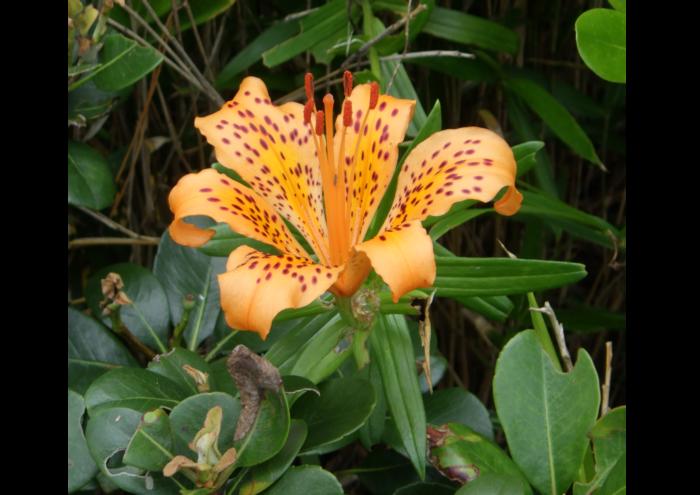
The new species of Japanese lily Lilium pacificum
66
SHARES
602
VIEWS
Share on FacebookShare on Twitter
ADVERTISEMENT

A new species of the Japanese lily known as sukashiyuri has been identified for the first time since 1914 by a research team led by Dr. Seita Watanabe, a specially appointed assistant professor at the Botanical Gardens and the Graduate School of Science at Osaka Metropolitan University.

The new species of Japanese lily Lilium pacificum

Credit: Osaka Metropolitan University

A new species of the Japanese lily known as sukashiyuri has been identified for the first time since 1914 by a research team led by Dr. Seita Watanabe, a specially appointed assistant professor at the Botanical Gardens and the Graduate School of Science at Osaka Metropolitan University.

Dr. Watanabe questioned the classification used up to now for sukashiyuri group, which usually has orange flowers. These lilies have high ornamental value, having been exported from Japan for more than two centuries. There have been only four taxonomic groups, but Dr. Watanabe and his team sought evidence to prove that there were more.

Traveling across Japan to observe the lilies, record images, gather specimens, and obtain DNA from plant materials, the research team members conducted a detailed analysis of the form and structure of the plants and their DNA. The results of their extensive work revises the conventional classification into eight taxons, including what they have named Lilium pacificum, the first new species of Japanese lily in 110 years.

Lilium pacificum grows on coastal areas facing the Pacific Ocean on Honshu from Ibaraki Prefecture south to Shizuoka Prefecture and the Izu Islands.

“It has an interesting characteristic: the tips of its leaves are curved into a claw-like shape,” Dr. Watanabe enthused. “Based on the new understanding of these eight taxonomic groups, we found that seven are endemic to Japan, each adapted to its environment, whether coastal or mountainous, and evolving unique traits.”

Dr. Watanabe added: “Our research shows that these plants have differentiated through complex processes, and we hope that our work will provide clues for speciation studies. In the past, individual differences may have been overlooked because of the apparent simplicity of the plants. Through this research, I was reminded of the importance of morphological observation.”

The findings were published in Taxon.

###

About OMU 

Established in Osaka as one of the largest public universities in Japan, Osaka Metropolitan University is committed to shaping the future of society through “Convergence of Knowledge” and the promotion of world-class research. For more research news, visit and follow us on social media: X, Facebook, Instagram, LinkedIn.


Journal

Taxon

DOI

10.1002/tax.13141

Method of Research

Experimental study

Subject of Research

Not applicable

Article Title

Biosystematic studies on Lilium (Liliaceae) II. Evolutionary history and taxon recognition in the L. maculatum–L. pensylvanicum complex in Japan

Article Publication Date

16-Feb-2024

Share26Tweet17
Previous Post

The popular kids in school may be sleeping less

Next Post

Science advisors unite in a call for greater variety of evidence in developing policy

Related Posts

blank
Biology

Host Factors Trump Kidney Function in Gut Microbiome

February 28, 2026
blank
Biology

Innate Immune Therapy vs Antibiotics for Cystitis

February 28, 2026
blank
Biology

HIV-Linked Gut Microbiome Drives Infection Risk

February 28, 2026
blank
Biology

AI Powers the Creation of Next-Generation Super Catalyst for Hydrogen Cars

February 28, 2026
blank
Biology

Study Finds Collagen Enhances Skin Health but Does Not Improve Physical Performance

February 28, 2026
blank
Biology

Candida auris Pump Drives Fluconazole Resistance Evolution

February 28, 2026
Next Post
INGSA2024 - The Transformation Imperative

Science advisors unite in a call for greater variety of evidence in developing policy

  • Mothers who receive childcare support from maternal grandparents show more parental warmth, finds NTU Singapore study

    Mothers who receive childcare support from maternal grandparents show more parental warmth, finds NTU Singapore study

    27618 shares
    Share 11044 Tweet 6902
  • University of Seville Breaks 120-Year-Old Mystery, Revises a Key Einstein Concept

    1022 shares
    Share 409 Tweet 256
  • Bee body mass, pathogens and local climate influence heat tolerance

    665 shares
    Share 266 Tweet 166
  • Researchers record first-ever images and data of a shark experiencing a boat strike

    532 shares
    Share 213 Tweet 133
  • Groundbreaking Clinical Trial Reveals Lubiprostone Enhances Kidney Function

    517 shares
    Share 207 Tweet 129
Science

Embark on a thrilling journey of discovery with Scienmag.com—your ultimate source for cutting-edge breakthroughs. Immerse yourself in a world where curiosity knows no limits and tomorrow’s possibilities become today’s reality!

RECENT NEWS

  • Early Alcohol Abstinence Linked to Brain and Immune Changes
  • Light Boosts Heat Tolerance Through Serotonin in Eyeless Species
  • BCL-2 in Fibroblasts Drives Reversible Lung Fibrosis
  • Wearables Track Heat Exposure in Preconception Cohort

Categories

  • Agriculture
  • Anthropology
  • Archaeology
  • Athmospheric
  • Biology
  • Biotechnology
  • Blog
  • Bussines
  • Cancer
  • Chemistry
  • Climate
  • Earth Science
  • Editorial Policy
  • Marine
  • Mathematics
  • Medicine
  • Pediatry
  • Policy
  • Psychology & Psychiatry
  • Science Education
  • Social Science
  • Space
  • Technology and Engineering

Subscribe to Blog via Email

Enter your email address to subscribe to this blog and receive notifications of new posts by email.

Join 5,190 other subscribers

© 2025 Scienmag - Science Magazine

Welcome Back!

Login to your account below

Forgotten Password?

Retrieve your password

Please enter your username or email address to reset your password.

Log In
No Result
View All Result
  • HOME
  • SCIENCE NEWS
  • CONTACT US

© 2025 Scienmag - Science Magazine

Discover more from Science

Subscribe now to keep reading and get access to the full archive.

Continue reading