

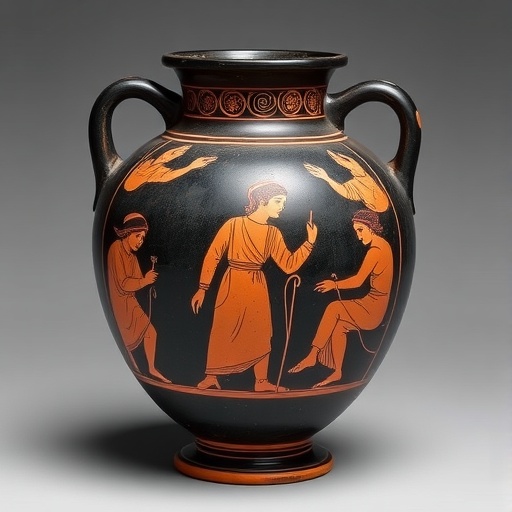
Recent archaeological discoveries in Sicily have provided significant insights into the fascinating world of early South Italian red figure pottery, with new research focusing on artifacts dating from 420 to 375 BCE. This work, undertaken by a team of researchers including Mangone, Serino, and Elia, has brought to light the artistry and cultural importance of pottery in the ancient cities of Himera, Lipari, and Syracuse. Their comprehensive analysis offers an interdisciplinary approach that integrates art history, archaeology, and material science, delving deeply into the techniques and practices of ancient artisans.
The red figure pottery of South Italy represents a pivotal moment in the evolution of ancient ceramics, reflecting both aesthetic preferences and societal influences of the time. The research team utilized advanced archaeometric techniques to analyze the clay compositions, pigments, and firing methods employed in the creation of these ceramic pieces. By investigating the material properties, the researchers aimed to understand not just the artistic merits, but also the technological innovations that characterized this pottery tradition.
Central to the research is the examination of artifacts excavated from the significant sites of Himera, Lipari, and Syracuse. Each site presents a unique context, shed light on the trade networks and cultural exchanges that flourished in ancient Sicily. Through the careful analysis of pottery fragments and complete vessels, the researchers were able to trace the influences of Greek colonial expansion on local styles and practices. This analysis reveals how external artistic norms were adapted and transformed within the local context, creating a distinctive Sicilian aesthetic.
An important aspect of the study involved the investigation of the decoration techniques utilized by ancient potters. The red figure technique, which allows for greater detail compared to the earlier black figure pottery, showcases intricate designs and narratives that highlight important cultural themes. The researchers focused on the pigments and their sources, noting variations that indicate regional differences and preferences. This attention to detail highlights how potters were not merely artisans but storytellers who conveyed complex narratives through their work.
Moreover, the research elaborates on the role of pottery in social and ritual contexts. In ancient Sicily, pottery was not only functional but served as a medium for communication and expression. The imagery depicted on these vessels often references mythology, daily life, and ceremonial practices. By examining the iconography, the researchers glean insights into the values and beliefs of the society that created these artifacts. This exploration is pivotal in understanding the broader socio-political landscape of the time.
In addition to studying the ceramic designs, the researchers utilized cutting-edge analytical techniques such as petrographic analysis and scanning electron microscopy. These methods allowed for a microscopic examination of the pottery’s fabric, revealing the mineralogical composition and providing clues about the sourcing of raw materials. The findings underscored the sophisticated knowledge and skills of ancient potters who manipulated their materials to achieve desired artistic effects.
Collaboration across disciplines has been crucial to this research. The convergence of archaeology, chemistry, and art history enabled a richer interpretation of the artifacts. Each researcher brought a unique perspective, facilitating a holistic understanding of the production and use of pottery in ancient Sicily. This collaborative spirit mirrors the interconnectedness of the societies being studied, emphasizing the importance of cultural exchange during this period.
The implications of this research extend beyond academic curiosity. Understanding the craftsmanship behind these ancient ceramics can enrich contemporary perspectives on art and design. It demonstrates how historical practices can influence modern techniques and aesthetic sensibilities. By reconnecting with these ancient traditions, contemporary craftsmen and artists can find inspiration and insight, fostering a dialogue between the past and the present.
As the study continues to unfold, the researchers aim to expand their analysis to include additional sites across Sicily and beyond. The potential for discovering new techniques and regional styles remains vast, promising further revelations about the rich tapestry of ancient Mediterranean ceramics. Each new finding contributes to the narrative of a complex society that thrived on creativity, innovation, and cultural interaction.
Public interest in archaeology and ancient cultures has been growing, prompting discussions on how such research can inform our understanding of contemporary issues. By examining the past, researchers not only recover lost knowledge but also challenge existing narratives about cultural superiority and artistic evolution. This study, like others, serves as a reminder that civilization is a mosaic of influences and experiences, reflecting the shared history of humanity.
In conclusion, the research conducted by Mangone, Serino, and Elia offers a profound exploration of early South Italian red figure pottery, shedding light on the artistic, social, and technological dimensions of ancient Sicilian culture. By employing a multidisciplinary approach, they unlock new understandings of how these artifacts reflect the societies that created them, inviting us to reconsider our relationships with historical legacies. The ongoing study of these ceramics promises to enhance our appreciation for the ingenuity of ancient peoples and the enduring power of art.
This archaeological work not only contributes to the academic discourse but also captivates the public imagination, fostering a deeper appreciation for the artistry and significance of ancient pottery. As excavations continue and research deepens, the stories behind these exquisite artifacts will enrich our understanding of the past and its relevance to our present.
Subject of Research: Early South Italian red figure pottery (420–375 BCE)
Article Title: Archaeometric insight into the early South Italian red figure pottery: evidence from Himera, Lipari, and Syracuse in Sicily.
Article References:
Mangone, A., Serino, M., Elia, D. et al. Archaeometric insight into the early South Italian red figure pottery (420–375 BCE): evidence from Himera, Lipari, and Syracuse in Sicily.
Archaeol Anthropol Sci 18, 34 (2026). https://doi.org/10.1007/s12520-025-02401-5
Image Credits: AI Generated
DOI: https://doi.org/10.1007/s12520-025-02401-5
Keywords: Archaeometry, South Italian pottery, Red figure, Himera, Lipari, Syracuse, Ancient ceramics, Cultural exchange, Artistic techniques, Socio-political context.


