

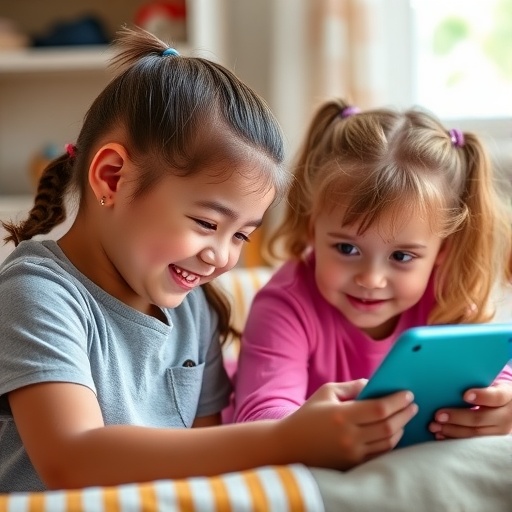
A groundbreaking study led by Florida Atlantic University and Aarhus University in Denmark has shed new light on the complex relationship between early childhood language development, solitary screen time, and subsequent socioemotional difficulties. The research delivers a compelling argument that unsupervised screen exposure in preschool and kindergarten-aged children who exhibit oral language difficulties significantly exacerbates emotional and behavioral problems later in childhood. This provocative finding challenges prevailing assumptions about screen time and underscores the critical importance of interactive social environments during early development.
Early language acquisition forms the foundation for the child’s ability to engage socially and emotionally within their environment. When communication skills are impaired, children are at an increased risk for a cascade of developmental challenges, including conduct issues and emotional dysregulation. The study specifically explores how solitary screen time — defined as the average number of hours young children spend alone with handheld devices or television absent adult supervision — acts as a detrimental amplifier of these risks.
A longitudinal investigation involving 546 children aged four and five years, attending childcare centers across Denmark, utilized multiple teacher assessments and standardized language testing to examine the children’s communicative competence and behavioral adjustment over a six-month timeframe. Importantly, parental reports detailed the extent of each child’s solitary screen use. The data revealed a clear linkage: children with both poor language skills and elevated solitary screen time were significantly more likely to experience worsening socioemotional problems, including conduct disturbances and emotional difficulties.
This study’s methodological strength lies in its ability to parse the compounded effects of language deficits in conjunction with unsupervised digital media exposure. Previous research has established that isolated oral language problems predispose children to later adjustment issues. However, the novel contribution here is the identification of solitary screen time as a potent ecological factor that magnifies these adverse trajectories. It appears that screen time, when consumed alone, deprives children of critical social interactions that foster language growth and emotional regulation.
The economic theory of opportunity costs serves as an insightful framework to interpret these findings. In essence, time allocated to solitary screen use is time not spent in reciprocal social engagements—a vital arena for practicing and internalizing the nuanced social communication skills often delayed in children with oral language difficulties. Since digital devices do not require negotiation, shared attention, or adaptive dialogue, young children miss crucial opportunities to develop interpersonal competencies that would otherwise mitigate behavioral risk.
The implications of these findings are particularly salient given the context of today’s digital landscape. The World Health Organization, along with the American Psychological Association, recommends limiting screen exposure in children aged two to five to no more than one hour per day, emphasizing co-viewing and interaction over passive consumption. Despite this, epidemiological surveys indicate that the majority of young children globally exceed these limits, with American children spending over two hours daily on screens during weekdays, and even more on weekends.
Crucially, this study differentiates between solitary and supervised screen time. Research strongly supports that high-quality, interactive screen content, when engaged with an adult, can provide cognitive and educational benefits, especially for older children. However, unsupervised use often leads to preference for rapid, attention-grabbing content that lacks developmental appropriateness and does not encourage social communication or emotional engagement, thereby compounding the challenges for children with pre-existing language vulnerabilities.
Lead author Molly Selover, a doctoral student in FAU’s psychology program, highlights that while screens have become routine tools within modern learning environments, their misuse poses unique hazards. Unsupervised screen time can inadvertently create barriers for children who are already struggling with social and communicative adaptation. Instead of scaffolding language acquisition and emotional growth, solitary media consumption may suppress motivation for interactive learning and peer engagement.
Senior author Brett Laursen extends this discussion by noting that the behavioral patterns identified have far-reaching consequences for children’s developmental pathways. Through the lens of developmental psychology, the absence of social interaction linked to solitary screen use restricts experiences that foster empathy, cooperation, and adaptive social functioning. These deficits, in turn, manifest as escalating conduct problems and emotional difficulties during critical formative years.
The study advocates for heightened parental awareness and intervention strategies focused on reducing isolated screen use among at-risk children with language challenges. Encouragement of joint media engagement, promotion of play and verbal exchanges, and restriction of unsupervised access to digital devices emerge as practical recommendations. Enhanced understanding of how technology interacts with developmental vulnerabilities can inform policymaking, educational programming, and clinical practices tailored to optimize child well-being.
In an era where electronic devices have become ubiquitous fixtures in children’s lives—often rivaling traditional toys and social activities—this research delivers a clarion call. The study’s findings highlight not only the risks of excessive screen time but emphasize the paramount importance of social context in mediating these risks. For children with limited communicative abilities, it is clear that unsupervised solitary screen engagement is far from harmless; it actively hinders essential developmental processes necessary for emotional stability and social competence.
As these insights permeate the scientific and parenting communities, it is critical to balance recognition of the educational potentials of technology with an understanding of its possible detriments when misapplied. This research adds a nuanced perspective to the ongoing discourse, advocating for mindful screen use policies grounded in developmental science. Ultimately, fostering environments rich in face-to-face interactions remains the most effective strategy to support children’s language and socioemotional growth in the digital age.
Subject of Research: People
Article Title: Solitary Screen Time Exacerbates Later Socioemotional Problems in Young Children with Oral Language Difficulties
News Publication Date: 12-Mar-2026
Web References:
- Research on Child and Adolescent Psychopathology
- Florida Atlantic University
- DOI: 10.1007/s10802-025-01409-8
References:
Laursen, B., Selover, M., Leggett-James, M. P., Højen, A., & Bleses, D. (2026). Solitary Screen Time Exacerbates Later Socioemotional Problems in Young Children with Oral Language Difficulties. Research on Child and Adolescent Psychopathology. DOI: 10.1007/s10802-025-01409-8
Image Credits: Florida Atlantic University
Keywords: Preschool, Developmental psychology, Emotional development, Social development, Socialization, Learning, Social interaction, Communication skills, Language development, Technology, Television, Smartphones, Children, Behavioral psychology, Cognitive development


