

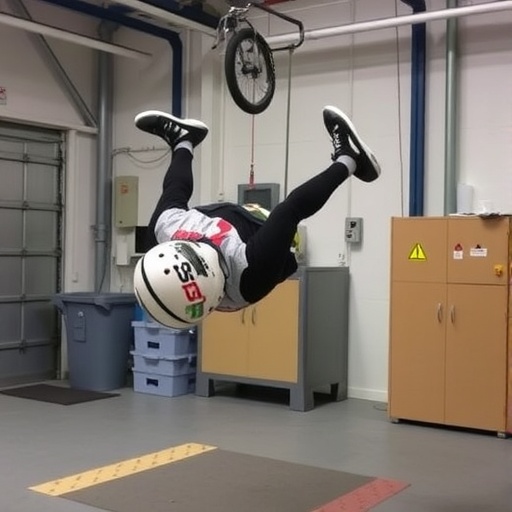
Recent advancements in safety equipment have brought to light the essential need for comprehensive testing methods to ensure user protection in high-risk environments. Among these, safety helmets are critical for mitigating head injuries during various activities, particularly those related to sports and construction. Researchers are now placing greater emphasis on developing standardized testing methods to accurately assess the performance of helmets under specific impact conditions. In a groundbreaking study titled “Development of a Fall-Specific Impact Testing Method to Evaluate Safety Helmet Performance and Injury Risk,” Gagliardi et al. explore a novel approach to evaluating helmet effectiveness to reduce injury risks.
The study underlines the alarming prevalence of head injuries resulting from falls, emphasizing how existing tests may not adequately replicate the scenarios in which such injuries typically occur. Traditional helmet testing methods often rely on drop tests that may not simulate the real-world impact conditions accurately, leaving a significant gap between laboratory results and actual safety performance. This discrepancy prompted the researchers to delve into creating a more targeted impact testing methodology specifically tailored to mimic the dynamics of falls.
The researchers conducted comprehensive analyses to identify the specific parameters that could lead to more relevant results in impact testing. Their investigation involved understanding the biomechanics of head injuries, notably the forces and angles that could lead to severe damage. By recognizing that falls can vary dramatically in characteristics—such as height, surface type, and impact angle—they proposed a standardized protocol that addresses these variables and generates data that is more aligned with real-world circumstances.
A pivotal aspect of the study involved extensive collaborations with engineers and industry experts who provided insights into the design and construction of helmets. Their contributions helped formulate criteria that were both practical and effective in assessing safety helmet designs. Armed with this framework, the researchers embarked on a rigorous evaluation of various helmet models, subjecting them to their new testing methods to generate comparative performance data.
The data accumulated from these tests revealed some surprising insights into the effectiveness of existing helmet designs. Some helmets that performed adequately in traditional testing failed to produce the same results when assessed through the new fall-specific impact testing method. This inconsistency raised concerns over the reliability of current safety rating systems and prompted calls for industry-wide reforms to adopt the new testing protocols.
Moreover, the researchers highlighted the importance of continuous innovation in helmet design. With their findings, there exists an urgent need for manufacturers to reconsider the materials and construction techniques used in helmet production. Advancements in technology and materials science could pave the way for helmets that not only meet safety standards but also offer improved comfort and usability for wearers in dynamic environments.
The implications of this research extend beyond academia into public policy and regulatory frameworks governing safety equipment. Policymakers can use these findings to drive legislative changes aimed at enhancing public safety standards. By prioritizing research-grounded methodologies in their regulations, authorities could ensure that all safety helmets sold in the market meet rigorous safety benchmarks tailored to real-life risks.
The study has also sparked interest among various stakeholders, including manufacturers, government agencies, and advocacy groups. Each party is keen to understand how the implementation of the new testing methods could reshape consumer expectations and industry standards. Consumers, for instance, expect more transparency and evidence backing the safety claims made by manufacturers, especially when it comes to products as crucial as helmets.
In light of the study, educational initiatives are recommended to raise awareness about the importance of helmet safety and the implications of choosing the right equipment. Educational campaigns targeting vulnerable demographics, such as youth athletes and construction workers, could be instrumental in disseminating knowledge about the newest safety standards and testing methodologies.
Moving forward, the research team is exploring the possibility of extending their testing method to other types of protective gear beyond helmets. Such advancements could create an ecosystem of enhanced safety equipment designed to save lives across multiple fields. By creating a foundational methodology that can be applied broadly, the researchers hope to influence the entire spectrum of personal protective equipment (PPE) usage and innovation.
In conclusion, Gagliardi et al.’s study represents a pivotal shift in how we approach helmet safety testing. With their focus on a fall-specific impact testing method, they have laid the groundwork for ensuring that safety helmets offer genuine protection against head injuries. As the research continues to reverberate across various sectors, it is clear that the implications will be felt for years to come, ushering in a new era of stringent safety standards that prioritize the well-being of individuals engaged in high-risk activities.
As society continues to grapple with issues of safety and risk management, studies like this serve to remind us that there is always room for improvement. Continuous research, innovative thinking, and collaboration are crucial in the pursuit of technologies that protect lives and minimize dangers associated with everyday activities. Helmet safety may be just one area among many that requires concerted efforts to push boundaries and redefine standards, but it is a critical one that can have far-reaching impacts on public health and safety.
Ultimately, the development of new testing methods presents an opportunity not just for academic inquiry, but for holistic advancements in safety awareness, product development, and regulatory measures aimed at ensuring that protective gear remains effective in safeguarding users against the unpredictable nature of falls and related incidents.
Subject of Research: Development of fall-specific impact testing methods for safety helmets.
Article Title: Development of a Fall-Specific Impact Testing Method to Evaluate Safety Helmet Performance and Injury Risk.
Article References:
Gagliardi, S.M., Stark, N.EP., Begonia, M.T. et al. Development of a Fall-Specific Impact Testing Method to Evaluate Safety Helmet Performance and Injury Risk.
Ann Biomed Eng (2025). https://doi.org/10.1007/s10439-025-03930-9
Image Credits: AI Generated
DOI: https://doi.org/10.1007/s10439-025-03930-9
Keywords: helmet safety, fall impact testing, injury prevention, head injuries, public safety standards.


