

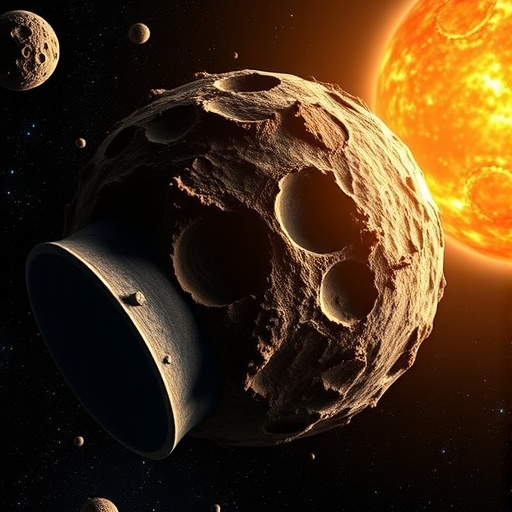
In a groundbreaking study that illuminates the magnetic and chemical evolution of early solar system materials, researchers from Tokyo University of Science have unveiled new insights into the natural remanent magnetization (NRM) characteristics of particles returned from asteroid Ryugu. These findings, recently published in the Journal of Geophysical Research: Planets, provide unprecedented details on how primordial astromaterials preserve records of the magnetic environment within the protoplanetary disk over 4.5 billion years ago.
The solar nebula—the cloud of gas and dust from which our solar system formed—was permeated by weak yet consistent magnetic fields generated by ionized gases. Understanding the interplay between this magnetic environment and early-formed solid materials enables scientists to reconstruct the conditions that governed planetary formation and disk evolution. Materials that accreted and underwent alteration within this primordial environment often lock in a magnetic signature as natural remanent magnetization, which can be preserved for billions of years, serving as a time capsule for solar system history.
Asteroid Ryugu, a near-Earth, carbon-rich rubble pile asteroid, originated from the catastrophic disruption of a larger parent body and is thought to harbor some of the most primitive solar system materials. The Hayabusa2 mission, spearheaded by the Japan Aerospace Exploration Agency (JAXA), successfully returned submillimeter-sized Ryugu particles to Earth in 2020, affording researchers direct access to pristine extraterrestrial material with minimal terrestrial magnetic contamination.
Previous studies analyzing the NRM of Ryugu samples have produced varying interpretations due to limited sample sizes and analytical sensitivity. Addressing this challenge, Associate Professor Masahiko Sato and his team conducted a comprehensive series of stepwise alternating field demagnetization (AFD) measurements on 28 individual Ryugu particles. Utilizing one of the world’s most sensitive superconducting quantum interference device (SQUID) magnetometers at the University of Tokyo, their methodological advances enabled precise separation of magnetic components.
Among the 28 studied particles, 23 exhibited stable NRM signatures, with several displaying complex, multi-component magnetization indicative of varied magnetization histories. Notably, one particle revealed spatially inhomogeneous remanent magnetization directions, signaling that some magnetization was acquired before full solidification of the particle itself. This critical observation rules out magnetization attributed to recent processes such as spacecraft handling or terrestrial contamination, confirming that the magnetization preserved is intrinsic and ancient.
The team interprets these magnetization characteristics as chemical remanent magnetization (CRM), consistent with growth of framboidal magnetite mineral structures within the Ryugu particles. The formation of these minute magnetic minerals is attributed to water-driven alteration processes on Ryugu’s parent body, demonstrating the role of aqueous alteration in the early solar system. Magnetite framboids are known for their stable magnetic properties, which make them excellent recorders of paleomagnetic fields.
Dating this magnetization to within approximately 3 to 7 million years of solar system formation situates the recorded magnetic fields in an era critical for the accretion and differentiation of early planetesimals. The preserved magnetic signal offers a window into the magnitude and temporal evolution of magnetic fields in the solar nebula during the epoch of planetary formation, thereby refining theoretical models of disk dynamics and mass transport.
These revelations have profound implications for our understanding of the conditions under which primitive materials—and eventually planets—formed. The data provide vital constraints on the timing and nature of magnetic field generation in the protoplanetary disk, a factor influencing dust coagulation, angular momentum transport, and the consequent structural evolution of the early solar nebula.
Dr. Sato emphasizes that “our high-sensitivity magnetic measurements on microsamples from asteroid Ryugu have resolved previous ambiguities about their natural remanence.” This breakthrough underscores the importance of high-precision paleomagnetic techniques in planetary science and the study of extraterrestrial materials to decipher the solar system’s formative processes.
The success of these meticulous analyses depended on advanced laboratory capabilities and careful curation protocols that prevented contamination. The research leverages interdisciplinary expertise spanning physics, mineralogy, and planetary science, showcasing the scientific value of sample-return missions like Hayabusa2.
Tokyo University of Science’s dedication to cutting-edge research and technological excellence has facilitated this landmark study. The university, with its long history of contributions to Earth and planetary magnetism research, continues to lead investigations that bridge atomic-scale phenomena with vast cosmic timescales.
Looking ahead, these findings open avenues for more detailed paleomagnetic investigations not only of Ryugu particles but also of samples returned from other celestial bodies, such as the Moon and Mars. Such studies will undoubtedly refine our understanding of early solar system evolution and the interplay between magnetic fields and planetary genesis.
This investigation marks a significant stride in unraveling the intricate magnetic history preserved in asteroid particles, advancing both scientific knowledge and the broader narrative of our cosmic origins.
Subject of Research: Not applicable
Article Title: Characteristics of Natural Remanence Records in Fine-Grained Particles Returned From Asteroid Ryugu
News Publication Date: 10-Feb-2026
References: DOI: 10.1029/2025JE009265
Image Credits: Associate Professor Masahiko Sato, Tokyo University of Science, Japan
Keywords
Natural remanent magnetization, Ryugu asteroid, Hayabusa2, framboidal magnetite, chemical remanent magnetization, superconducting quantum interference device, protoplanetary disk, solar nebula magnetic fields, paleomagnetism, early solar system evolution, planetary formation, aqueous alteration


