

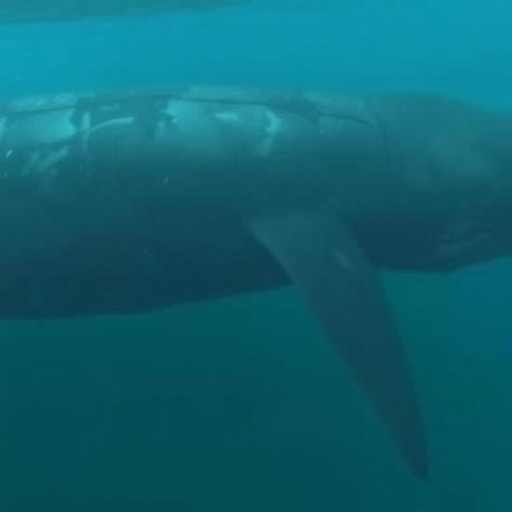
Scientists have made a groundbreaking leap in understanding one of the ocean’s most mysterious inhabitants—the beaked whale—without the need for direct visual observation. By harnessing advanced passive acoustic monitoring techniques, researchers have reconstructed the three-dimensional underwater movements and deep-diving behaviors of these elusive whales in the Gulf of Mexico. This unprecedented perspective offers critical insight into the lives of beaked whales, which are notoriously difficult to study due to their deep-sea habits and fleeting surface appearances.
The focal species of this study is the Gervais’ beaked whale (Mesoplodon europaeus), a species for which detailed behavioral data has been virtually non-existent until now. Through passive acoustic data alone, scientists have crafted a comprehensive picture of how these whales navigate, forage, and dive to extreme depths. This innovative approach captures the intricacy of their behaviors far below the ocean surface, revolutionizing our ability to study animals that remain concealed from conventional research methods.
Beaked whales spend the majority of their lives offshore in the deep ocean, surfacing only briefly to breathe before plunging once again into the dark abyss. Their elusive nature has made visual sightings incredibly scarce, and traditional tagging technologies are often impractical due to the animals’ sensitivity and deep-diving habits. The research team addressed these challenges using passive acoustics—deploying underwater listening stations capable of detecting species-specific echolocation clicks. These biologically generated clicks serve as acoustic signatures that can be precisely localized to track individual whales during their foraging descents.
Employing a network of High-Frequency Acoustic Recording Packages (HARPs) deployed at depths around 1,100 meters off the coast of Louisiana, scientists captured acoustic data during fifty distinct deep foraging dives. These HARPs consist of multiple time-synchronized sensors allowing for triangulation of the whales’ echolocation clicks. By measuring minute differences in the arrival times of sounds between sensors, the research team could estimate the direction and distance of individual whales, enabling the reconstruction of their three-dimensional movement paths underwater.
The application of this technology marked the first-ever detailed acoustic tracking of beaked whale dive behavior in the Gulf of Mexico. Three beaked whale species were studied: goose-beaked whales, Gervais’ beaked whales, and Blainville’s beaked whales. Among them, goose-beaked whales demonstrated longer detection durations and consistently deeper foraging dives, often approaching the seafloor. These new behavioral insights provide fresh understanding about species-specific diving strategies and habitat use.
This study’s innovative use of passive acoustics offers a scalable and non-invasive research methodology that can be applied across large marine areas. The ability to monitor these species continuously over long periods brings a significant advantage over traditional visual surveys or tagging, both of which are limited by weather conditions, observer availability, and the animals’ brief surfacing intervals. Such data acquisition is critical for robust conservation strategies, particularly as beaked whales face escalating threats from human activities.
The Gulf of Mexico, the site of this research, has experienced significant ecological disruptions over the past decade, most notably the 2010 Deepwater Horizon oil spill. Previous studies suggest that beaked whale populations in this region may have declined by up to 83% since the spill. The urgency to understand the behaviors and population dynamics of these whales amid mounting industrial impacts has never been greater. This research contributes vital baseline data to inform recovery and protection efforts in a heavily industrialized marine environment.
Héloïse Frouin-Mouy, Ph.D., lead author and bioacoustics scientist at the University of Miami’s Cooperative Institute for Marine and Atmospheric Studies (CIMAS), emphasized the critical timing of these findings. According to her, reliable, detailed behavioral data on these whales are necessary to monitor populations and address the potential declines caused by anthropogenic disturbances such as noise pollution and habitat degradation.
Data integration from two spatially separated HARPs allowed for more robust three-dimensional tracking capabilities. By comparing time-of-arrival differences of individual echolocation clicks at each sensor, researchers constructed a fine-scale map of whale movements and diving behavior. This approach not only uncovers spatial positioning but also temporal patterns in whale foraging, surfacing intervals, and movement dynamics within their deep-sea habitat.
The study’s comprehensive acoustic approach was conducted within the framework of the LISTEN project (Long-term Investigations into Soundscapes, Trends, Ecosystems, and Noise), a collaborative initiative led by NOAA’s Southeast Fisheries Science Center and partners, including the Scripps Institution of Oceanography. The project aims to expand understanding of marine soundscapes and the effects of anthropogenic noise on cetacean populations, which is increasingly pressing given the growth of offshore industrial activities.
Publishing their findings in the open-access journal PLOS One, the research team has set a new standard for marine mammal study methodology. The paper, “Beaked whale dive behavior and acoustic detection range off Louisiana using three-dimensional acoustic tracking,” outlines the technical innovations and biological discoveries enabled by these acoustic techniques and underscores their implications for conservation science.
Funding for this research was provided through NOAA’s RESTORE Science Program as part of a grant focused on monitoring long-term trends in cetacean populations throughout the Gulf of America. Additional support came from the Deepwater Horizon Open Ocean Trustee Implementation Group’s project aimed at reducing the impacts of anthropogenic noise on cetaceans. This combined support highlights the collaborative and multidimensional effort to mitigate human impacts on marine ecosystems.
In sum, this study demonstrates the remarkable potential of passive acoustic monitoring to pierce the veil of the deep sea and illuminate the lives of some of its most enigmatic residents. Through unprecedented acoustic tracking of beaked whales’ deep-diving behavior, researchers are opening doors to new understanding and more effective stewardship of the ocean’s fragile ecosystems amid an era of increasing anthropogenic pressures.
Subject of Research: Animals
Article Title: Beaked whale dive behavior and acoustic detection range off Louisiana using three-dimensional acoustic tracking
News Publication Date: 4-Feb-2026
Web References:
https://doi.org/10.1371/journal.pone.0340398
References:
Frouin-Mouy, H., Frasier, K.E., Hildebrand, J.A., Snyder, E.R., Wiggins, S.M., Garrison, L.P., Soldevilla, M.S. (2026). Beaked whale dive behavior and acoustic detection range off Louisiana using three-dimensional acoustic tracking. PLOS One. https://doi.org/10.1371/journal.pone.0340398
Image Credits:
Heloise Frouin-Mouy, Cooperative Institute for Marine and Atmospheric Studies (CIMAS), University of Miami Rosenstiel School of Marine, Atmospheric, and Earth Science
Keywords:
Mammals, Marine life, Cetaceans, Aquatic animals, Marine mammals


