

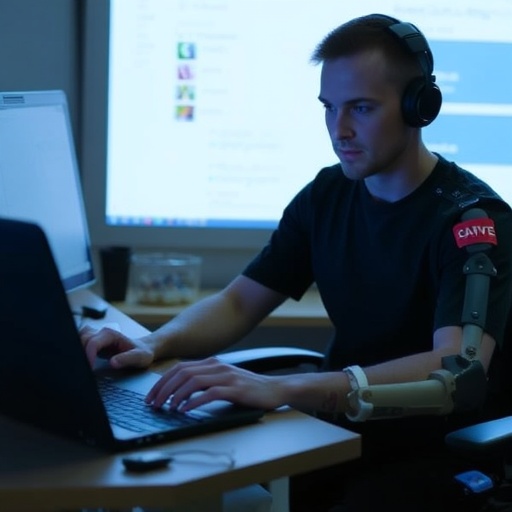
In a groundbreaking advancement at the intersection of neuroscience and neuroengineering, researchers have unveiled a novel neuroprosthetic device capable of restoring rapid, natural bimanual typing in an individual paralyzed from the neck down. This pioneering work, published in Nature Neuroscience in 2026, marks a significant stride toward reestablishing intricate motor functions through direct brain-machine interfaces. Far beyond mere cursor control or single-finger movements, the system enables fluid, coordinated typing with both hands, approaching the speed and dexterity observed in able-bodied individuals.
The rehabilitation of motor capabilities after paralysis has long presented a formidable challenge. While prior work has demonstrated the ability to decode simple motor intentions or restore limited hand function, translating complex, bimanual tasks such as typing remained elusive. The current study harnesses advanced neuroprosthetic technology integrated with sophisticated decoding algorithms to interpret neural population activity from motor cortical areas. By converting these signals in real-time into precise commands for a robotic interface, the team achieved a new paradigm for naturalistic motor restoration.
Central to the success of this approach was the implantation of intracortical electrode arrays into multiple brain regions responsible for planning and executing hand movements. These microelectrode arrays record the electrical activity of hundreds of individual neurons simultaneously, capturing the rich ensemble dynamics that underlie coordinated hand function. Using machine learning frameworks customized for high-dimensional neural data, the researchers decoded intended finger kinematics with unprecedented temporal and spatial fidelity, supporting simultaneous control of both hands.
The neural decoding pipeline was meticulously optimized to accommodate the rapid succession of finger movements characteristic of typing. Unlike earlier models focused on single-joint or isolated digit movements, this system leverages a multi-dimensional state-space model capturing inter-finger coordination and temporal patterns intrinsic to fluent typing. Consequently, the neuroprosthesis translates complex motor plans into seamless, multivariate control signals that drive two robotic arms equipped with dexterous fingers.
Extensive offline and online validation demonstrated that this technical feat translated into meaningful functional gains. The subject achieved a typing speed exceeding 70 words per minute with remarkable accuracy, rivaling pre-injury capability. The results signal a paradigm shift, indicating that restoring natural bimanual dexterity in people with severe paralysis is within reach. This level of performance was sustained over extended sessions, underscoring the neuroprosthesis’s potential for real-world applications such as communication and computer interaction.
Moreover, the study explored adaptive decoder recalibration techniques enabling the system to continuously refine performance as neural signals evolve. The brain’s plasticity was leveraged through closed-loop feedback, where the subject’s continual interaction with the neuroprosthesis and visual feedback led to progressively more fluent typing. This feedback-driven adaptability illustrates a new model for neuroprosthetic integration, where the device becomes an extension of the user’s own motor system rather than a passive tool.
This breakthrough was enabled by significant advancements in several complementary fields. High-channel count intracortical arrays with improved biocompatibility and longevity allowed long-term stable neural recordings. Parallel innovations in computational neuroscience facilitated the extraction of meaningful motor commands from noisy, complex neural activity patterns. Furthermore, custom robotic prosthetics designed to replicate the biomechanics of human hands provided the mechanical subtlety required for rapid typing.
Ethical and translational considerations accompanied the technical development. The researchers closely monitored brain tissue response and ensured minimally invasive surgical approaches to maximize safety and durability of the implants. The human subject’s input remained central throughout the experiment, emphasizing patient-centered design. This approach highlights the importance of integrating neural engineering with clinical neuroscience to move emerging therapies from laboratory prototypes to viable clinical solutions.
Looking forward, this technology sets a precedent for restoring a wide array of intricate motor functions lost to paralysis. While typing is critical for communication, the underlying principles can extend to musical instrument playing, tool use, or personal care tasks requiring dexterous bimanual coordination. As decoding algorithms and device designs further improve, the prospect of fully reanimating complex hand functions through brain-machine interfaces becomes increasingly realistic.
The implications of this advancement ripple beyond motor restoration. It provides a platform for fundamental neuroscience studies probing the cortical basis of coordinated bimanual actions. Understanding how the brain orchestrates fine motor control at the neural population level informs both basic science and neuroprosthetic innovation. The integration of robotics with brain signals also explores new frontiers in human-computer interaction, blurring the lines between biological and artificial systems.
Despite this remarkable progress, challenges remain to be addressed. Long-term implant stability, minimizing user fatigue, optimizing power consumption, and enhancing portability are key engineering hurdles. Researchers are also investigating methods to incorporate sensory feedback to provide closed-loop haptic perception, which could further augment naturalistic control. The road to widespread clinical deployment will require extensive trials and continued refinement of user-centric design.
Nevertheless, this study represents a beacon of hope for individuals coping with devastating paralysis. By demonstrating the coupling of cutting-edge neural decoding with dexterous robotic hardware to restore complex actions, the research inspires renewed optimism. The restoration of rapid bimanual typing reveals how technology can empower human expression and autonomy despite profound physical limitations.
As the field builds on this landmark achievement, it will be crucial to foster interdisciplinary collaboration between neuroscientists, engineers, clinicians, and end-users. Such synergy accelerates the translation of lab-based breakthroughs into accessible, impactful therapies. The long-term vision is a future where brain-machine interfaces routinely enable people with paralysis to regain not only simple motor skills but the full spectrum of human hand function, reclaiming agency and quality of life.
The research journey reflects a harmonious synthesis of decades of innovation in neural recording, computational modeling, and robotics. From early brain-computer interface experiments that allowed cursor movement control to today’s advanced multi-degree-of-freedom neuroprostheses, this accomplishment is the culmination of persistent, collaborative effort. It exemplifies how scientific persistence can transform lives by unlocking the brain’s inherent capacity to guide artificial effectors.
In summary, the study published by Jude and colleagues signals a new era in neuroprosthetics. The swift restoration of natural, bimanual typing after paralysis no longer belongs to the realm of science fiction but stands firmly implanted in reality. This integrative approach, combining neural decoding with state-of-the-art robotic hands, lays the foundation for future sophisticated neurorehabilitation paradigms. The prospect of reconnecting mind and world through technology has never been more tangible or inspiring.
Subject of Research: Restoration of rapid, natural bimanual typing through neuroprosthesis after paralysis.
Article Title: Restoring rapid natural bimanual typing with a neuroprosthesis after paralysis.
Article References:
Jude, J.J., Levi-Aharoni, H., Acosta, A.J. et al. Restoring rapid natural bimanual typing with a neuroprosthesis after paralysis. Nat Neurosci (2026). https://doi.org/10.1038/s41593-026-02218-y
Image Credits: AI Generated
DOI: https://doi.org/10.1038/s41593-026-02218-y


