

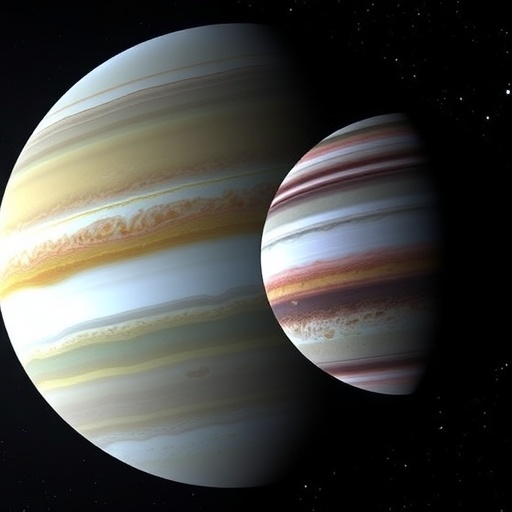
Deep within the forbidding interiors of ice giants like Uranus and Neptune, a remarkable and previously unrecognized state of matter may reside, challenging our fundamental understanding of planetary science and high-pressure physics. Researchers Cong Liu and Ronald Cohen from the Carnegie Institution for Science have recently utilized advanced computational simulations to predict the existence of a quasi-one-dimensional superionic phase in carbon hydride compounds under the extreme pressure and temperature conditions present in these distant celestial bodies. This groundbreaking discovery not only highlights new dimensions in the behavior of simple chemical systems but also opens exciting possibilities for interpreting planetary magnetic fields and internal energy transport mechanisms.
Recent advancements in exoplanet detection have expanded our catalog of planetary systems beyond the Solar System to over 6,000 confirmed worlds, intensifying interdisciplinary efforts among astronomers, planetary scientists, and condensed matter physicists. To decode the dynamic and often enigmatic processes shaping these planets, researchers must probe deep beneath planetary surfaces where conditions reach millions of times Earth’s atmospheric pressure and thousands of degrees in temperature. Such extremes foster exotic physical phenomena and previously unknown material phases, which, until now, remained elusive.
The ice giants Uranus and Neptune showcase particularly intriguing internal structures, with mass and density data suggesting stratified layers comprised of “hot ices” — dense phases of water, methane, and ammonia residing beneath their thick hydrogen-helium atmospheres but above their rocky cores. However, the intense pressure-temperature regime within these layers, reaching upward of 3,000 gigapascals and temperatures of several thousand Kelvin, forces materials to adopt unconventional arrangements. This complex environment challenges existing models and prompts theoretical inquiries into the possible emergent behaviors of planetary constituents.
Using a robust combination of fundamental quantum mechanical simulations powered by high-performance computing and enhanced with machine learning algorithms, Liu and Cohen explored the properties of carbon hydride (CH) under these extreme conditions. Their simulations spanned pressures of nearly 5 to 30 million atmospheres, with temperatures ranging from approximately 4,000 to 6,000 Kelvin. These studies revealed the spontaneous formation of a novel hexagonal lattice framework, within which hydrogen atoms exhibit highly directional, spiral-like mobility — a hallmark signature of superionic conduction.
Superionic materials occupy a fascinating intermediate phase of matter, simultaneously displaying characteristics of both crystalline solids and ionic liquids. In the newly identified carbon hydride phase, carbon atoms constitute a rigid hexagonal backbone, while hydrogen ions are not static but can traverse fixed, quasi-one-dimensional helical pathways embedded within the carbon scaffold. This behavior contrasts sharply with typical superionic phases, where ionic conduction occurs in three-dimensional random pathways, marking a significant shift in our understanding of atomic mobility under such conditions.
Ronald Cohen elaborates, noting that the anisotropic, directional movement of hydrogen ions along helical channels is particularly striking. This motion is restricted to defined spiral routes, reflecting a quasi-one-dimensional superionic phase unlike any previously observed in condensed matter physics. This emergent behavior is governed by the intricate interplay of lattice geometry, ion-ion interactions, and the daunting pressure-temperature environment reminiscent of planetary interiors.
The implications of such highly directional ionic conduction reach far beyond mere structural curiosity. The intricate pathways could profoundly affect the transport properties within Uranus and Neptune’s interiors, including thermal conductivity and electrical conduction, two critical factors in understanding the generation and modification of planetary magnetic fields. Unlike Earth’s geodynamo, driven by convective motion in the liquid iron outer core, ice giants generate magnetic fields whose origins remain enigmatic, partly due to their unconventional internal compositions.
By capturing such directional superionic behavior, Liu and Cohen’s predictive models promise to inform and refine numerical simulations of planetary interiors and magnetohydrodynamic processes. Their work highlights how the exotic physics of superionic phases might modulate not only heat distribution but also electrical current pathways, potentially leading to complex magnetic field geometries and temporal variations observed around ice giants.
Moreover, this research expands the frontiers of condensed matter physics by demonstrating the emergence of unexpectedly intricate structures from deceptively simple elemental systems. Carbon and hydrogen, ubiquitous cosmic elements, reveal if subjected to sufficient pressure and temperature, the capacity to self-organize into ordered frameworks with emergent directionality and ion mobility constrained in novel ways. Such phenomena challenge existing paradigms and hint at a rich spectrum of phases yet to be discovered under extreme conditions.
Beyond planetary science, such findings carry potential ramifications for materials engineering and technology on Earth. Understanding strongly directional superionic pathways could inspire the design of advanced ionic conductors, solid-state electrolytes, or heat management systems with tailored anisotropic conduction properties possibly relevant for next-generation batteries, fuel cells, or electronic devices. By mimicking nature’s playbook under extreme environments, scientists could innovate beyond current materials limitations.
Cong Liu underscores the incomplete nature of our knowledge regarding carbon and hydrogen’s joint behavior under planetary interior conditions despite their cosmic abundance. The complex phases emerging inside giant planets remain largely unexplored experimentally, making theoretical predictions vital guides for future high-pressure experiments and spacecraft investigations. Such knowledge bridges planetary physics, chemistry, and materials science in a truly interdisciplinary fashion.
Ultimately, the study of quasi-one-dimensional superionic carbon hydride not only advances planetary interior modeling but also enriches our broader understanding of matter under extremes. As computational power grows and experimental techniques push toward recreating planetary core conditions, the boundary between theoretical predictions and empirical verification narrows, promising exciting discoveries in the years ahead.
Subject of Research:
Phase behavior of carbon hydride under extreme pressure and temperature conditions characteristic of giant planetary interiors.
Article Title:
Prediction of thermally driven quasi-1D superionic states in carbon hydride under giant planetary conditions
Web References:
https://www.nature.com/articles/s41467-026-70603-z
DOI: 10.1038/s41467-026-70603-z
Image Credits:
Illustration by Cong Liu showing hexagonal carbon hydride with spiral chains of carbon (yellow) and hydrogen (blue).
Keywords:
carbon hydride, superionic state, quasi-one-dimensional conduction, ice giant interiors, high-pressure physics, planetary magnetic fields, quantum simulations, carbon-hydrogen compounds, planetary science, condensed matter physics, high-temperature materials, machine learning simulations


