

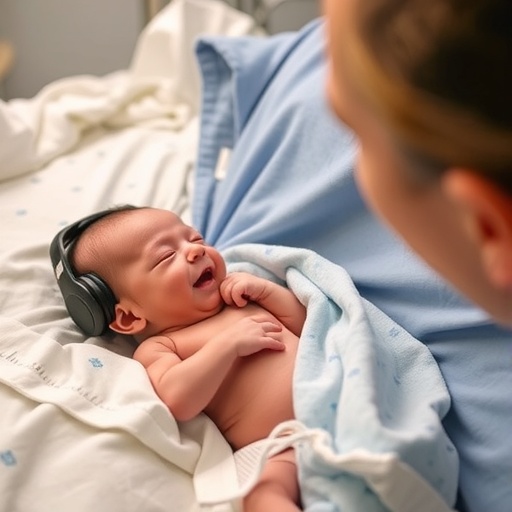
In a groundbreaking study set to reshape our understanding of early developmental care, researchers have unveiled compelling evidence on how language and sound exposure during neonatal intensive care unit (NICU) stays influence the neurodevelopmental trajectories of critically ill newborns. The investigation, spearheaded by Pineda, Woodward, Vesoulis, and colleagues, provides an in-depth analysis of how the auditory environment within NICUs—traditionally viewed through a clinical and often utilitarian lens—plays a pivotal role in shaping early neurological outcomes for these vulnerable infants. This research, published in the Journal of Perinatology in March 2026, arrives at an inflection point where technological advances in neonatal care meet emergent insights from developmental neuroscience.
Neonatal intensive care units are intrinsically noisy environments, dominated by the frequencies of medical devices, alarms, and caregiving activities, but generally lack the rich, modulated soundscapes that foster normal sensory and language development. The research team employed sophisticated audio monitoring equipment to quantify the quality and quantity of sound exposure across different stages of hospitalization. They found that not merely the presence of sounds but their linguistic content—the cadence, rhythm, and complexity of spoken language—significantly modulated neurobehavioral outcomes. This challenges earlier paradigms that primarily focused on medical stabilization, suggesting that sensory inputs during critical windows are equally imperative for brain maturation.
The investigators meticulously cataloged auditory stimuli, parsing apart machine-generated noise from human speech and other meaningful sounds. Infants exposed to higher proportions of parentese—infant-directed speech characterized by exaggerated intonation and slower tempo—and soothing auditory stimuli demonstrated accelerated milestones in early cognitive and motor function assessments. The acoustic environment emerged not as an incidental backdrop but as an active agent in neurodevelopment. These findings emphasize the NICU’s transformation possibilities, proposing that intentional sound landscapes could be integrated into standard care protocols.
Technological innovation played a crucial role in this research endeavor. The team utilized state-of-the-art acoustic analysis software capable of continuous, non-intrusive monitoring without disturbing the fragile neonates. Beyond passive observation, the study leveraged machine learning algorithms to predict outcomes based on sound exposure patterns, thus forging a link between complex auditory environments and developmental prognostication. This integration of technology heralds a new era where real-time feedback on NICU sound quality could dynamically tailor interventions to optimize neurodevelopmental health.
The implications of this research extend beyond theoretical insights, offering a roadmap for clinical application. Developmental care in NICUs has often concentrated on physical health parameters, but now caregivers must attend to auditory and linguistic environments as modifiable factors influencing developmental programming. Creating auditory niches—spaces within NICUs enriched with parental voices, controlled exposure to language, and minimized disruptive noise—may reframe neonatal care practices. Interdisciplinary collaboration among neonatologists, speech therapists, and environmental designers is warranted to translate these findings into tangible benefits.
Further, the study underscores the critical interplay between early environmental exposures and the plasticity of the neonatal brain. During the critical periods of sensory cortex development, appropriate auditory stimuli appear to enhance synaptogenesis and neural circuit refinement. Conversely, excessive or chaotic noise exposure may impose stress responses, triggering neuroinflammatory pathways detrimental to long-term outcomes. This dual-sided effect positions sound management as a potential target to mitigate adverse sequelae commonly associated with premature birth and prolonged hospitalization.
The research also contributes valuable data to the burgeoning field of epigenetics, suggesting that auditory experiences might shape gene expression patterns related to neurodevelopment. While causality requires further elucidation, the observed associations hint at intricate biological mechanisms where external sensory cues are translated into molecular changes, thus influencing brain architecture and function. This avenue promises fertile ground for future inquiries exploring how early life soundscapes modulate genomic regulation.
Importantly, the study brings attention to disparities in familial presence and auditory exposure. Infants with limited parental visitation or those in resource-poor settings typically face impoverished linguistic environments during hospitalization, which could exacerbate developmental vulnerabilities. This social dimension of neonatal care highlights the need for systemic interventions ensuring equitable access to enriching sensory experiences. Hospitals may consider integrating technologies such as recorded parental voices or virtual interaction platforms to bridge these gaps.
The authors emphasize that this research does not diminish the need for medical vigilance but rather complements it by revealing a critical, previously underappreciated aspect of neurodevelopmental support. Neonatal teams must balance necessary interventions and monitoring with strategies designed to cultivate beneficial auditory environments. Protocols may evolve to minimize unnecessary alarms, optimize the timing and nature of caregiver speech, and incorporate family-centered language therapies as standard elements of neonatal care.
Additionally, the study’s findings have ramifications for the design of future NICU facilities. Acoustic architecture, including soundproofing, strategic use of speakers, and ambient noise modulation systems, could be integral to new construction and refurbishment projects. The convergence of engineering and clinical science encapsulated in this research underlines an emerging multidisciplinary approach to neonatal health, where environmental modifications are as essential as pharmacological and surgical treatments.
On a broader horizon, the insights gleaned from this pivotal study enhance our understanding of critical periods in brain development and the malleability of early neural circuits to environmental inputs. They reinforce the concept that sensory experience right from birth influences trajectories far beyond the neonatal period, shaping language acquisition, social-emotional skills, and cognitive competencies throughout life. Interventions in the NICU, therefore, carry weighty implications not just for immediate survival but for lifelong well-being.
The authors call for larger, multicenter trials to validate these outcomes and refine auditory intervention protocols. They envision an ecosystem where real-time acoustic monitoring devices, embedded in NICU workflows, inform personalized care plans that optimize each infant’s sensory and neurological environment. This prospective shift toward integrative, sound-conscious neonatal care has the power to transform clinical paradigms and improve quality of life for countless children born prematurely or with critical illness.
In sum, Pineda, Woodward, Vesoulis, and their research colleagues have delivered a compelling narrative that beckons a re-evaluation of neonatal intensive care. Their work elevates the importance of language and sound exposure from peripheral considerations to essential therapeutic elements. As neonatal survival rates improve, attention must pivot towards optimizing neurodevelopmental outcomes, and auditory environment modulation emerges as a promising frontier, offering hope for enhancing brain resilience from the very first moments of life.
This research not only adds a vital piece to the puzzle of neonatal development but also inspires a broader societal rethinking of how humanity supports its most fragile members during their earliest, most vulnerable phases. By advocating soundscapes infused with language, care, and nurture, the findings encourage us to imagine NICUs not just as medical sanctuaries but as environments where the seeds of human potential are nurtured through carefully orchestrated auditory experiences.
Subject of Research: Language and sound exposure during neonatal intensive care hospitalization and their relationship to early developmental outcomes.
Article Title: Language and sound exposure across neonatal intensive care hospitalization and relationships with early outcome.
Article References:
Pineda, R., Woodward, L., Vesoulis, Z. et al. Language and sound exposure across neonatal intensive care hospitalization and relationships with early outcome. J Perinatol (2026). https://doi.org/10.1038/s41372-026-02623-y
Image Credits: AI Generated
DOI: 10.1038/s41372-026-02623-y, Published 13 March 2026


