

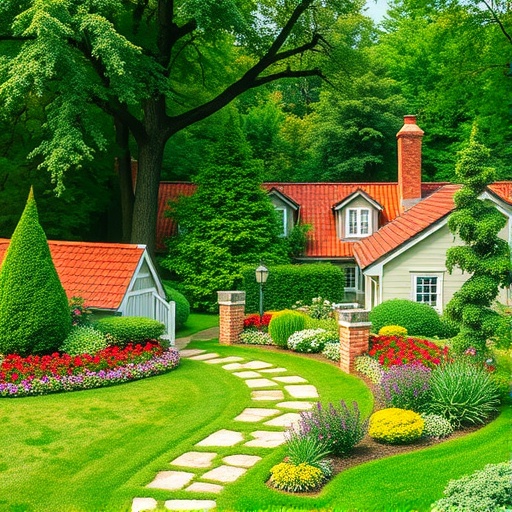
In an era marked by escalating urbanization and the consequent strain on natural habitats, private gardens have emerged as critical bastions for conserving urban biodiversity. A groundbreaking study conducted by Liebe, Meyerhoff, and Rehdanz, recently published in npj Urban Sustainability, has delivered a surprising insight into the social dynamics influencing biodiversity efforts at the neighborhood level. Their research robustly challenges the prevailing assumption that neighborhood social norms act as a barrier to biodiversity conservation in private gardens. Instead, the study elucidates that these norms do not significantly impede homeowners’ environmental stewardship, opening new avenues for urban conservation strategies.
The exponential growth of cities worldwide has led to the fragmentation and loss of natural habitats, threatening countless species. Urban green spaces, including private residential gardens, have gained recognition for their role in preserving urban biodiversity. However, the collective success of biodiversity conservation in private gardens can be influenced by social factors. Conformity to neighborhood aesthetics and shared expectations has often been speculated to suppress ecological initiatives, particularly those that might appear untidy or unconventional from a landscaping perspective.
Liebe and colleagues systematically investigated the relationship between neighborhood norms and biodiversity-friendly gardening practices. Their interdisciplinary approach integrated sociological analysis with environmental science, aiming to dissect how social pressures might shape conservation behaviors in urban settings. The study employed comprehensive surveys and behavioral assessments across diverse neighborhoods, capturing nuanced data on residents’ motivations, attitudes, and actual gardening practices.
A pivotal finding of the study is that concerns over social acceptance and adherence to neighborhood aesthetics do not present a decisive blockade to biodiversity-promoting actions. Contrary to expectations, many gardeners who actively engage in ecological gardening reported little to no fear of social sanctions or negative judgment from their neighbors. This insight overturns the once-dominant narrative suggesting that social conformity severely limits ecological innovation within private residential spaces.
The researchers suggest that this phenomenon may be partly explained by a shifting cultural paradigm wherein environmental consciousness increasingly overlaps with desirable social identities. Gardening for biodiversity is becoming a symbol of civic responsibility and modern lifestyle rather than a social anomaly. This shift underscores the potency of social norms evolving in tandem with environmental awareness, thereby fostering pro-conservation behaviors rather than hindering them.
Technically, the study deployed advanced statistical models to parse out the impact of neighborhood norms versus individual environmental values. By controlling for variables such as socioeconomic status, garden size, and prior exposure to ecological information, the analysis pinpointed the relative insignificance of normative social pressures compared to personal convictions and ecological knowledge. These findings validate that internal motivations and education may be more critical drivers of biodiversity conservation at home than previously recognized.
Further elucidating these dynamics, the team explored the types of biodiversity-friendly practices most commonly embraced by residents. These included the planting of native species, reduced use of chemical pesticides, installation of pollinator habitats, and creation of structural diversity through logs, stones, and varied vegetation layers. Notably, adoption rates of these practices were highest among individuals with strong pro-environmental attitudes rather than those influenced by neighborhood conformity.
An important dimension of the study also involved qualitative interviews revealing residents’ perceptions of neighborhood social dynamics. Participants overwhelmingly described their communities as “supportive” or “neutral” regarding wildlife-friendly gardening. Fear of neighborly criticism was often eclipsed by pride in contributing to urban ecological health, hinting at a transformation in the social narrative surrounding gardening aesthetics and biodiversity.
The implications of these findings for urban sustainability policies are profound. Municipalities and conservation organizations can recalibrate their outreach and incentive programs to emphasize empowering individual values and environmental education over attempting to modify neighborhood social norms. Tailoring strategies to foster intrinsic motivation may prove more effective in scaling up biodiversity-friendly practices on private properties.
Moreover, the study advocates for integrating biodiversity into urban planning frameworks not merely as an ecological goal but as a socially endorsed lifestyle choice. By reinforcing positive ecological identities and facilitating peer networks of conservation-minded gardeners, cities can harness social dynamics as allies rather than obstacles in their efforts to enhance urban biodiversity.
The technical underpinnings of the research also provide a robust framework for future investigations. The methodological synergy of sociological theory and environmental impact analysis establishes a replicable model for assessing social-ecological interactions across diverse urban contexts. Researchers can now apply similar approaches to examine other conservation behaviors influenced by social norms beyond gardening, such as water conservation, waste reduction, and urban wildlife support.
In summary, the research led by Liebe, Meyerhoff, and Rehdanz marks a pivotal advancement in understanding how urban social structures interface with biodiversity conservation in private gardens. By debunking the myth that neighborhood norms stifle ecological innovation, the study offers hope and practical pathways for augmenting urban biodiversity through empowered individual action. As cities continue to grapple with environmental challenges, leveraging this insight will be paramount in designing resilient, biodiverse urban futures.
Looking forward, continued interdisciplinary research building on these findings can further unravel the complexities of human-nature relationships within cities. Longitudinal studies may track how shifting social norms and environmental attitudes interact with evolving urban landscapes over time. Additionally, expanding the geographical scope to include varied cultural contexts will enrich the global applicability of these conclusions.
Ultimately, this study champions a renewed optimism for urban biodiversity conservation. Private gardens—once perceived as socially constrained spaces—are revealed as fertile grounds for ecological restoration, driven by informed, motivated, and socially supported homeowners. Mobilizing this potential at scale promises to transform urban ecosystems into vibrant, wildlife-friendly habitats amid the concrete sprawl.
This new paradigm aligns harmoniously with the broader goals articulated in global sustainability agendas, including the United Nations Sustainable Development Goals. Emphasizing individual empowerment coupled with positive social identity formation can accelerate progress toward healthier, more inclusive, and ecologically rich urban environments. The findings from Liebe and colleagues thus resonate far beyond scientific circles, calling for a collective reevaluation of how we nurture nature where we live.
As residents increasingly recognize the value of biodiversity in their own backyards and communities, cities worldwide may witness a cultural renaissance—a cultivation of green spaces that are both beautiful and biologically vital. This evolution in urban living, underpinned by the study’s pivotal insights, offers a vision where every garden becomes a microcosm of global sustainability in action.
Subject of Research:
Article Title:
Article References:
Liebe, U., Meyerhoff, J. & Rehdanz, K. Neighbourhood norms do not hinder biodiversity conservation in private gardens.
npj Urban Sustain (2026). https://doi.org/10.1038/s42949-025-00335-4
Image Credits: AI Generated
DOI: https://doi.org/10.1038/s42949-025-00335-4
Keywords: urban biodiversity, private gardens, neighborhood norms, biodiversity conservation, social norms, urban sustainability, ecological gardening, pro-environmental behavior


