

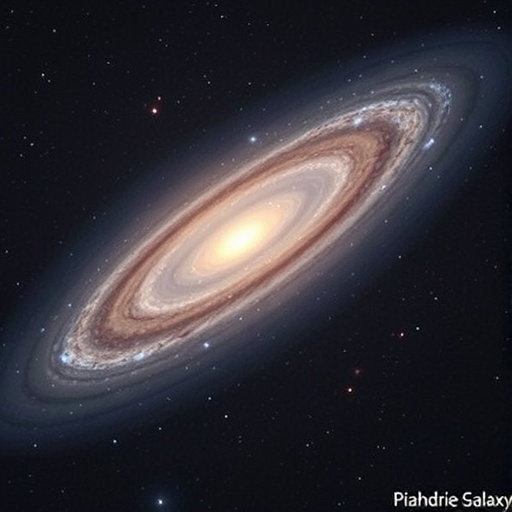
In a groundbreaking study published in The Astrophysical Journal, astronomers from the University of Arizona have unveiled compelling evidence pointing to a direct collision between two of the Milky Way’s nearest galactic neighbors—the Small Magellanic Cloud (SMC) and the Large Magellanic Cloud (LMC)—as the cause of the SMC’s curious stellar motion. This collision, which took place several hundred million years ago, has left the SMC in a dramatic state of upheaval, disrupting its expected rotational dynamics and challenging long-standing assumptions about its structure and evolution.
Located in the southern sky, the SMC is a small, gas-rich dwarf galaxy visible to the naked eye and gravitationally tethered to the Milky Way alongside the larger LMC. Despite decades of observation and detailed maps cataloging its stars and gas, the SMC defies the typical galactic behavior: its stars do not orbit neatly around its center in an orderly rotational pattern, a hallmark of many galaxies. This anomalous behavior has puzzled astronomers for over fifty years, until now.
The research team, led by graduate student Himansh Rathore at the University of Arizona’s Steward Observatory, used sophisticated computational simulations combined with observational data from the Hubble Space Telescope and the European Space Agency’s Gaia satellite to unravel this enigma. Their models reveal that the SMC plowed directly through the disk of the LMC in a high-velocity collision. The immense gravitational forces of the larger LMC disrupted the SMC’s internal equilibrium, sending its stars into chaotic, non-rotational orbits.
This galactic crash not only perturbed the stars but also dramatically impacted the SMC’s gas dynamics. Typically, gas in galaxies cools and contracts under gravity into a rotating disk, which seeds the formation of stars that inherit this rotational momentum. However, the collision exerted what physicists term ram pressure on the SMC’s gas, analogous to the way water droplets get stripped from a hand moving swiftly through air. As the SMC’s gas plowed through the denser environment of the LMC’s gas, it experienced a devastating loss of its coherent rotational motion.
The collision’s effect on the SMC’s gaseous and stellar components sheds light on a decades-old controversy. Historically, observations hinted that the SMC’s gas was in rotation, but the stars did not mimic this spin—a discrepancy that complicated previous models of star formation and galactic structure in the dwarf galaxy. Rathore and his team’s innovative analysis shows this apparent rotation was in fact an illusion caused by perspective: the SMC’s tidal stretching during the collision created velocity gradients along our line of sight, mimicking rotation in spectral observations.
This revelation profoundly affects how scientists view the SMC as a cosmic laboratory. For years, astronomers have used the SMC as a nearby analog for understanding the properties of early galaxies—small, gas-rich, and low in metallicity. However, the recognition that the SMC is currently in a highly disturbed, non-equilibrium state caused by this collision implies that it may no longer serve as a pristine benchmark for galactic evolution studies. The aftermath of the collision injected energy and complexity into the system, making the SMC an exceptional, rather than typical, galaxy.
Professor Gurtina Besla, a senior author on the paper and an expert on galactic dynamics, emphasizes the significance of this finding. “The SMC is not a ‘normal’ galaxy,” she notes. “Its catastrophic encounter with the LMC has fundamentally altered its internal motions, providing a vivid glimpse of galaxy transformation in real time.” This perspective encourages astronomers to reconsider assumptions about dwarf galaxy evolution throughout cosmic history.
The University of Arizona team utilized highly tailored computational models calibrated with precise empirical parameters, including the mass distributions of stars and gas in both the SMC and LMC, as well as their spatial trajectories through the Milky Way’s gravitational environment. These simulations, integrated with hydrodynamic calculations of gas interactions during the collision, allowed them to replicate the observed kinematic signatures and further refine interpretations of the SMC’s current state.
Furthermore, the methodological advances pioneered in this study provide new tools for decoding the messier motions of stars in post-collision galaxies, beyond the SMC. These techniques can be broadly applied to other galactic systems observed in disturbed or interacting states, enhancing our ability to translate telescope data into accurate insights about the dynamics and history of stellar populations.
This transformative event between the SMC and LMC not only explains the disordered stellar kinematics but also leaves intriguing imprints on the structure of the LMC itself. Previous research led by Rathore in 2025 found that the collision tilted the LMC’s central bar-shaped structure out of its galactic plane. This tilt is strongly influenced by the amount of dark matter contained in the SMC, suggesting a novel way to probe the elusive dark matter component indirectly through its gravitational impact on galactic morphology.
Astrophysics often relies on static snapshots of celestial bodies, but this study highlights the fluidity of cosmic evolution. As Rathore eloquently states, “These two galaxies did not merely nudge each other—they collided and redefined their paths, offering unmatched insight into the dynamism of galactic life cycles.”
Ultimately, this research underscores the importance of integrating dynamical histories into our models of galaxy behavior, particularly in dwarf galaxies where interactions can dramatically skew their evolutionary trajectories. The Small Magellanic Cloud’s current turbulent state serves both as a cautionary tale and a scientific opportunity, revealing the complex interplay of gravity, gas, and stars shaping galaxies across the universe.
Subject of Research: Not applicable
Article Title: A Galactic Transformation—Understanding the SMC’s Structural and Kinematic Disequilibrium
News Publication Date: 16-Mar-2026
Web References: DOI link to the study
Image Credits: Himansh Rathore, University of Arizona
Keywords
Small Magellanic Cloud, Large Magellanic Cloud, galactic collision, stellar kinematics, ram pressure stripping, dwarf galaxies, galactic evolution, cosmic dynamics, dark matter, computational simulation, Hubble Space Telescope, Gaia satellite


