

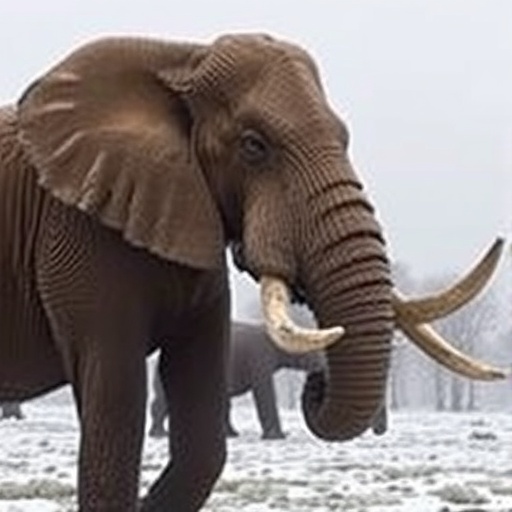
In the northeastern German region of Neumark-Nord, a remarkable paleontological landscape once flourished during the last interglacial period, approximately 125,000 years ago. Today, this area, situated in Saxony-Anhalt, stands as one of Europe’s paramount sites for the study of the extinct European straight-tusked elephant, Palaeoloxodon antiquus. Excavations during lignite mining have uncovered fossilized remains of more than seventy individual elephants, offering an unparalleled glimpse into the interactions between these colossal megafauna and the Neanderthals who inhabited the region during the Pleistocene epoch.
The significance of Neumark-Nord lies not only in the sheer abundance of elephant remains but also in their contextual association with late Middle Paleolithic human activity. These extensive finds form a crucial nexus for understanding both paleoecology and early human predation strategies. To unravel the life histories of these elephants and their intricate relationship with Neanderthals, an international team of researchers from Germany, the Netherlands, and the United States employed state-of-the-art analytical techniques combining isotope geochemistry and palaeoproteomics, fostering a multidisciplinary approach straddling archaeology, paleontology, and molecular biology.
Central to their investigation was a detailed examination of the teeth of four individual elephants using isotopic signatures derived from carbon (δ^13C), oxygen (δ^18O), and strontium isotopes (^87Sr/^86Sr), coupled with protein analyses preserved in dental enamel. Strontium isotope analysis, performed along the incremental growth lines of the molars, illuminated the geographical mobility of these animals across the European landscape. The variances in strontium isotope ratios revealed that several elephants undertook migrations spanning distances up to 300 kilometers over multiple years before settling in the Neumark-Nord region. This migratory behavior underscores the dynamic spatial ecology of Palaeoloxodon antiquus, contrasting with assumptions of strictly localized ranges.
Simultaneously, the isotopic analysis of carbon and oxygen provided critical insights into the dietary strategies and climatic conditions experienced by these prehistoric giants. Carbon isotope ratios elucidate the types of vegetation consumed, reflecting the ecological niches exploited, while oxygen isotopes shed light on climatic and hydrological variability, potentially influencing the movement and behavior of the elephants. The rigorous isotope measurements conducted at Frankfurt’s Isotope and Element Research Center (FIERCE) and the Max Planck Institute for Chemistry in Mainz allowed the researchers to reconstruct an unprecedented oral travel diary, tracing the complex ecological and environmental contexts encountered over the lifespans of these mammals.
Complementing the isotopic data, the application of palaeoproteomics opened a new frontier in paleontological research by successfully determining the sex of individual elephants through protein residues preserved in tooth enamel. This methodological breakthrough, marking the first use of such a technique on European straight-tusked elephants, illuminated sex-specific life histories and social structure within the population. Among the four individuals analyzed, three males and one likely female were identified. Notably, the males displayed isotopic signatures indicative of broader territorial ranges compared to the female, mirroring behavioral patterns observed in extant elephant species and suggesting intricate social organization.
The implications of these findings for understanding Neanderthal behavior are profound. The consistent concentration of elephant remains, combined with isotopic evidence, indicates that Neanderthals at Neumark-Nord engaged in deliberate, planned hunting of these massive animals rather than opportunistic scavenging. Such organized hunting implies a sophisticated comprehension of elephant ecology and movement patterns, necessitating cooperative strategies and knowledge of the landscape garnered over extended periods. This challenges traditional perceptions of Neanderthal subsistence strategies and social complexity, positioning them as adept predators capable of targeting megafauna.
Further archaeological and paleoecological evidence from Neumark-Nord complements this behavioral narrative. The site has yielded traces of systematic butchery and carcass processing spread across multiple locations, demonstrating an advanced division of labor and resource exploitation. Neanderthals extracted fat from large mammals at scale, supplemented their diet with plant foods like hazelnuts and acorns, and likely modified their environment through controlled use of fire to shape local ecosystems. These findings collectively suggest that Neanderthal populations at Neumark-Nord functioned within larger, socially organized groups with nuanced knowledge of their ecological niche.
Despite the critical inferences drawn from isotopic and proteomic data, several questions about the population dynamics of Neumark’s elephants remain open. Specifically, it is unclear whether Neumark-Nord served as a common aggregation point for elephants migrating from disparate regions or if it functioned as a permanent homeland, with individuals occasionally dispersing for adolescence or mating purposes. To address these uncertainties, ongoing genetic analyses aim to reconstruct the population structure and movement patterns more precisely, potentially yielding further insights into the interplay between elephant demography and Neanderthal predation strategies.
The collaborative effort behind this groundbreaking research involved a consortium of leading institutions, encompassing the University of Modena and Reggio Emilia, Goethe University Frankfurt, California Institute of Technology, Johannes Gutenberg University Mainz, MONREPOS Archaeological Research Center and Museum for Human Behavioral Evolution, Leiden University, Max Planck Institute for Chemistry, and Columbia University. Such interdisciplinary cooperation underscores the complexity of reconstructing ancient life histories and the necessity of integrating advanced technologies from diverse scientific domains.
In essence, the Neumark-Nord site encapsulates a vibrant snapshot of Pleistocene life, where massive herbivores roamed shifting lake-dominated landscapes and Neanderthals not only survived but thrived through sophisticated ecological adaptations. The revelation of elephants’ long-distance migrations, their social structuring, and the evidence of strategic human hunting behavior mark a pivotal advance in understanding the Pleistocene ecosystems of Europe. These insights reshape our comprehension of Neanderthal cognitive capacities, social organization, and interactions with megafauna, positioning them as an active and influential component of their environment rather than mere passive inhabitants.
Looking forward, the integration of isotopic, proteomic, and genomic data promises to further unravel the enigmatic relationships between prehistoric humans and their megafaunal contemporaries. The Neumark-Nord site, with its rich depositional record and wealth of archaeological and paleontological data, remains a cornerstone for such multidisciplinary investigations. As techniques evolve and more data accumulate, the story of life during the last interglacial and Neanderthal ecological strategies will continue to emerge with increasing clarity and complexity.
Subject of Research:
Article Title: Life histories of straight-tusked elephants from the Last Interglacial Neanderthal site of Neumark-Nord (~125 ka)
News Publication Date: 13-Mar-2026
Web References: http://dx.doi.org/10.1126/sciadv.adz0114
Keywords: Paleontology, Fossils, Macrofossils, Animal fossils, Paleobiology, Paleozoology, Vertebrate paleontology, Chemical composition, Chemical physics, Chemical elements, Oxygen, Carbon, Isotopes, Chemistry, Physical sciences


