

Cosmic Abyss Revealed: Scientists Illuminate the Enigmatic Shadow of a Naked Singularity
Prepare for your mind to be stretched as far as the cosmic horizon, because a groundbreaking new study has just peeled back another layer of the universe’s most profound mysteries. Imagine a place so dense, so warped, that not even light can escape its gravitational embrace. Now, imagine that instead of the familiar singularity cloaked by an event horizon, we’re peering at a “naked” singularity – a theoretical cosmic entity whose extreme gravity is exposed to the universe. This isn’t science fiction; it’s the cutting edge of astrophysics, and researchers Yasmin and Jamil have just delivered a stunning visual and theoretical exploration of such a phenomenon. They’ve delved into the “shadow geometry” of a Kerr MOG naked singularity, a complex astrophysical object that pushes the boundaries of our understanding of gravity and spacetime itself. This research, published in the esteemed European Physical Journal C, offers a tantalizing glimpse into a realm where the laws of physics as we know them are stretched to their absolute limit, potentially rewriting our cosmic rulebook.
The concept of a singularity, a point of infinite density and zero volume, is famously associated with black holes. However, the prevailing wisdom in general relativity suggests that singularities are always hidden behind an event horizon, a point of no return that prevents any information from escaping. The idea of a “naked” singularity, one that exists without this cosmic veil, is a highly speculative but incredibly exciting prospect. If such objects exist, they would represent a profound challenge to Einstein’s theory of general relativity and could be the key to unlocking even deeper secrets about the very fabric of reality. The work by Yasmin and Jamil focuses on a specific theoretical model, known as the Kerr MOG naked singularity, which incorporates modifications to gravity beyond the scope of standard general relativity, suggesting that our current understanding might be incomplete in the face of such extreme gravitational environments.
What makes this study particularly captivating is the team’s focus on the “shadow geometry” of this theoretical naked singularity. Just as a black hole casts a shadow due to the extreme bending of light around its event horizon, a naked singularity would also imprint its presence on the surrounding spacetime. However, the nature of this shadow would be vastly different, offering unique observational fingerprints. Yasmin and Jamil have meticulously analyzed how light interacts with such an object, calculating the precise shape and characteristics of the shadow it would cast. This is not merely an academic exercise; understanding these shadow geometries is crucial for future observations, as it provides the theoretical framework necessary to identify such elusive objects if they exist in the cosmos. It’s like deciphering an alien language, where the patterns of light reveal the nature of the unseen source.
Furthermore, the research extends beyond just the geometry of the singularity’s shadow to investigate the luminosity of accretion disks surrounding it. An accretion disk is a structure formed by diffuse material in orbital motion around a much central body, typically a star or a black hole, or a so-called “naked singularity” in this case. As matter spirals inward, friction heats it to incredibly high temperatures, causing it to glow intensely across the electromagnetic spectrum. Yasmin and Jamil have modeled the behavior of such a disk around their Kerr MOG naked singularity, predicting its radiation output and spectral properties. This analysis is vital because it connects the theoretical abstractness of a naked singularity to observable phenomena that we might actually detect with our powerful telescopes, bridging the gap between abstract theoretical physics and tangible cosmic observation, and potentially revealing that these powerful objects are not just theoretical constructs but active participants in the universe’s grand drama.
The implications of discovering a naked singularity would be nothing short of revolutionary. For decades, physicists have grappled with the “cosmic censorship hypothesis,” a conjecture that states all singularities are hidden behind event horizons. If naked singularities are proven to exist, this hypothesis would need to be re-evaluated, and our understanding of how gravity behaves in its most extreme manifestations would undergo a radical transformation. This could lead to new theoretical frameworks that go beyond general relativity, potentially unifying gravity with other fundamental forces or revealing entirely new physics. The very notion of predictable cosmic evolution could be challenged, as information might theoretically be able to escape from regions of spacetime previously thought to be impenetrable, opening up avenues for understanding phenomena that current physics struggles to explain, making this research a pivotal step in pushing the boundaries of our cosmological comprehension.
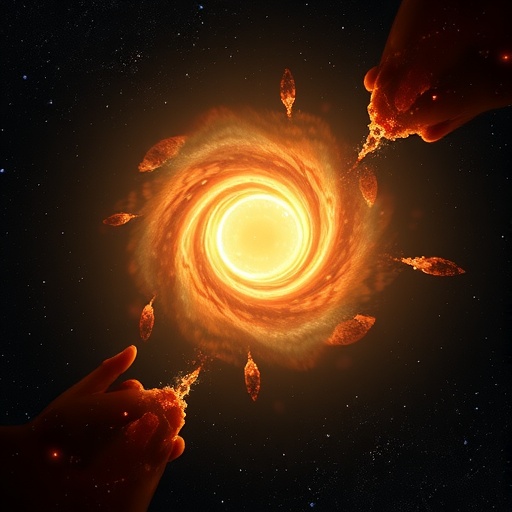
The visual representation provided alongside the study, while likely an AI-generated artistic interpretation for illustrative purposes, powerfully conveys the cosmic spectacle being investigated. It depicts a swirling vortex of light and shadow, hinting at the immense gravitational forces at play. This visual aid, coupled with the rigorous mathematical analysis, allows us to conceptualize the abstract theories of spacetime distortion and extreme gravity. It’s a reminder that behind the complex equations and theoretical models lies a universe of awe-inspiring phenomena, where the very nature of reality is constantly being tested and redefined by cosmic forces far beyond our everyday experience, making the invisible tangible and the abstract visually compelling for a wider audience.
The specific model of a “Kerr MOG naked singularity” is significant because it incorporates elements of MOG (MoG theory), which stands for Modified Gravity. This approach deviates from standard Einsteinian gravity, proposing alterations to the gravitational force at extreme scales or under specific conditions. By exploring a naked singularity within this modified gravity framework, Yasmin and Jamil are venturing into uncharted territory, investigating how different gravitational theories predict the behavior of these hypothetical objects. This allows for a comparative analysis, highlighting how variations in our understanding of gravity can dramatically alter our predictions about the universe’s most extreme environments, pushing both theoretical and observational astrophysics into new dimensions.
The calculation of the accretion disk luminosity is not just about predicting brightness; it’s about understanding the energy output and the observational signatures we might detect. Different types of accretion disks, and the nature of the central object they orbit, produce distinct patterns of radiation. By analyzing the predicted spectrum and intensity of light from an accretion disk around a Kerr MOG naked singularity, astronomers could one day compare these predictions with actual telescopic data. A match would be compelling evidence for the existence of such an object, even if we cannot directly “see” the singularity itself. It’s a cosmic detective story, where faint signals from distant objects can reveal the presence of the universe’s most elusive and powerful entities.
The very existence of a naked singularity challenges the notion of predictability in the universe. If singularities are always hidden behind event horizons, then the future evolution of spacetime is, in principle, predictable by observers outside the horizon. However, a naked singularity would act as a window into the unpredictable, a region where the laws of physics could break down and the future could become inherently unknowable. This has profound philosophical implications for our understanding of causality and determinism in the cosmos, prompting deep questions about the fundamental nature of reality and the limits of scientific inquiry when faced with phenomena that defy our current comprehension and theoretical frameworks.
The research team’s meticulous approach involves sophisticated mathematical modeling and simulation techniques. They are not just making educated guesses; they are employing the powerful tools of theoretical physics to derive precise predictions. This rigor is essential when dealing with such exotic objects, as any deviation from established theory requires robust justification and testable predictions. The complex geometry of spacetime around such an object demands advanced mathematical machinery, which the researchers have skillfully deployed to unravel the secrets of the naked singularity’s shadow and its surrounding energetic phenomena, showcasing the power of theoretical physics to probe the very limits of existence.
The potential observational implications of this work are immense. Future generations of telescopes, both ground-based and space-borne, will be capable of detecting fainter signals and resolving finer details in the universe. If the predictions made by Yasmin and Jamil hold true for observable naked singularities, these advancements could pave the way for the first detection of such an object. This would be a monumental discovery, akin to the first direct image of a black hole, further solidifying our understanding of gravity’s extreme behavior and potentially leading to Nobel Prize-winning physics. The pursuit of these elusive cosmic entities fuels the ongoing innovation in observational astronomy.
The study’s authors are contributing to a vibrant and ongoing debate within the astrophysics community regarding the true nature of singularities. While black holes are well-established astrophysical objects, the existence of naked singularities remains a theoretical possibility that continues to fascinate and perplex researchers. This work adds a significant piece to the puzzle, providing concrete theoretical predictions that can be used to guide future observational strategies. It’s a testament to the scientific process, where theoretical exploration directly informs the search for empirical evidence, pushing the boundaries of human knowledge ever outward with each new discovery.
The conceptualization of “shadow geometry” is a brilliant way to make the abstract tangible and observable. While we cannot directly observe a singularity, its gravitational influence profoundly warps the path of light. The “shadow” is the absence of light from regions behind the singularity, or where light has been so bent that it doesn’t reach us. By precisely calculating the shape and size of this shadow, scientists can infer the properties of the object creating it. This technique has already proven invaluable in studying black holes, and its application to naked singularities offers a new avenue for detection and investigation in regions of spacetime where our understanding is still in its nascent stages.
In conclusion, the research by Yasmin and Jamil on the shadow geometry of Kerr MOG naked singularities and their accretion disk luminosity represents a significant leap forward in our quest to understand the most extreme objects in the universe. It challenges our current theoretical paradigms, offers new avenues for observational exploration, and pushes the boundaries of human comprehension regarding the nature of gravity and spacetime. This study is not just an academic paper; it is an invitation to peer into the abyss, to contemplate the unthinkable, and to marvel at the sheer audacity of the cosmos, reminding us how much more there is yet to discover beyond the familiar.
Subject of Research: The shadow geometry and accretion disk luminosity of a theoretical Kerr MOG naked singularity, a class of exotic astrophysical objects that challenge current theories of gravity.
Article Title: Shadow geometry of Kerr MOG naked singularity and analysis of accretion disk luminosity.
Image Credits: AI Generated
DOI: https://doi.org/10.1140/epjc/s10052-025-15147-0
Keywords**: naked singularity, MOG theory, Kerr metric, accretion disk, shadow geometry, general relativity, astrophysics, cosmology, gravitational lensing


