

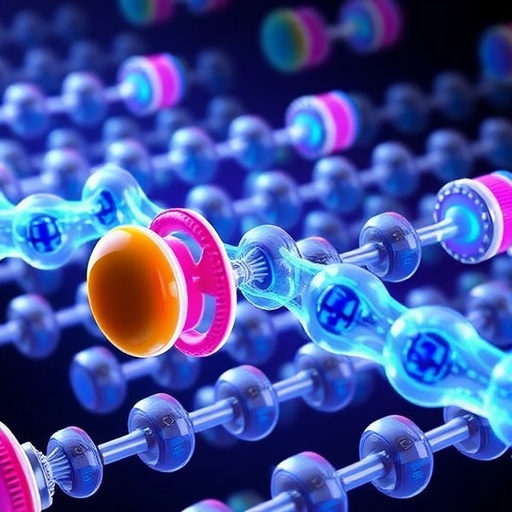
In a groundbreaking advance that could redefine the future of soft robotics and flexible electronics, researchers have developed a novel class of ionic actuators inspired by the sophisticated mechanics of human muscle fibers. This innovative work, soon to be published in npj Flexible Electronics, reveals ionic actuators possessing an unprecedented combination of high bandwidth and mechanical robustness, enabled by intricately engineered fibrillar ion-transport networks. The team’s biomimetic approach not only mimics muscular architecture but also revolutionizes ion transport mechanisms to overcome long-standing limitations in actuator speed and efficiency.
Ionic actuators have long been prized for their potential to deliver flexible movement with low voltage inputs, making them ideal candidates for applications ranging from wearable devices and soft robotics to biomedical implants. However, conventional ionic actuators have struggled to achieve high-frequency responses while maintaining significant force output and durability. This tradeoff has restricted their practical integration, especially in devices requiring rapid, precise motions. The newly reported muscle-inspired design fundamentally addresses this bottleneck by emulating the fibrillar ion channel structures found in biological muscle tissue.
At the heart of this innovation lies the fabrication of an actuator material embedded with highly aligned, nanoscale fibrillar ion-transport conduits. These microscopic fiber networks facilitate extraordinarily rapid ionic conduction, effectively mimicking the synergistic interplay of muscle fibers and extracellular matrix components that govern biological actuation. By aligning ion channels in a coherent fibrillar architecture, the researchers enabled fast ion migration and reduced transport resistance, which are critical determinants of actuator response time and bandwidth.
Beyond conduction, the novel ionic network confers exceptional mechanical properties by providing a scaffold that distributes stress uniformly across the actuator matrix. This design minimizes mechanical fatigue and deformation during rapid cycles of expansion and contraction. The material’s resilience stems from the balanced interplay between ion transport efficiency and structural integrity—achieved through careful modulation of fibril density, orientation, and polymer composition—yielding stable actuation performance over hours of continuous operation.
The material synthesis involved a multi-step process integrating advanced polymer chemistry and nanoscale self-assembly. Polymers with ion-conductive moieties were coaxed to form interconnected fibrils by controlling solvent evaporation rates, temperature gradients, and external fields. This meticulous engineering produced a hierarchically structured matrix with fibrils oriented along the actuation axis. Microscopic and spectroscopic analyses confirmed the presence of continuous ion-transport pathways with minimal defects, validating the structural hypothesis inspired by skeletal muscle tissue.
Comprehensive electro-mechanical testing underscored the actuator’s superior temporal response. Measurements revealed operational frequencies exceeding tens of hertz—far beyond the capabilities of traditional ionic actuators—while sustaining strain amplitudes comparable to muscle contractions. Remarkably, the actuator maintained stable force output over thousands of cycles, indicating robust durability and predictable performance, crucial for real-world deployments where reliability is paramount.
Mechanistically, the work illuminates how the alignment and connectivity of ionic pathways translate into macroscopic actuation phenomena. As ions migrate swiftly along fibril conduits under applied electric fields, localized swelling and deswelling generate mechanical deformation. The muscle-inspired architecture ensures synchronized ionic flux and force development, resulting in rapid and synchronized contraction and relaxation reminiscent of biological muscle twitching, but at engineered speeds and scales.
The implications of this technology are vast and varied. In soft robotics, the high-bandwidth ionic actuators could serve as artificial muscles, enabling robots with complex, lifelike motions previously unattainable with electrostatic or pneumatic actuators. Wearable devices could harness these actuators for haptic feedback systems that operate with high fidelity and low energy consumption. Moreover, implantable medical devices requiring smooth, controlled actuation—for instance, artificial sphincters or cardiac assist mechanisms—could greatly benefit from the biocompatible and efficient design.
Furthermore, the research opens pathways for integrating ionic actuators with flexible electronics that demand rapid mechanical responses synchronized with electronic signal processing. The fibrillar ion-transport networks can interface seamlessly with stretchable sensors and conductive pathways, enabling multifunctional devices that emulate the sensory-motor integration seen in living organisms. This convergence sets the stage for biohybrid systems blurring the line between biological and artificial materials.
While these achievements mark a significant milestone, challenges remain in scaling manufacturing processes for commercial viability. The delicate fibrillar architectures require precise environmental controls that must be adapted for industrial-scale production without compromising performance. Additionally, long-term stability in diverse environmental conditions, including variable humidity and temperature, requires further investigation to ensure broad applicability.
Future research directions include exploring alternative polymer chemistries and composite formulations to enhance not only ionic conductivity but also biocompatibility and sustainability. The modular nature of the fibrillar design invites customization tailored to specific applications, adjusting parameters like fibril density, geometry, and ionic species. Integration with neural interfaces and bioelectronics also appears promising, potentially enabling closed-loop systems that respond adaptively to physiological signals.
This pioneering work stands as a testament to the power of biomimicry combined with cutting-edge materials science. By capturing the fundamental principles of muscle ion transport and applying them in novel synthetic systems, the research team has charted a compelling new route toward actuators that are faster, stronger, and more reliable. The findings invigorate the field of ionic actuation, inspiring new designs that may soon transform robotics, healthcare, and flexible electronics industries.
In conclusion, the muscle-inspired, high-bandwidth ionic actuators featuring fibrillar ion-transport networks represent a paradigm shift in soft actuation technology. The meticulous architecture engineering translates directly into enhanced speed, force, and durability properties that ekes past previous biological and synthetic limitations. This interdisciplinary advance underscores the critical synergy of biology, chemistry, and engineering in forging next-generation materials capable of meeting the complex demands of emerging intelligent systems.
As this technology matures and transitions from laboratory exploration to applied innovation, it promises to unlock remarkable capabilities. From dynamic prosthetics that emulate natural limb movement to responsive wearable systems enhancing human interaction with machines, the practical impact spans diverse sectors. The muscle-inspired ionic actuators are poised not only to mimic life but to augment it through a new frontier of adaptive, flexible, and high-performance actuation.
Subject of Research: Muscle-inspired ionic actuators with high-bandwidth performance enabled by fibrillar ion-transport networks.
Article Title: Muscle-inspired, high-bandwidth ionic actuators enabled by fibrillar ion-transport networks
Article References:
Kim, S.Y., Lim, J.S., Choi, H. et al. Muscle-inspired, high-bandwidth ionic actuators enabled by fibrillar ion-transport networks. npj Flex Electron (2026). https://doi.org/10.1038/s41528-026-00573-1
Image Credits: AI Generated


