

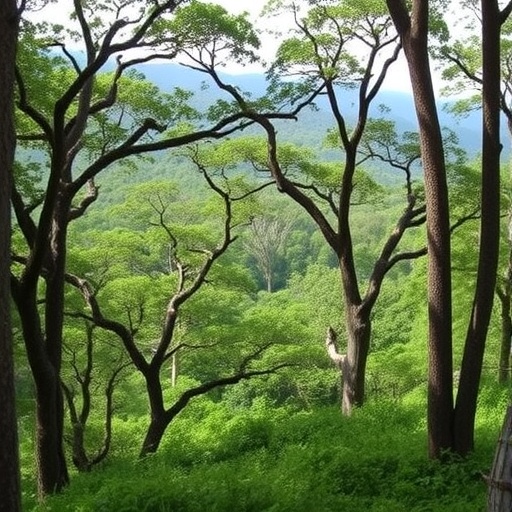
The Mumosho forest landscape in Eastern Democratic Republic of the Congo (DR Congo) is emerging as a crucial focal point for understanding the interplay between land use patterns, woody plant diversity, and carbon sequestration. This region, rich in biodiversity and ecological importance, provides critical insights into how land management practices can influence both ecosystem health and climate dynamics. The study, led by Mukotanyi et al., explores these relationships with alarming clarity, underscoring the imperatives of sustainable practices in forestry and agriculture amid ongoing environmental challenges.
A significant aspect of the research involves the temporal land use patterns observed in the Mumosho forest. Over the past few decades, the landscape has undergone substantial changes due to human activities, particularly agricultural expansion and logging. The study meticulously maps these transitions, offering a timeline that reflects the shift in land use from vast woodland areas to cleared spaces for farms. This transformation raises significant questions regarding habitat displacement and the consequences for species diversity in the region. Additionally, the researchers emphasize how these changes impact carbon storage capabilities, which is pivotal given the rising concerns over global warming.
Woody plant diversity serves as a central theme in the research, revealing that biodiversity is not merely a metric of environmental health but also an indicator of ecosystem resilience. The findings illustrate that diverse plant communities are better equipped to withstand environmental stressors, including climate change and invasive species. The implications are profound; protecting diverse plant species is not an isolated environmental goal but rather one closely tied to ensuring carbon sequestration is optimized. More diversely populated forests can capture more carbon dioxide from the atmosphere, mitigating the greenhouse effect that is increasingly threatening the planet.
One of the pivotal discussions in Mukotanyi et al.’s findings revolves around carbon sequestration, a process through which forests absorb carbon dioxide, thereby playing a vital role in combating climate change. The study quantifies the amount of carbon sequestered in the Mumosho landscape, drawing comparisons with other forest types. This quantification provides a stark reminder of the role that healthy, preserved ecosystems play in our fight against global warming. The researchers advocate for more robust climate policies that prioritize the conservation of biodiverse ecosystems, which directly contribute to carbon capture.
The study is meticulously documented, utilizing advanced geographical information systems (GIS) technology to visualize land use changes over time. This method not only enhances the clarity of the data presented but also allows for better predictive modeling of future changes should current land use trends continue. By employing such technology, the researchers create an invaluable tool for policymakers and conservationists alike, facilitating informed decision-making that could steer the region towards sustainable development.
The cultural implications of the research findings cannot be overlooked. The local communities of Eastern DR Congo have coexisted with these forests for generations, relying on their resources for subsistence. The encroachment of agriculture has, however, led to an intricate balance between environmental preservation and human needs. Mukotanyi and the team highlight that future conservation efforts must integrate local knowledge and practices, ensuring that the voices of those who live in proximity to these forests are included in the discussions about land use.
Despite the richness of its ecological resources, the Mumosho forest landscape is under threat. The study draws attention to external pressures such as mining and logging, which exacerbate the challenges faced by local ecosystems. As the global demand for natural resources continues to rise, the socio-environmental dynamics in regions like Mumosho become increasingly complex. This interconnectedness stresses the urgency for collaborative conservation efforts that span both local and global contexts to safeguard these vital ecosystems for future generations.
Future research directions are also emphasized in the study, proposing a range of interdisciplinary approaches to further investigate the ecological complexities of the Mumosho forest landscape. Integrating social science methodologies alongside environmental assessments could enrich understanding and enhance adaptive management strategies. The collaboration of ecologists, anthropologists, and local communities can facilitate a more holistic view of the ecological, economic, and social factors influencing land use.
The researchers acknowledge the limitations of their study, particularly in data coverage and the need for longitudinal studies to monitor ongoing changes. They advocate for expanded research funding and support from local and international organizations to bolster conservation initiatives. In acknowledging these gaps, Mukotanyi et al. underscore the importance of continuous inquiry into the dynamics of forest ecosystems in the face of rapid global change.
The engagement of educational institutions is crucial in driving forward the agenda of conservation and sustainable practices in forest management. The findings from this study can serve as a vital resource for academic programs on environmental science, ecology, and sustainability, training the next generation of conservationists and policymakers. By fostering awareness and understanding of the delicate balance within ecosystems, future leaders may be better equipped to tackle conservation challenges.
In conclusion, the research conducted by Mukotanyi et al. presents not only vital data on the Mumosho forest landscape but also an urgent call for action. As the impacts of climate change manifest more dramatically across the globe, understanding and protecting our remaining biodiverse ecosystems becomes increasingly critical. The interplay between land use, plant diversity, and carbon sequestration serves as a reminder of our responsibility to shift towards more sustainable practices. The time for recognizing the significance of the Mumosho forest landscape is now, as its future may hold the key to our environmental sustainability.
In light of this comprehensive exploration of the Mumosho forest landscape, it becomes evident that the path forward will require concerted efforts across scientific, political, and community domains. As we harness the insights gleaned from research, we must rally to promote practices that protect and restore biodiversity, thereby enhancing climate resilience. The stage is set for transformative change, one that honors both the intricate ecosystems and the people who depend on them so profoundly.
Subject of Research: Land use patterns, woody plant diversity, and carbon sequestration in the Mumosho forest landscape, Eastern DR Congo.
Article Title: Temporal land use patterns, woody plant diversity, and carbon sequestration in Mumosho forest landscape, Eastern DR Congo.
Article References:
Mukotanyi, S.M., Mbaswa, J.N., Badesire, L.A. et al. Temporal land use patterns, woody plant diversity, and carbon sequestration in Mumosho forest landscape, Eastern DR Congo.
Discov. For. 2, 3 (2026). https://doi.org/10.1007/s44415-025-00053-w
Image Credits: AI Generated
DOI: https://doi.org/10.1007/s44415-025-00053-w
Keywords: Biodiversity, carbon sequestration, land use change, forest conservation, ecological resilience.


