

In a groundbreaking advancement poised to reshape the landscape of photonics, researchers have unveiled a novel approach to manipulating light within fiber optic systems using exceptional-point-encirclement emulation. This pioneering technique centers around the concept of exceptional points (EPs), unique degeneracies in non-Hermitian systems where eigenvalues and eigenvectors coalesce, leading to unconventional and highly sensitive physical phenomena. The team, led by Li, Zhang, Wang, and colleagues, has successfully translated these abstract mathematical properties into practical engineering solutions, enabling unprecedented control over light propagation in all-fiber devices.
Exceptional points have long fascinated the scientific community for their potential to enhance sensor sensitivity and realize exotic wave phenomena. However, their experimental realization and application have been challenging due to the stringent requirements on system parameters and environmental stability. The new research circumvents these issues by developing an emulation framework that simulates EP encirclement dynamics within all-fiber configurations, thereby maintaining robustness and feasibility in realistic operational scenarios.
Central to the breakthrough is the multidimensional asymmetric switching mechanism embedded within the fiber devices. Traditional symmetric switching in photonic systems limits the degree of control and flexibility achievable, often constraining device performance. By harnessing the non-Hermitian characteristics around exceptional points, the research team engineered a paradigm where directionally dependent, or asymmetric, switching can be intricately tailored. This multidimensional control paves the way for devices that can selectively route, modulate, or amplify signals with a previously unattainable level of precision.
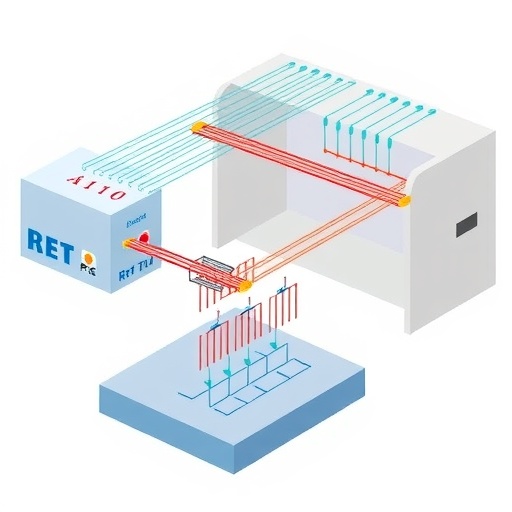
The experimental setup involves a carefully designed fiber optic loop system where gain and loss are co-engineered to emulate the non-Hermitian Hamiltonian encountering an exceptional point. By dynamically varying parameters such as coupling strength and loss distribution, the researchers emulate cyclical encirclements of the EP in parameter space. This dynamic encirclement leads to distinct switching outcomes dependent on the direction of parameter variation, a hallmark of chiral behavior associated with EPs.
Through meticulous measurement and analysis, the team demonstrated that this encirclement produces multidimensional asymmetric switching where not only the intensity but also the polarization and phase characteristics of the light exhibit direction-sensitive transformations. This complex manipulation enriches the functional versatility of all-fiber devices beyond conventional boundaries and opens new horizons for integrated photonics.
Importantly, the all-fiber nature of the devices ensures compatibility with existing fiber optic technologies, promising seamless integration into the current telecom and sensor networks. This compatibility enhances the practical impact and scalability of the technology, potentially accelerating its adoption across diverse fields, from high-speed communications to precision metrology.
The implications of this work are multifaceted. On one front, the precision control afforded by EP-encirclement emulation stands to revolutionize optical switches and modulators, enabling devices with faster response times and lower power consumption. On another, the ability to exploit the inherent sensitivity near exceptional points could dramatically improve sensor performance, detecting minute environmental changes with unrivaled accuracy.
Moreover, the research sheds light on the intricate interplay between topology and non-Hermitian physics in photonic systems. By physically realizing EP encirclement within fiber devices, the study provides a tangible platform to explore fundamental concepts that could guide the design of new materials and devices exploiting topological protections and non-Hermitian symmetries.
The multidimensional approach to asymmetric switching also hints at future applications in quantum information processing, where controlled light-matter interactions at exceptional points could facilitate robust qubit manipulation and state transfer. Such advances could accelerate the development of quantum networks integrating seamlessly with classical fiber infrastructures.
Despite these promising outcomes, challenges remain. The precise engineering of gain and loss profiles demands exquisite control over fabrication and operation conditions. Additionally, environmental perturbations such as temperature fluctuations and mechanical vibrations could influence device stability, necessitating further studies on robustness and error-correction mechanisms.
The research team’s framework provides a flexible toolkit for tuning the encirclement path and parameters, offering pathways to customize device behavior for specific functional requirements. This adaptability, combined with the inherent advantages of fiber optics—such as low loss, high bandwidth, and immunity to electromagnetic interference—positions the technology at the forefront of next-generation photonic device research.
In sum, this exploration into exceptional-point-encirclement emulation within all-fiber devices heralds a new chapter in photonics. It seamlessly blends abstract theoretical physics with practical engineering, delivering a platform that promises to drive innovation across communications, sensing, and beyond. The study exemplifies how fundamental insights into non-Hermitian physics can be harnessed to overcome longstanding technical challenges, ultimately enabling a new class of photonic devices distinguished by their multidimensional control and asymmetric response.
Future research directions could include the extension of this approach to other material platforms, integration with active elements like semiconductor lasers, and exploration of EP encirclement in higher-dimensional parameter spaces. Additionally, investigating the interplay of multiple interconnected EPs could yield even richer functionalities and opportunities for device miniaturization.
As the photonics community continues to unravel the potential of exceptional point physics, this seminal work by Li, Zhang, Wang, and the collaborators stands as a testament to the transformative power of marrying advanced theoretical concepts with innovative device design. It not only pushes the boundaries of what is achievable in fiber optic technologies but also lays a robust foundation for broader exploration of non-Hermitian topological photonics.
The breakthrough underscores the vital role of interdisciplinary collaboration, merging expertise in physics, material science, and engineering to realize devices that not only perform well under laboratory conditions but are also poised to make a tangible impact in real-world applications.
With all-fiber architectures offering inherently scalable and cost-effective solutions, the approach demonstrated could rapidly accelerate the transition from proof-of-concept demonstrations to ubiquitous deployment in telecommunications, environmental monitoring, and quantum communication networks.
In closing, the multidimensional asymmetric switching enabled by exceptional-point-encirclement emulation represents a powerful new tool in the photonics arsenal, one that promises to redefine our interaction with light and signal processing technologies. It sparks an exciting trajectory towards smarter, more efficient, and highly adaptable fiber optic devices designed to meet the burgeoning demands of a connected world.
Subject of Research: Exceptional-point-encirclement emulation and multidimensional asymmetric switching in all-fiber photonic devices
Article Title: Exceptional-point-encirclement emulation tailoring: multidimensional asymmetric switching of all-fiber devices
Article References:
Li, K., Zhang, Y., Wang, S. et al. Exceptional-point-encirclement emulation tailoring: multidimensional asymmetric switching of all-fiber devices. Light Sci Appl 15, 8 (2026). https://doi.org/10.1038/s41377-025-02144-x


