

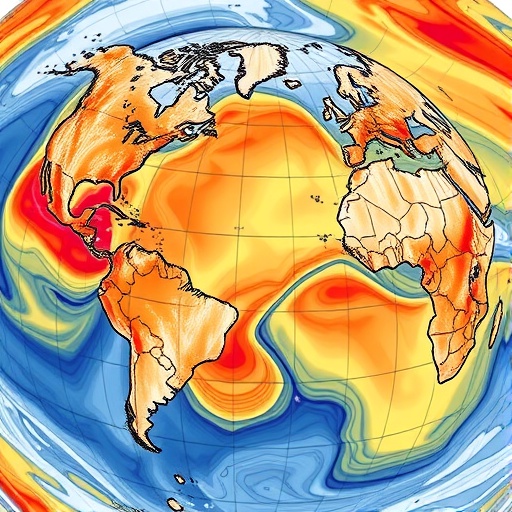
In the past two years, Earth’s energy balance experienced an unprecedented surge, marked by a significant increase in the net incoming radiation at the top of the atmosphere. This phenomenon, which represents the global mean energy uptake, has played a central role in driving record-breaking surface temperatures and extreme climate events observed worldwide during 2023 and into early 2024. The causes behind this extraordinary energy influx, however, have remained elusive, largely due to the complex interplay between anthropogenic forcing and natural variations within the Earth’s climate system. Groundbreaking research recently published in Nature Geoscience sheds new light on this mystery by linking the extreme energy uptake primarily to internal climate variability, specifically focusing on the critical transition from a multi-year La Niña state to El Niño conditions that unfolded between 2022 and 2023.
This transition, as revealed by the study’s analysis of multimodel climate simulations and satellite datasets, emerged as a pivotal mechanism amplifying the overall positive energy imbalance imposed by external forcing factors, such as greenhouse gas emissions and aerosol changes. The research team, led by Tsuchida, Kosaka, and Minobe, meticulously investigated the relative contribution of this La Niña–El Niño swing within the broader context of Earth’s energy budget dynamics. Their findings strongly suggest that this internal variability component accounted for approximately three-quarters of the observed energy uptake anomaly, signaling a dominant influence over the record-setting energy accumulation.
Understanding the Earth’s energy budget is fundamental to climate science, as it governs the rate at which the planet warms or cools. The balance is determined by incoming solar radiation minus the outgoing reflected and emitted radiation. Any imbalance—where more energy is absorbed than emitted—results in warming. Typically, this energy uptake progresses gradually, but anomalies such as the 2022–2023 spike raise critical questions about the underlying drivers. Historically, external forcings linked to anthropogenic activities have been the principal focus, yet internal climate variability has often been underestimated or poorly resolved in global models. This study addresses that gap by quantifying the role of multiyear ocean–atmosphere oscillations.
The research utilizes a robust ensemble of climate model simulations that assimilate observations and apply Shared Socio-economic Pathway (SSP) scenarios. These scenarios represent varied emissions trajectories used to project future climate states and their associated forcings. Through this approach, the study distinguishes the externally forced components from natural variability, allowing for precise attribution. By isolating the effects of the La Niña-to-El Niño transition, the team demonstrated an exceptional multi-year persistence in La Niña conditions prior to 2022, which preconditioned the oceanic and atmospheric state toward enhanced energy uptake once the system shifted into El Niño dominance.
La Niña and El Niño are alternating phases of the El Niño Southern Oscillation (ENSO), a natural climate pattern originating in the tropical Pacific Ocean. La Niña is associated with cooler-than-average sea surface temperatures and suppressed convection, whereas El Niño brings warmer waters and intensified atmospheric convection. These shifts modulate global weather and climate patterns by altering heat and moisture distribution, which in turn influence cloud cover, precipitation, and radiation budgets. The study crucially pinpoints that the sequence of a strong, persistent La Niña followed by a rapid El Niño transition acted synergistically to maximize the net radiation absorbed by the Earth system, thus driving the unprecedented energy uptake seen in 2022–2023.
One notable aspect of the research is its methodological innovation in “sampling analyses.” By drawing from a wide range of climate model simulations, each reproducing different potential internal variability patterns, the authors could assess the statistical likelihood and magnitude of energy imbalance enhancements linked to various ENSO sequences. This extensive model-based experimentation allows for a compelling argument that the 2022–2023 extreme energy uptake was not a random anomaly, but a predictable consequence of well-understood internal climate processes interacting with long-term anthropogenic forcing trends.
The study also underscores the potential for existing climate models to capture these internal dynamics when operated in ensembles sufficiently large to encompass multi-year variability. This capability is instrumental for improving near-term climate projections and for anticipating abrupt or extreme climate events related to ENSO phases. Furthermore, by demonstrating the outsized role of the La Niña-to-El Niño transition, the research highlights a pathway through which internal variability could amplify future warming trends and associated impacts, even under moderate external forcing scenarios.
Satellite observations, a critical component of the research, provide direct, high-precision measurements of Earth’s radiative budget. These data were integral in verifying model outputs and ensuring that the observed post-La Niña energy surge represented a real and substantial climate phenomenon. The combination of empirical observation and sophisticated modeling thus strengthens confidence in the study conclusions and counters previous uncertainty surrounding the magnitude and drivers of recent energy imbalance changes.
The implications of these findings extend beyond academic interest and into practical climate impact forecasting. Enhanced understanding of how ENSO phase transitions affect the planetary energy budget offers an opportunity to refine climate risk assessments across various sectors, including agriculture, water resources, disaster preparedness, and infrastructure planning. As climate extremes become more frequent and severe, improved predictability of such internal drivers of energy uptake could facilitate better adaptation strategies worldwide.
Additionally, the research confronts the broader question of climate system feedbacks under warming conditions. The persistence and strength of La Niña and El Niño events themselves may evolve with global temperature increases, potentially creating feedback loops that alter Earth’s radiative balance in complex ways. This study thus contributes to a growing body of evidence emphasizing the necessity to consider internal climate variability as an active component synergistically interacting with anthropogenic forcing, rather than as noise to be averaged out.
In summary, the 2022–2023 extreme energy uptake episode is not merely a product of escalating greenhouse gas concentrations but is critically shaped by natural internal oscillations within the ocean–atmosphere system. The remarkable influence of the protracted La Niña state followed by a pronounced El Niño onset represents a climatic catalyst that drove a significant acceleration in Earth’s net radiative energy gain. These dynamics indicate that future climate variability and change cannot be fully understood without integrating the interplay between external forcing and complex internal processes such as the ENSO cycle.
The findings also point toward a future in which internal variability may not only modulate but potentially amplify the impacts of anthropogenic climate change. This insight elevates the importance of advancing climate models and observational networks to better resolve and predict these oscillatory processes. Improved understanding in this area will be critical as humanity confronts the dual challenges of mitigating emissions and adapting to a changing and increasingly volatile climate.
As climate science pushes forward, studies like this illuminate the multifaceted nature of Earth’s energy system and encourage a paradigm that embraces complexity rather than oversimplification. The nexus between long-persistent La Niña conditions and subsequent El Niño transitions represents a compelling example of how internal variability can emerge as a powerful force within the global climate framework, shaping the trajectory of warming in profound, previously underappreciated ways.
The insights gained from the 2022–2023 energy uptake event offer invaluable context for interpreting near-future climate fluctuations and for structuring global climate policy. Recognizing that such extremes arise from layered interactions between natural cycles and human influence may help align expectations for climate response timescales and the potential for abrupt warming episodes. Ultimately, this research underscores the urgency of integrated climate observation and modeling to build climate resilience in the face of ongoing, dynamic planetary change.
Subject of Research: Earth’s energy budget; influence of internal climate variability on the global energy imbalance; role of the La Niña–El Niño transition in extreme energy uptake during 2022–2023.
Article Title: Multi-year La Niña–El Niño transition influenced Earth’s extreme energy uptake in 2022–2023.
Article References:
Tsuchida, K., Kosaka, Y. & Minobe, S. Multi-year La Niña–El Niño transition influenced Earth’s extreme energy uptake in 2022–2023. Nat. Geosci. (2026). https://doi.org/10.1038/s41561-026-01921-6
Image Credits: AI Generated


