
Monday, March 2, 2026
Science
No Result
View All Result
  • Login
  • HOME
  • SCIENCE NEWS
  • CONTACT US
  • HOME
  • SCIENCE NEWS
  • CONTACT US
No Result
View All Result
Scienmag
No Result
View All Result
Home Science News Policy

More than just medicine: Proactive approach responds to ethical issues facing medical care teams

August 19, 2024
in Policy
Reading Time: 3 mins read
0
Fig.
67
SHARES
610
VIEWS
Share on FacebookShare on Twitter
ADVERTISEMENT

Osaka, Japan – In recent years, advances in medical science have led to an increase in the number of medical treatment options available, making clinical decision-making more complex and leading to a variety of ethical issues.

Fig.

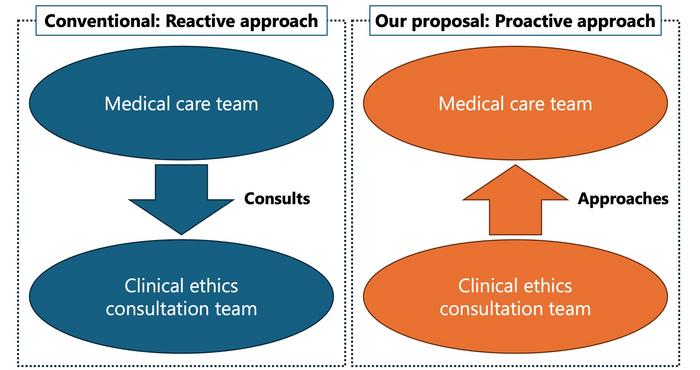
Credit: Atsushi Kogetsu and Jungen Koimizu

Osaka, Japan – In recent years, advances in medical science have led to an increase in the number of medical treatment options available, making clinical decision-making more complex and leading to a variety of ethical issues.

In response, a number of hospitals have been establishing systems to provide clinical ethics consultation to medical care teams as support for the various ethical issues that arise in the medical field.

However, since the number of consultation cases remains low even on a global scale, the effectiveness of this system remains a challenge. Reasons for this include low awareness of clinical ethics consultation among hospital staff, uncertainty about which issues to consult on, and difficulty in clearly communicating their concerns about important but ambiguous issues.

To address the above issues, the research group clarified the specific strategies, potential benefits, significance, and points to keep in mind for effective implementation based on different practices of proactive ethics consultation at two hospitals.

In “inter-professional ethics rounds,” consultation teams visit hospital departments and communicate with medical staff in order to identify ethical issues and provide advice on how to resolve them. “Patient note reviews” involve reviewing patient records in departments where ethical issues are most likely to arise and working with the medical care team to identify cases that need to be addressed.

“We hope that the new methods we have implemented over the past few years will help other hospitals develop their ethics consultation teams more effectively,” says lead author of the study Atsushi Kogetsu. “Ultimately, we expect that these methods will lead to the resolution of ethical issues in clinical practice, the provision of better medical care, and the alleviation of moral anguish among medical staff.”

###
The article, “Two approaches of ‘proactive consultation’: Towards well-functioning clinical ethics consultation,” was published in Asian Bioethics Review at DOI:

About Osaka University
Osaka University was founded in 1931 as one of the seven imperial universities of Japan and is now one of Japan’s leading comprehensive universities with a broad disciplinary spectrum. This strength is coupled with a singular drive for innovation that extends throughout the scientific process, from fundamental research to the creation of applied technology with positive economic impacts. Its commitment to innovation has been recognized in Japan and around the world. Now, Osaka University is leveraging its role as a Designated National University Corporation selected by the Ministry of Education, Culture, Sports, Science and Technology to contribute to innovation for human welfare, sustainable development of society, and social transformation.
Website:


Journal

Asian Bioethics Review

DOI

10.1007/s41649-024-00302-8

Method of Research

Commentary/editorial

Subject of Research

Not applicable

Article Title

Two approaches of ‘proactive consultation’: Towards well-functioning clinical ethics consultation

Article Publication Date

15-Aug-2024

Share27Tweet17
Previous Post

NUS and A*STAR researchers develop wearable, stretchable sensor for quick, continuous, and non-invasive detection of solid-state skin biomarkers

Next Post

Low cortisol, hair-trigger stress response in the brain may underlie Long COVID

Related Posts

blank
Policy

Leading Scientists Challenge DOE Climate Report, Calling It ‘Demonstrably Incorrect’ in New Analysis

February 27, 2026
blank
Policy

THRIVE: Revolutionizing Health by Restoring Innate Vitality for All

February 27, 2026
blank
Policy

IP4OS Releases the Synergy Framework for Enhancing Knowledge Valorisation

February 26, 2026
blank
Policy

New Georgia Tech Study Shows Safe AI Alone Isn’t Sufficient

February 26, 2026
blank
Policy

Experts Propose Enhanced Strategies for Strengthening Genetic Privacy Laws

February 26, 2026
blank
Policy

New Study Illuminates Gaps in Understanding Child Care Outcomes

February 26, 2026
Next Post

Low cortisol, hair-trigger stress response in the brain may underlie Long COVID

  • Mothers who receive childcare support from maternal grandparents show more parental warmth, finds NTU Singapore study

    Mothers who receive childcare support from maternal grandparents show more parental warmth, finds NTU Singapore study

    27618 shares
    Share 11044 Tweet 6902
  • University of Seville Breaks 120-Year-Old Mystery, Revises a Key Einstein Concept

    1022 shares
    Share 409 Tweet 256
  • Bee body mass, pathogens and local climate influence heat tolerance

    665 shares
    Share 266 Tweet 166
  • Researchers record first-ever images and data of a shark experiencing a boat strike

    532 shares
    Share 213 Tweet 133
  • Groundbreaking Clinical Trial Reveals Lubiprostone Enhances Kidney Function

    518 shares
    Share 207 Tweet 130
Science

Embark on a thrilling journey of discovery with Scienmag.com—your ultimate source for cutting-edge breakthroughs. Immerse yourself in a world where curiosity knows no limits and tomorrow’s possibilities become today’s reality!

RECENT NEWS

  • Mapping Alzheimer’s Brain Subtypes with Normative Models
  • Advancements in EV Battery Technology to Surpass Climate Change-Induced Degradation
  • Engineered Immune Cells Demonstrate Potential in Combating Brain Metastases: Insights from Preclinical Research
  • AI cancer tools prone to “shortcut learning” instead of identifying genuine biological signals

Categories

  • Agriculture
  • Anthropology
  • Archaeology
  • Athmospheric
  • Biology
  • Biotechnology
  • Blog
  • Bussines
  • Cancer
  • Chemistry
  • Climate
  • Earth Science
  • Editorial Policy
  • Marine
  • Mathematics
  • Medicine
  • Pediatry
  • Policy
  • Psychology & Psychiatry
  • Science Education
  • Social Science
  • Space
  • Technology and Engineering

Subscribe to Blog via Email

Enter your email address to subscribe to this blog and receive notifications of new posts by email.

Join 5,190 other subscribers

© 2025 Scienmag - Science Magazine

Welcome Back!

Login to your account below

Forgotten Password?

Retrieve your password

Please enter your username or email address to reset your password.

Log In
No Result
View All Result
  • HOME
  • SCIENCE NEWS
  • CONTACT US

© 2025 Scienmag - Science Magazine

Discover more from Science

Subscribe now to keep reading and get access to the full archive.

Continue reading