

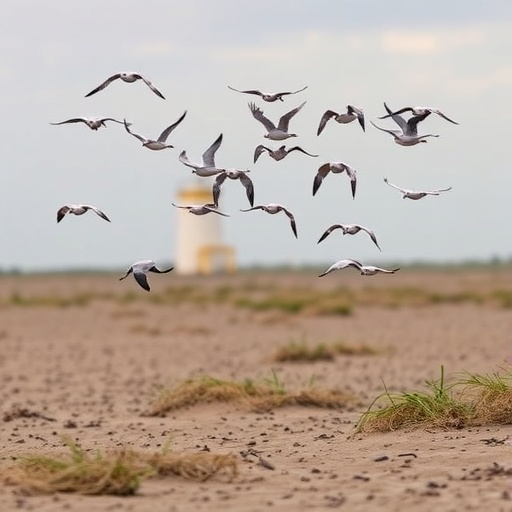
In a groundbreaking study published in Commun Earth Environ, researchers led by Dr. Hu Xiao have unveiled remarkable insights into the relationship between monsoon winds and migratory shorebirds along the East Asia-Australasian Flyway. This extensive research, which spans multiple ecological and ornithological disciplines, presents a compelling argument for the crucial role that seasonal winds play in shaping migratory patterns, thus highlighting the intricacies of our planet’s ecology.
The East Asia-Australasian Flyway is one of the major global migratory routes for birds, spanning thousands of kilometers and encompassing a variety of ecosystems. The findings of this research indicate that monsoon winds, particularly during the transition from summer to autumn, serve as natural highways for migratory shorebirds, facilitating their movement between breeding and wintering grounds. This revelation challenges previously held notions of migratory behavior and underscores the importance of climate and weather patterns in avian migration.
Monsoon seasons traditionally bring heavy rainfall and changing weather patterns that can significantly impact wildlife behavior. However, what Dr. Xiao and his team found is that these winds also provide a critical lift for birds engaged in long-distance travel. The study meticulously documents how these winds can enhance flight efficiency, allowing birds to conserve energy while covering vast distances. This is particularly important for shorebirds, which rely heavily on consistent wind patterns to make their treks across the Flyway.
Empirical data collected by the research team through GPS tracking devices affixed to various shorebird species offers a detailed look at their migratory routes. The analysis reveals that birds are able to exploit favorable wind patterns, resulting in more direct migration paths and reduced travel times. The scientists observed that during periods of strong monsoon winds, certain species completed their journeys days earlier than expected, demonstrating the powerful influence of meteorological phenomena on biological processes.
In conjunction with the collection of quantitative data, the research team conducted a series of observational studies across key stopover sites along the Flyway. These sites are crucial for the nourishment and rest of migratory birds, and the study emphasizes how the availability of food resources is intricately tied to seasonal weather patterns. As monsoon rains transform the landscape, they rejuvenate habitats, creating abundant feeding opportunities that birds rely on to refuel for the next leg of their journey.
In a world increasingly affected by climate change, understanding the dynamics of migratory patterns is more critical than ever. The disruption of monsoon patterns due to climate change poses a significant threat to the migratory success of shorebirds. As the timings and intensities of these winds become unpredictable, the consequence may result in breeding failures and decrease in migratory populations. The research, therefore, serves as a clarion call to conserve not only migratory routes but also the climatic conditions essential for their survival.
Alongside these alarming trends, the study also explores conservation strategies that could buffer the adverse effects of changing climate on migratory birds. The authors propose initiatives aimed at preserving key stopover habitats and restoring landscapes impacted by human activity. By focusing on creating a network of protected areas that align with migratory timelines, there is potential for enhancing the resilience of shorebird populations in the face of ongoing environmental changes.
Moreover, the findings resonate widely beyond just the realm of ornithology; they invoke a deeper conversation on the interconnectedness of climate, ecosystems, and wildlife. Birdwatchers, conservationists, and policy-makers alike can draw valuable insights from this study as they devise strategies to mitigate the impacts of climate change on various species. The research emphasizes that protecting avian migration pathways can safeguard broader ecological systems, thus nurturing biodiversity as a whole.
Reflecting on the ecological implications of the study, Dr. Xiao notes that “these dynamics affirm the urgent need to address climate change while promoting collaborative conservation efforts across shared environments.” As migratory patterns are interlinked with seasonal climates, recognizing such connections is vital to understanding the breadth of climate impacts on global biodiversity.
This groundbreaking study may very well reshape how we view avian migration and the factors that influence it. With its roots grounded in rigorous scientific inquiry and a focus on real-world impacts, the research not only adds the growing body of knowledge concerning migratory patterns but also propels a necessary discourse on climate action. By illuminating the vital role that monsoon winds play for migratory shorebirds, the research encourages further exploration into other ecological dynamics at play in an increasingly climate-affected world.
The work of Dr. Xiao and his colleagues serves as a beacon of hope in conservation biology. It heralds the importance of multidisciplinary approaches to understanding ecological phenomena, showcasing how atmospheric science can inform wildlife management practices. As the scientific community grapples with the challenges of climate change, studies such as this offer critical pathways to enhance our understanding and protective measures for vulnerable species.
In summary, as the migratory journey of shorebirds becomes more challenging due to shifting climatic conditions, Dr. Xiao and his team’s findings shed light on the fascinating interplay between aviation and environmental science. The implications are far-reaching; as we better understand the mechanisms driving migration, we can hope to mitigate detrimental impacts on these avian travelers. The future of the East Asia-Australasian Flyway and its feathered inhabitants relies on our commitment to preserving both the ecological and climatic conditions that sustain them.
Subject of Research: The impact of monsoon winds on the migratory patterns of shorebirds in the East Asia-Australasian Flyway.
Article Title: Monsoon winds create an expressway for migratory shorebirds on the East Asia-Australasian Flyway.
Article References:
Xiao, H., Sun, X., Lei, W. et al. Monsoon winds create an expressway for migratory shorebirds on the East Asia-Australasian Flyway.
Commun Earth Environ (2025). https://doi.org/10.1038/s43247-025-03049-8
Image Credits: AI Generated
DOI: 10.1038/s43247-025-03049-8
Keywords: migratory shorebirds, monsoon winds, East Asia-Australasian Flyway, conservation, climate change.


