

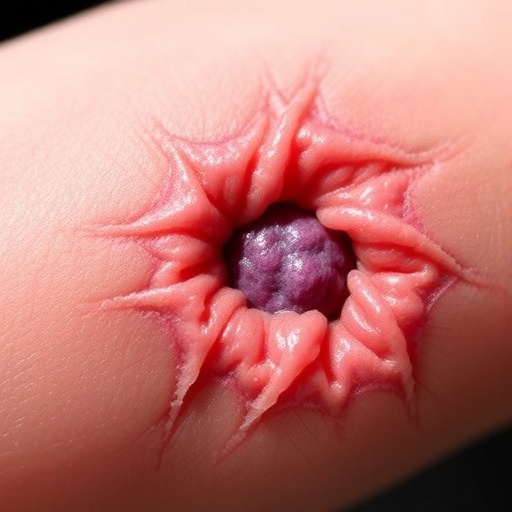
In recent years, the field of biomedical engineering has seen significant advancements, particularly in understanding the complexities of wound healing. Researchers have sought to develop sophisticated models that not only describe this intricate process but also provide insights into potential therapeutic avenues. A groundbreaking study conducted by Haber, Battista, and Wagner contributes profoundly to this dialogue with their 2025 paper, “A Mathematical Model of Wound Healing Incorporating Strain-Induced MSC Differentiation”. This publication opens new frontiers in how we conceptualize wound healing processes and therapeutic interventions.
At the heart of this study lies the development of a mathematical model that integrates critical biological factors driving wound healing. This model focuses particularly on the role of mechanical strain in influencing the behavior of mesenchymal stem cells (MSCs). MSCs are pivotal in tissue repair and regeneration; understanding the mechanics of their differentiation could revolutionize how we approach wound management. By investigating how physical forces affect cell behavior, the researchers illuminate pathways that could be exploited for improved healing outcomes.
The mathematical framework proposed by the authors serves as a powerful tool to simulate and predict healing dynamics under various conditions. By incorporating parameters such as injury size, tissue elasticity, and strain levels, the model allows for a nuanced analysis of healing. Notably, the authors emphasize that traditional models have often overlooked the role of mechanical forces, which are ubiquitous in biological environments and vital for cellular activity. This oversight historically limited the effectiveness of therapeutic strategies designed to enhance wound healing.
As wound healing is a complex, multi-stage process involving inflammation, proliferation, and remodeling, the mathematical model aims to capture this dynamism. It accounts for the initial inflammatory response, during which immune cells mobilize to the site of injury. The authors detail how the model reflects the anatomical and physiological features of tissue, enhancing its relevance to real-world scenarios. This in-depth approach offers a more realistic understanding of how wounds heal under varying mechanical conditions and biological influences.
Additionally, the study places a significant emphasis on strain-induced differentiation of MSCs. Mechanical strain can derive from body movements or the tension in the surrounding tissues, and the authors provide a detailed analysis of how these forces can dictate stem cell fate. As MSCs differentiate into various cell types, their role becomes crucial in generating new tissues. This aspect of the study underscores a novel perspective on how physical forces can be harnessed to guide regenerative processes, paving the way for innovative treatment modalities.
In moving past basic descriptions of healing, the authors employ differential equations to describe the interactions between biological cells and their physical environment. These equations allow for predictions on cellular response under different strain scenarios. By elucidating the relationships among various factors, such as strain magnitude and MSC proliferation rates, the model serves as a predictive instrument for personalized medicine approaches. This is particularly essential as the quest to tailor therapies for individual patients becomes increasingly paramount in the medical field.
The implications of this research extend beyond basic understanding; they offer potential pathways for clinical advancements. For instance, the insights gained from the model may inform the design of biomaterials tailored to deliver mechanical signals that enhance MSC activity at wound sites. Such biomaterials could provide scaffolding that not only supports cellular organization but also strategically applies strain to promote healing. This intersection of engineering and medicine encapsulates the essence of contemporary biomedical research.
Moreover, the mathematical model invites interdisciplinary collaboration between mathematicians, biologists, and clinicians. It underlines the necessity of a unified approach to solve complex biological problems. As researchers in these fields come together, they can refine the model and adapt it to a variety of clinical contexts, from chronic wound management to surgical recovery strategies. The collaborative potential illustrated in this study serves as a call to action for further explorations at the crossroads of mathematics and biology.
In understanding the key drivers of wound healing, it becomes apparent that the microenvironment’s nuances significantly influence cellular behavior. The authors point out that factors such as extracellular matrix composition and the mechanical properties of the surrounding tissues can dictate not only the speed of healing but also the quality of regenerated tissues. This insight prompts a reevaluation of current practices in wound care and rehabilitation, underscoring the need for a comprehensive approach that acknowledges these interactions.
Haber, Battista, and Wagner’s model also reflects a growing trend in medical research: the acknowledgment of individuality in biological responses. By enhancing our understanding of how mechanical strain affects MSC differentiation, clinicians can better anticipate patient responses to treatments. Personalized treatment plans that consider mechanical factors could lead to faster, more effective healing, ultimately improving patient outcomes.
In summary, the study highlights the importance of integrating mathematical modeling with biological research to unravel the complexities of wound healing. The authors’ innovative approach opens doors for novel therapeutic strategies and demonstrates how the physical properties of tissues can interplay with cellular responses. As the field moves forward, incorporating engineering principles into biological contexts will undoubtedly lead to transformative changes in how we view, study, and treat injuries.
The work of Haber, Battista, and Wagner stands as a testament to the power of interdisciplinary research in solving critical health challenges. By harnessing the potential of mathematical modeling, this study not only enhances our understanding of bodily processes but also lays the groundwork for innovative medical interventions. As we advance into an era defined by personalized and precise medicine, studies like this will be integral in shaping future healthcare developments.
The implications of their findings extend beyond the laboratory, encouraging a deeper exploration of how physical mechanisms can be employed therapeutically. As researchers continue to delve into the intricacies of wound healing, the integration of mechanics, biology, and quantitative analysis will prove essential in fostering a new generation of medical solutions.
As we stand on the brink of these advancements, the study serves as both a blueprint and a challenge for future investigations. The marriage of engineering and biology not only has the potential to unlock secrets of wound healing but can also redefine the paradigms of clinical practice. Thus, we embark on a thrilling journey towards innovative strategies that promise to enhance healing processes and improve quality of life for countless individuals facing the challenges of injuries.
Subject of Research: Mathematical modeling of wound healing incorporating strain-induced MSC differentiation
Article Title: A Mathematical Model of Wound Healing Incorporating Strain-Induced MSC Differentiation
Article References:
Haber, S.H., Battista, N.A. & Wagner, C.T. A Mathematical Model of Wound Healing Incorporating Strain-Induced MSC Differentiation.
Ann Biomed Eng (2025). https://doi.org/10.1007/s10439-025-03858-0
Image Credits: AI Generated
DOI:
Keywords: Wound healing, Mathematical model, Mesenchymal stem cells, Strain differentiation, Biomedical engineering


