

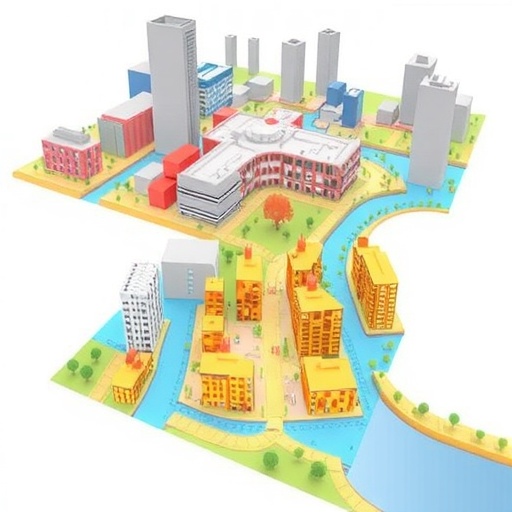
In the face of escalating climate change impacts and rapid urbanization, the imperative to enhance flood resilience within metropolitan landscapes has never been more urgent. A groundbreaking study published in npj Urban Sustainability sheds new light on how urban planning can strategically contribute to flood resilience when evaluated under the lens of shared socioeconomic pathways (SSPs), a framework that integrates future socioeconomic trends with climate scenarios. This research, led by Feng, W., Liu, Y., Zhu, A., and colleagues, advances our understanding by employing sophisticated modeling techniques to predict and manage flood risks in cities worldwide.
Urban areas have become hotspots of vulnerability, where the convergence of dense populations, critical infrastructure, and complex ecosystems amplifies the consequences of extreme weather events like flooding. Traditional flood management approaches often focus on engineering solutions such as levees and drainage systems, but these alone are insufficient considering the dynamic nature of urban growth and shifting socioeconomic factors. The study’s novel integration of SSPs provides a multi-dimensional perspective, accounting for population growth, economic development, technological advancement, and policy changes, which critically influence both the exposure and adaptive capacity of urban environments.
The research utilizes advanced computational models to simulate various urban planning scenarios across different SSP frameworks. These pathways offer distinct narratives, from sustainable development and green growth to regional rivalry and fossil-fueled development, each reflecting divergent trajectories of socioeconomic and environmental change. By overlaying these pathways with flood event simulations, the study identifies how urban interventions can be optimized to bolster resilience in diverse future conditions.
Central to the study is the synthesis of urban morphology and hydrological modeling, allowing a granular exploration of how land use patterns, building density, green spaces, and infrastructure design impact flood risk. The authors demonstrate that smart zoning policies, combined with adaptive infrastructure investments, can significantly mitigate flood damage. Moreover, the incorporation of nature-based solutions such as urban wetlands and permeable surfaces emerges as a vital strategy, helping cities absorb excess rainfall and reduce runoff.
One of the transformative aspects of this work lies in its emphasis on co-benefits and trade-offs inherent in urban planning decisions. While flood resilience is paramount, the research underscores the need to balance it with other urban objectives like economic vitality, social equity, and environmental health. The SSP framework enables policymakers to weigh these priorities systematically, guiding decision-making processes toward pathways that deliver long-term sustainability and resilience.
The study also reveals the spatial heterogeneity of flood risks and resilience capabilities, highlighting that certain urban districts are more vulnerable due to historical development patterns and socio-economic disparities. The modeling outputs encourage tailored urban planning strategies that address localized vulnerabilities rather than one-size-fits-all approaches, which often fail to account for neighborhood-level nuances in exposure and sensitivity.
Climate adaptation is intricately linked with urban growth dynamics, and this research highlights feedback loops where unchecked urban sprawl can exacerbate flood risks, but well-planned densification paired with green infrastructure can reduce them. The findings advocate for integrated planning frameworks that combine climate adaptation and sustainable development goals, ensuring urban growth trajectories do not compromise future resilience.
The researchers also tackle the challenge of uncertainty inherent in climate projections and socioeconomic trends by incorporating probabilistic approaches in their modeling. This allows for robust scenario analyses, helping stakeholders prepare for a range of possible futures rather than relying on a single deterministic prediction. This stochastic perspective is crucial for designing adaptive management strategies that remain effective under varying environmental and societal conditions.
Importantly, the study emphasizes the role of governance and policy frameworks in translating modeling insights into actionable urban plans. Transparent, multi-stakeholder engagement, and inclusive policy design are identified as key enablers for the successful implementation of flood resilience measures. Without alignment across government tiers and sectors, even the most scientifically sound strategies may fail to achieve desired outcomes.
Technological innovation also features prominently in the study’s recommendations, from advanced sensing and data analytics for real-time flood monitoring to smart infrastructure systems capable of dynamic responses during extreme events. The integration of digital tools with urban planning not only improves risk assessment precision but also enhances the operational efficiency of flood management strategies.
The model’s capacity to incorporate evolving socioeconomic conditions situates this work at the frontier of sustainable urban resilience research. As cities continue to expand and climate impacts intensify, decision-makers need predictive tools that account for socioeconomic complexity. This study’s approach represents a substantial advancement, demonstrating how urban planning can proactively shape flood resilience pathways aligned with broader sustainability objectives.
Furthermore, the interdisciplinary methodology adopted here bridges urban science, climate modeling, hydrology, and social sciences, setting a new benchmark for holistic risk assessment in urban environments. This comprehensive approach is crucial to capturing the multifaceted nature of flood resilience, which transcends technical engineering to encompass social behavior, economic incentives, and ecological processes.
As urban planners, engineers, policymakers, and researchers grapple with the realities of climate change, this study offers a beacon of hope, illustrating how proactive, evidence-based urban design can reduce vulnerabilities and enhance adaptive capacity. The insights generated could influence metropolitan planning strategies across continents, from megacities in Asia and Africa to flood-prone regions in Europe and the Americas.
The urgency of these findings is underpinned by the growing burden of urban flooding globally, exacerbated by climate-driven intensification of rainfall, sea-level rise, and changing hydrological cycles. By embedding socioeconomic scenarios within flood risk assessments, the study enables a forward-looking stance that anticipates future challenges rather than reacting to past events.
In sum, Feng, W., Liu, Y., Zhu, A., et al.’s pioneering research inaugurates a new paradigm in urban flood resilience, demonstrating that the fusion of urban planning, climate science, and socioeconomic forecasting is instrumental for safeguarding cities’ futures. The nuanced understanding proffered by their modeling work empowers stakeholders to craft urban landscapes that are not only resilient to floods but also sustainable, equitable, and thriving in the face of a rapidly changing world.
Subject of Research:
Modeling urban planning contributions to flood resilience under shared socioeconomic pathways.
Article Title:
Modeling Urban Planning Contributions to Flood Resilience under Shared Socioeconomic Pathways
Article References:
Feng, W., Liu, Y., Zhu, A. et al. Modeling urban planning contributions to flood resilience under shared socioeconomic pathways. npj Urban Sustain (2026). https://doi.org/10.1038/s42949-026-00353-w
Image Credits:
AI Generated


